Showing posts with label amazon. Show all posts

Friday, July 24, 2009

Amazon Apology -- the Final Chapter in this Particular Saga

amazon logo Jeff Bezos -- in an effort to close the book on the Amazon deletion of books on the Kindle -- issued a "deep apology" yesterday.

. . . the way we previously handled illegally sold copies of 1984 and other novels on Kindle.  Our 'solution' to the problem was stupid, thoughtless, and painfully out of line with our principles. It is wholly self-inflicted, and we deserve the criticism we've received. We will use the scar tissue from this painful mistake to help make better decisions going forward, ones that match our mission.

Now maybe we can all get back to actually reading. . .

del.icio.us Tags: ,,,

Monday, July 20, 2009

Big Brother and the Kindle

Irony is my most favorite form of humor!  And last week Amazon provided me with a great "laugh out loud" funny moment.

Seems that Kindle owners who bought copies of 1984 and Animal Farm woke up one morning to find that Amazon had deleted their copies.  No notice; no indication that anything was wrong.  They just remotely zapped the copy of the book off the machine.

Someone (I can't remember who or find the quote) noted that this would be like Barnes and Nobles coming into your house in the middle of the night and stealing back books you bought from them.

Which of course made me curious about the actual Amazon Kindle User Licence Agreement.  I actually went to the source and read it.  Lots of legalize, intended, I am sure, to confuse the average person.  But there are a few thing in actual English.

One of them is this sentence:  "Amazon grants you the non-exclusive right to keep a permanent copy of the applicable Digital Content and to view, use, and display such Digital Content an unlimited number of times..."

Now if you are me and you see the word permanent, you figure it means unchangeable, enduring and everlasting.  And I would further opine that my purchase was a purchase of real intellectual property even if it is in bits and bytes and not between covers.  Evidently Amazon (and their lawyers) think differently.  

The whole concept of someone being able to delete electronic material you have paid for (at will) is pretty scary and brings up legitimate questions about eBook ownership; but the fact that it was 1984 that got zapped is truly delicious!!

Tuesday, April 14, 2009

Amazon Says It Was Merely a Glitch

It was merely a "glitch" that de-ranked all those GLBT and erotica titles on Amazon.  This according to Patty Smith, Amazon's Director of Corporate communications:

There was a glitch in our systems and it’s being fixed

And I have a bridge for sale. . .

A Few Words About Romance, GLBT and Genre Fiction

All of this got me thing about romance and erotica and other genre fiction.  There is actually a historical perspective.

An article in the The New York Times last week entitled Recession Fuels Readers’ Escapist Urges started me thinking about genre fiction in general.  According to the article sales of romance so far this year are up 2.4%.

Add to that this factiod: 16% of all books sold in the first three months of 2009 were from the Stephanie Meyer's Twilight series!  A vampire romance!

We live in an increasingly complex and confusing world.  This latest economic downturn has shown us how illusive real answers can be.  So with all this confusion it is no wonder that people are escaping into genre fiction.  There is great appeal in happy endings, neat explanations and an alterative world.  Still, I can't help but think that there is something very wrong in our society when the most popular escape literature is about vampires. But I digress. . .

The point is that even if it is popular genre fiction gets no respect. Never has.  Probably never will.

During the great depression of the 1930's it was called pulp fiction.  Maybe because most of the books were printed on cheap paper. Maybe as a pejorative designation.  No matter.  However you think about it the fact is that the publishing industry looked down there noses because these books were sold in "non-traditional" outlets like bus stations and liquor stores. 

The writing wasn't necessarily eloquent. The vocabulary pedestrian and small,  The plots were formulaic. They were popular with the unwashed masses and they were cheap. All this made it easy to put them down as "not literature."

Because it was considered inferior, pulp fiction was under the radar of the Hays Commission; the enforcers of morality. An alternative publishing space opened up.  Many writers got there start churning out pot boilers for mass consumption.  Erotica, particularly gay and lesbian fiction, gained a venue.  And as the country moved into the 1950s Lesbian stories became increasingly popular. Over the years it has become almost mainstream.

So maybe, just maybe, I am paranoid.  Perhaps the whole dust up with Amazon is about disrespecting genre fiction and not about GLBT and erotica titles at all.

And I still have that bridge. . . .

Monday, April 13, 2009

Amazon Ranking and Censorship

Itopt is hard to overestimate the importance of rank to an Amazon author or bookseller. It is an objective measure of a book's popularity and salability.  Everyone wants to be #1 (or a least in the top 1000).

Readers use rank as an unofficial  guide reading guide.  Authors and booksellers use it as a quick calculator for sales --  If you rank 1-10 you can expect to sell a book every few minutes.  If you have a high ranking like 50,000 you might sell your books in a year or so.   Booksellers use rank as a buying guide when ordering inventory for their stores.

Rank is everything.

So what happens when Amazon "de-ranks" a title?  Pretty much, the books chances of being sold are 0. 

Last week Mark Probst noticed a curious thing.  His book, a young adult romance title, The Filly, mysteriously lost rank.

So he wrote Amazon and asked them why.  Here is their answer:

In consideration of our entire customer base, we exclude "adult" material from appearing in some searches and best seller lists. Since these lists are generated using sales ranks, adult materials must also be excluded from that feature.

Hence, if you have further questions, kindly write back to us.

Best regards,

Ashlyn D

Member Services

Amazon.com Advantage

thefilly Oh, did I mention that The Filly is a Western and that the romance is between two men? That other than being a "gay-themed" story it is strictly G rated?  It seems that all of the sudden Amazon has gotten into the business of censorship! 

With one simple algorithm change they have de-ranked GLBT titles and any of those where the publisher has labeled the books as erotica.  As of today Brokeback Mountain, Rubyfruit Jungle, The Well of Loneliness, some of the teen books by Alex Sanchez, and Heather Has Two Mommies have been de-ranked. 

I find this deeply disturbing and actually offensive.  Even if I personally do not read gay themed erotica, I will fight to the death to preserve your right to read it.

Mostly it has been the government who has indulged in this kind of censorship (aka book banning).  Now a major corporation has entered the culture wars and unilaterally decided what is appropriate.

Maybe you don't care about erotica or GLBT literature.  But if Amazon can abruptly affect the market for these books today; what or who will they decide to target tomorrow?

Monday, March 23, 2009

The SAG (Sony, Amazon, Google) Wars

Last week Sony and Google announced their eBook agreement.  Under the agreement,  Google Book Search is making 500,000 public domain books available to Sony eReader owners.  All of these titles are in the public domain, meaning that the copyright on the book has expired.

sony google

I am a little puzzled as to what the big deal is.  After all, a 100,000 or so of these titles are already available through Project Gutenberg in text or html format that can be ready by pretty much anyone.

Perhaps the big deal is simply that Sony can now say that they have more eBook titles than Amazon.  After all, the Amazon Kindle now only has 250,000 titles available.  Lots of books are a good idea, but just exactly what are they?  For fun, I checked out some of the new titles:

  • Explorations of the Highlands of the Brazil By Richard Francis Burton
  • The English Dairy Farmer, 1500-1900 By George Edwin Fussell
  • Quinquennial catalogue of the Dental School of Harvard University, 1869-1900 By Dental School, Harvard University
  • Vivisection By United States, District of Columbia, Senate, Congress
  • Alphabetical List of Battles, 1754-1900 By Newton Allen Strait

I don't know about you, but these will not be on my reading list anytime soon.  Admittedly there is some great, classic and readable literature in the public domain.  Some of my favorite titles as a little girl like Pollyanna or Little Women and still current favorite authors like Jane Austin, Jules Verne, Charles Dickens and Mark Twain. But good literature is only a small percentage of the 500,000 titles. Much of this work is heavy duty academic tomes and historical artifacts that are of limited interest to the general reading public.  Quantity is one thing, quality and desirability are another!

I keep wondering why Sony thinks this partnership with Google is a good idea for them?   Yes. they become bigger than Amazon but at what price? They are giving Google a huge boost and while it may  derail the Kindle in the short run, but they are probably hastening the demise of their reader in the long run.

Google is obviously setting the stage for online books.  Books that make proprietary readers unnecessary.  Their goal is to render all eBook readers as interesting artifacts. 

Maybe the answer is that Sony and Google are hoping to create an iTunes-like store with content for eBook readers.  The problem of course is that ultimately the iPhone or something like it will make the eBook reader an interesting artifact without any help from Google at all.

It is fascinating to watch the anti-evolutionary forces in the eBook market join forces to release books from Darwin's period and call it progress.

Monday, March 16, 2009

eBook pricing - 2009 edition

kindlecapture As a bookseller eBook pricing is pivotally important to me. It impacts my daily business life and is often a source of frustration. I am bound to pricing as set by the publisher, evidently Amazon is not. 

Over the last few years a pricing structure has evolved where the list eBook price was the same or slightly lower than the trade paper.

And then  -- along came Amazon loudly touting that every Kindle eBook is priced at only $9.99.

Evidently, Amazon intended to use the Kindle in the same way Gillette used the razor.  People might pay for the Kindle but Amazon saw the real money in on going book sales. 

Or maybe Amazon was trying to emulate the Apple iTunes model and inject a little conformity into eBook pricing. 

Either way one thing was clear:  this was a clear attempt to muscle in on the pricing of eBooks.  Amazon was putting the world on notice that they have the clout and the resources to set eBook pricing at any level they want.

You have to admit, that for the average book buyer the pitch is great.  Buy any book for only $9.99. 

A year later, it turns out that the $9.99 price per title is (depending on your point of view) disingenuous or a downright lie. According to Knipfty on the Amazon blog, a more accurate statement is that only  33,000 of their 240,000 titles are listed to sell in the $9.01-10.00 range.  That is only 13.75%; a long way from 100%!

A close look at Amazon pricing shows that:

  • 79,250 or 33% sell for between $0.01 and $10.00
  • 105,000 or 43.75% sell for between $10.01 and 19.99
  • 55,750 or 23% sell for over $20.00
  • 80% of all the new books added by Amazon since Jan 20 have been priced above $9.99

Should all eBooks should be priced at $9.99 or lower?  Maybe.  But that isn't really the point.  The point is that when Amazon arbitrarily sets prices, everyone suffers.

Authors are the biggest losers in this scheme since they are usually paid a percentage on the actual revenue derived from each sale.  Publishers,book reps and booksellers also take a hit.

But ultimately it is the consumer who suffers when decisions about what can be read, in what format and how much can be charged are made by any one large company. That is a monopoly we can't afford.

Monday, February 9, 2009

eBooks in the News

It was busy, busy week for eBook news items. Here is a grab bag of the ones I found the most interesting.

Google Mobile

Google announced that it's library of 1.5 million scanned books is now available for the PC, the iPhone and the T-Mobile G1. These books are scanned so that there are no links but the image quality is pretty impressive.   Check out it out on the Google Book Search Blog.

Amazon Kindle 2.0 and Surprise Announcement

Rumor has it that Amazon will be releasing a new version of the Kindle next week.  More info and pictures can be found on the  Boy Genius blog

AND according to the New York Times, Amazon is now working on making Kindle titles available on a variety of mobile phones. Not surprising really. . . of course there is no time estimate but the idea has a lot of people watching this new development.

Computer World Predicts a Bright Future for eBooks

One of the most interesting articles I have read about the growth in the eBook market showed up over the weekend in Computer World.  Staff writer Mike Elgan makes a case for revolutionary growth in the eBook market.  He believes that six major trends will finally kick eBooks into the mainstream:

  • The economy
  • The environment
  • Publishing revolution
  • Aggressive eBook marketing
  • A rise in books written for electronic reading
  • The decline of the newspaper industry

An excellent and persuasive piece which is worth reading from top to bottom.  Click here to read it.

A Short History of eBooks

Another excellent piece is a rather long article by John Siracusa at ars technica.  He traces his experience with eBooks starting with his job at Palm in 2002 to the present.  My favorite quote:

Let me leave you with a quote from another Peanut Press founder, one which reflects his not-entirely unfounded optimism about the subtle seduction of e-books: "You know what we call people who finally try e-books after they've sworn they could never read on a handheld device? 'Customers.'"

It is an excellent history of eBooks and the story of his personal experiences with the content and the technology.  I actually laughed out loud a couple of time!

Cell Phones -- the Statistics

I know.  Lies, Damn Lies and Statistics.  I can not resist, however, quoting some statistics that back up my belief that cellphones are going to rule the world of eBook reading.  

  • 1.18 Billion new mobile phones were sold in 2008 (IDC 2009)
  • There are 4 Billion mobile phone subscribers
  • The world has about 6.7 Billion people, so this means that 60% of the world population has a cell phone

Admittedly some people own multiple phones but even so, that might take the percentage down to 50% (extremely low).

Tomi Ahonen and Alan Moore explore this phenomena in great detail on their blog. Check it out!

That's it for this week -- my top five stores.  Stay tuned for news and updates and follow the links to read the items mentioned here.

Monday, November 3, 2008

eBook Stats - Lies, Damn Lies and Statistics

I don't know about you, but these days I am looking for any good news I can find!  Last week I found some:  the IDPF (International Digital Publishing Foundation) says that eBook sales for August of this year are up 83% over August of last year.  And year to date, sales have grown 53%.

I am so impressed that I have actually printed the latest IDPF graph and posted it on my bulletin board:

idpf graph

The idea that anything is growing in this economy is novel enough.  But the idea of publishing as a growth industry makes me laugh out loud.  This is my own personal version of change I want to believe in.

Remember, the IDPF numbers are very conservative and quite limited in scope.  Their website notes these caveats:

  • The data represent United States revenues only
  • The data represent only trade eBook sales via wholesale channels
  •   Retail numbers may be as much as double due to industry wholesale discounts.
  • The data represent only data submitted from approx. 12 to 15 trade publishers
  • The data does not include library, educational or professional electronic sales
  • The numbers reflect the wholesale revenues of publishers
  • The definition used for reporting electronic book sales is "All books delivered electronically over the Internet OR to hand-held reading devices"

Presumably the Amazon Kindle numbers are buried in these statistics.  Add to that the factiods that the biggest retail distributor of books, other than Amazon is Ingram Digital (ID). Last month ID reported that they "enjoyed record third quarter growth with downloads more than double the same quarter last year".

Maybe a statistician could figure out the impact of Kindle on these numbers.  I can't.  All I know is that after years of believing that eBooks would eventually catch on; it looks like it is finally happening.  And that, folks, is economic news that makes me happy!

Monday, October 27, 2008

eBooks, Amazon and Oprah

It's been quite a week for Amazon. On Thursday they announced a revised projection for 4th quarter sales: somewhere between $6 and $7 billion. I don't care who you are; that is a LOT of money!

oprah kindleBefore you start feeling sorry for them; consider that on Friday Oprah endorsed the Kindle. Called it a "life changing" product, no less! She says it changed her life and even says "It's absolutely my new favorite favorite thing in the world."

Oprah is, of course, a marketing machine and this endorsement is sure to help Amazon's bottom line. And you can be sure that publishers are hoping it helps them as well.

The thing that really strikes me is that when it comes to eBooks, Amazon has fixed it so that they realize revenue off of almost every eBook sold for portable devices. Take a look at the chart listing the various popular reading devices and the reading software that they use to read DRM protected eBooks.

Adobe eReader MobiMS ReaderPropr- ietary Palm
BeBook

X

Cybook

X

iPhone

X

Illiad

X

Kindle

X

Nokia Phones

X

Palm

X

X

PocketPC

X

X

SonyPRC

X

X

Almost all of them use Mobipocket as the reader of choice. And just guess who owns Mobipocket. Amazon, or course. So, as long as publishers insist on using DRM on their titles, Amazon wins big!

It might be inaccurate to say that Jeff Bezos has bet the farm on digital reading, but however you look at it, he has certainly hedged his bets!

This is very good for Jeff and Amazon, I am not so sure that it that good for authors, publishers or even readers. Amazon is in the extraordinary position of control both access to the market (authors and publishers) and product placement in the market (readers). It always makes me nervous when any company has that much control (or even influence) in a particular market.

Tuesday, July 1, 2008

Henri's Lament: The Death of the Sunday Morning Bookstore Run

Gigi and I used to go to the bookstore nearly every Sunday morning.

Obviously, we both read a lot. The biggest hour in our week was spent browsing the shelves of whatever bookstore we chose on that particular Sunday. That morning period was something we looked forward to with great anticipation on most weeks of the year.

Now it is over! She reads eBooks, and thinks that I am still stuck in the past.

I still get to the bookstore; I’ve been doing that since found out that I could buy a book in the used paperback store on Lake street in Minneapolis for a dime, back in the 1950’s. I haunt the used stores and the new stores whenever I can, but it’s not the same.

The used book stores are going now, disappearing every day. I went back to one last week and it was gone. So was the owner, disappeared into the past like the onsite book trade is threatening to these days. The new stores are not far behind. Some great ones have fallen in the last two years, in New York, Boston, Pasadena and San Francisco to name just a few places where I have lost old friends.

Sure I can use the Internet. I buy books there occasionally, but I still like the feel and smell of a real bookstore. Gigi on the other hand could care less; she buys all of her books eBooks About Everything.  At least it pays for her books and mine and a usually a little more. We started it on a whim and it has grown into a real, if small, Internet business.

But I don’t want to read eBooks!!!!!!! I don’t want to buy from Amazon.com or any of the other stores on the Internet that are demolishing the bookstores that I still frequent!!!! I am the man without hope because the way of life that brought me so much joy is disappearing. In every town I ever visited someone used to make a decent living selling books. New books, used books, great books, awful books and every kind in between were all available in those stores.

Too much joy and pain passed through my mind that was carried by the books I purchased in those stores for me to ever want to give them up for something on the Internet. The Internet cannot convey the smell and feel of walking into a different store with the dream of discovering a new author or an unread tome by a favorite writer.

An now, added to that, I am in mourning most of all for all of those wonderful Sunday mornings with my lovely wife spent together searching for books to read on a lazy summer afternoon.

Monday, March 31, 2008

Amazon -- eBooks, POD & Killing the Competition

amazon logo If you have been paying attention, you probably figured out long ago that Amazon has a pretty simple business strategy:  to become the biggest and most complete publishing and books distribution company in the world. 

In the ideal Amazon world, an author can upload their completed manuscript to Amazon's digital content management system.  By doing so they grant Amazon the right to sell this content on demand as a physical object (hardback/paperback book)  or digital file (eBook or AudioBook).  They agree to let Amazon set price and margins in return for utilizing the biggest book distribution and marketing channel in the world.

Over the last 3 years Amazon has been very busy -- they have acquired Mobipocket for eBooks, BookSurge to print books and Audible for audio books. 

In the eBook world, they acquired Mobipocket and for months nothing happened.  Amazon continued to use Ingram's eBook service to sell eBooks in PDF, MS-Reader and Palm formats.  The Mobipocket site continued to live in it's own little world pretty much untouched by Amazon.  Same primitive website with no big changes.

Then one day in July, 2006 Amazon notified Ingram (who notified the rest of us) that  "Amazon.com has decided to discontinue its use of Ingram’s e-Book delivery services effective mid-July for new e-Book sales and the end of August for prior e-Book sales."  And poof -- the only way to buy eBooks on Amazon was to be redirected to the Mobi site. 

eBook authors and publishers were outraged and the blogosphere hummed with indignation and vague threats against Amazon.  But outrage only lasts a little while and soon authors and publishers got to work setting up their own sites, finding other eBook distributors and getting on with life.

Last week, Amazon turned it's sites on Print On Demand (POD) publishers.  These are the guys who print, bind and ship very small quantities of books.  POD is a strictly just in time system where the printing is done as needed on an order by order basis:  from one book to hundreds of books.

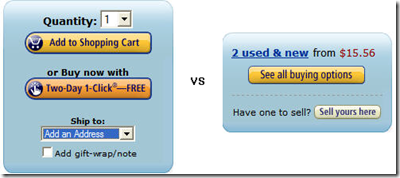
Very quietly they started to remove the Add to Shopping Cart Button with the See all Buying Options button on selected books.
 image

Everything else is unchanged,  you sill see the cover, book information and both editorial and reader reviews.  Just no quick shipment or shipping discounts available;  you will have to find the book in the Amazon Marketplace. 

The selected books just happened to be books from a prominent POD publisher -- Publish America with over 30,000 titles listed on Amazon.  A day later Whiskey Creek Press was similarly turned off.  I suspect Lulu will be next.  

Evidently, Amazon has a new policy for writers -- if you want to publish your print on demand title and sell it directly on Amazon you must go through BookSurge. 

Predictably authors and POD publishers are outraged and the blogosphere is humming with indignation and vague threats against Amazon.  But outrage only lasts a little while and soon publishers will get to work and set up their own sites, find other distribution channels and get on with life.

Obviously, Jeff Bezos and the management team at Amazon believe that slashing and burning the competition is a viable business strategy.  In the short term they might even be right. 

Over the long term it looks less likely.  Slash and Burn techniques hurt both the general publishing/bookselling market and Amazon.  Amazon stands to loose the goodwill and cooperation of publishers, distributors, authors and a portion of the buying public.  And that will hurt over time.

History shows us that when you make enough people mad because you are a monolithic, monopolistic business eventually they fight back. The result is that the company is either weakened or seriously injured. 

The good news is that right now there are individuals and businesses out there who are highly motivated to develop new competitive strategies.  They are looking for new ideas and advantages and their focus is aimed directly at Amazon. 

del.icio.us Tags: ,,,,,

Thursday, March 20, 2008

Publishing World Odds and Ends

Seems like there have been an inordinate number of interesting and creative people how have left us in the last month or so.  In my more depressive moments, I look around at the world we live in and wonder if they don't have the right idea.  And then I snap out of it.

Arthur C. Clarke

Arthur C. Clarke was someone who looked around and saw opportunities.  I think he saw the world and the humans in it as raw material. 

I am not a big Science Fiction fan but I am sure I have seen 2001:  A Space Odyssey at least ten times.  For my generation it was a rite of passage. 

Between the movie and his appearances with Walter Cronkite during the space walks I knew who he was.  As a bookseller he was hard to miss with over 100 titles that he either wrote or co-authored.

My main connection to him, however is more personal.  It is in the form of a placard on my desk.  It has been there for over 20 years and was given to me by a couple of programmers. Once in the middle of a project I asked them to explain to me exactly what they were doing and how the software they had written worked.  After listening to a long convoluted explanation I finally concluded that it was just easiest to say that what they did was magic.   

The next day they presented me with a placard that simply says:

"Any sufficiently advanced technology

is

indistinguishable from magic.”

Arthur C. Clarke was an original who produced his how kind of magic.

Another One Bites the Dust

I wasn't sure how to characterize this piece of information.

audible    

It's official:  Amazon now owns Audible.  Amazon has said they completed their acquisition of Audible.com at the $11.50 a share offering price. Audible is now a wholly-owned subsidiary of Amazon.  Evidently media consolidation is proceeding everywhere; even on the Internet.

Audible just celebrated a solid ten year anniversary.  That is a long time in internet years.  It is hard to remember now, but 10 years ago MP3 was an unproven technology.  Players were primitive and CD's ruled the audio market. iPods did not exist. Most people saw this as a good idea, but no one was sure if it would really catch on.

So here were are ten year later.  MP3 music and books are ubiquitous.  It makes me very happy to see that the early believers in an unproven technology are getting compensation for their faith.

On A Lighter Note

This is too good to have made up. . .

Publishers assign each book to a specific category.  I routinely get lists that show me the Title of a Book, the ISBN number, the Author, the Publisher and the category (as assigned by the publisher).  Here is my current favorite:

image

I almost left it there; but then who would find it? 

Friday, December 14, 2007

Fun News for the week

A Different View

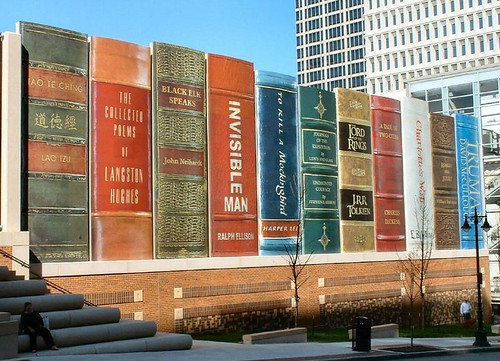
A friend sent me a link to some wonderful book pictures taken by David King and posted on Flickr.  Here are some shots of the Kansas City Library taken in April. 

AND Another One Bites the Dust

I swore I wasn't going to do it!  I was going to sit back and let everyone else bash the Kindle. I wrote my one post and that was going to be it. 

There has been a new development, however, that I pretty much "forces" me to break my silence.  This on is just too good not to pass on!

In less than two weeks the much talked about Kindle DRM has been "hacked" by one, Igor Skochinsky.

Mr. Skochinsky figured out the Kindle algorithm that takes a regular Mobipocket file (.prc) and turns in into a Amazon proprietary one (.azw)  He has kindly and posted his very simple python scripts for anyone to use.

I suspect Jeff Bezos is not very happy today. 


Monday, September 10, 2007

Amazon eReader and Google Book Search

Last week the New York Times had a long article on Amazon and Google. Seems both companies have a big interest in digital reading. Their approach to digital reading has nothing in common, except that, neither one expects to create a significant revenue stream from it in the short run. Their approaches are an interesting window into today’s world of electronic reading.

Amazon is reportedly taking a gamble on a new e-reading device, the Kindle, complete with wireless connection, keyboard and e-Ink screen. Google, on the other hand, is eschewing the reader and focusing on content.

Amazon’s “revolutionary” feature is the ability to download directly from the Web (no intermediate computer needed). I am still shaking my head in disbelief! After all, any smart phone has been able to do this for years. And when you think it can’t get weirder, you find out that this "revolutionary" web-connected device is unable to produce color or handle animated images.

Google continues to focus on aggregating content. Now, however, they want to start charging you for it. Soon Google Book Searcher users will be able to open a book and read a segment of it for a small fee. The owner of the content will receive some type of revenue sharing. In other words every time someone uses a device (computer, smart phone, eReader or PDA) to open a book and read even 1 page, the owner receives a little dough. Since Google reaches about 25% of all internet users in any given day this could add up to a lot of cash for publishers and authors.

Amazon will present their titles in Mobipocket format, while Google offers most of the Book Search titles in Adobe PDF (digital editions) format.

Amazon has been building a device while Google has been busy digitizing books that can be read on just about any device.

The two approaches really do highlight everything that is wrong with commercial digital content and the eBook market. Here are two giant companies with different approaches to digital reading and neither one of them will make a dent in the real problem.

They don’t get it! The consumer (you and I) is drowning in a flood of words and information: email, newspapers, newsletters, RSS feeds, magazines and books are coming out our ears. We don’t need or want every book every book ever written in digital form. A lot of them weren’t any good on paper in the first place!

We want and need a common sense way to access, utilize and organize the information we have!

Ultimately, the winners in the digital reading derby will not be the maker of a device or the aggregator of content. They will be the companies that focus on what the consumer needs – making the right content visible, accessible and usable.

Google
 

Subscribe Now: Feed Icon