Showing posts with label ebook technology. Show all posts

Tuesday, July 21, 2009

Amazon Kindle Agreement

legal money I mentioned the agreement in passing yesterday.  Later in the day I stumble upon this great blog piece that is an annotated version of the Kindle license agreement

Stowe Boyd does a great job of taking the agreement apart and explaining it in plain English.  He concludes:

This is an enormous mess for Bezos and Amazon, and the license agreement is not going to protect them from their misdeeds.

Probably not good news for Amazon because class action law firm KamberEdelson is looking at suing Amazon for removing books from the Kindle. 

Jay Edelson "says he intends to argue that the recall infringes on consumers' property rights. He will also argue that Amazon's ability to delete books makes the Kindle less valuable to consumers, who believed they were purchasing a device that would allow them to store books forever. Edelson says he intends to seek to represent all Kindle owners in the case against Amazon."

This is so much fun to watch!  Stay tuned. . .

del.icio.us Tags: ,,,

Thursday, July 9, 2009

Sullivan's Island and Return to Sullivan's Island -- eBooks by Dorothea Benton Frank

Dorthea Benton Frank is a southern writer.  Her works have been compared to Pat Conroy and Anne Rivers Siddons.  Nine years ago, those comparisons lead me to pick up her first book Sullivan's Island.  I loved it. 

The publisher synopsis really doesn't capture the magic of her writing or the powerful back story about her family, South Carolina and desegregation. 

Set in the steamy, stormy landscape of South Carolina, Sullivan's Island tells the unforgettable story of one woman's courageous journey toward truth.


Born and raised on idyllic Sullivan's Island, Susan Hayes navigated through her turbulent childhood with humor, spunk, and characteristic Southern sass. But years later, she is a conflicted woman with an unfaithful husband, a sometimes resentful teenage daughter, and a heart that aches with painful, poignant memories. And as Susan faces her uncertain future, she realizes that she must go back to her past. To the beachfront house where her sister welcomes her with open arms. To the only place she can truly call home.

When I read last year that Frank was writing an sequel Return to Sullivan's Island, I immediately added it to my summer reading list. Then I started think about the original book, Sullivan's Island.  I realized that my memory was pretty hazy; so hazy that it would make sense to re-read the book.

Actually, it turned out to be a good/bad decision. 

The good part is that Sullivan's Island is well written, engrossing and I would have missed some of the subtleties of the Return if I had not reread it. It was as much fun to reread as it had been to read. 

The bad part is that in the Return to Sullivan's Island the plot and the writing were definitely not up to the same standard.  I actually found myself wishing that she had not returned.  Or at least not in this particular fashion.  I found the return was incredibly disappointing and stretching my credulity beyond it's normal limits. 

I'm not sure it would have been so disappointing if I had read the books separately or if I had never read Frank before.  Return to Sullivan's Island is an "OK" beach read; it is mindless reading that will keep you entertained for several hours.  Great literature it is not.  Sullivan's Island on the other hand is recommended reading for the beach or anywhere else you happen to be!


Dorothea Benton Frank returns to the enchanted landscape of South Carolina's Lowcountry made famous in her beloved New York Times bestseller Sullivans Island to tell the story of the next generation of Hamiltons and Hayes.

Newly graduated from college and an aspiring writer, Beth Hayes craves independence and has a world to conquer. But her notions of travel, graduate study, and writing the great American novel will have to be postponed. With her mother, Susan, leaving to fulfill her own dreams in Paris and her Aunt Maggie, Uncle Grant, and stepfather, Simon, moving to California, Beth is elected by her elders to house-sit the Island Gamble.

Surrounded by the shimmering blue waters of the Atlantic, the white clapboards, silver tin roof, and confessional porch have seen and heard the stories of generations of Hamiltons. But will the ghosts of the Island Gamble be watching over Beth? Buoyed by sentimental memories of growing up on this tiny sandbar that seems to be untouched by time, Beth vows to give herself over to the Lowcountry force and discover the wisdom it holds. She will rest, rejuvenate, and then reenter the outside world. Just as she vows she will never give into the delusional world of white picket fences, minivans, and eternal love, she meets Max Mitchell. And all her convictions and plans begin to unravel with lightning speed. There is so much about life and her family's past that she does not know. Her ignorance nearly costs her both her inheritance and her family's respect. But Beth finds unexpected friends to help her through the disaster she faces: her wise and charming Aunt Sophie; Cecily Singleton, the granddaughter of Livvie Singleton; and Woody Morrison, the solid young investment banker.

This wonderful ensemble of characters could be your own family, but watch what unfolds as they succumb to the island's spell. If everything happens for a reason, then Beth's return to Sullivans Island teaches her that betrayal and tragedy are most easily handled when you surround yourself with loyal family and friends in a magical place that loves you so much that it wants to claim you as its own.

Monday, April 27, 2009

eBook And Publishing News . . .And Spring Fever

Most days I sit down to write this blog and the biggest problem I have is narrowing it down to just one or two topics.  This week, for some unknown reason, I haven't been able to find anything interesting enough to write about.

I seem to be in some sort of spring fever state which makes it impossible to focus on any of the list of possible topics:

Not one of them really caught fire with me this week; but PLEASE check them out for yourself.  There is some really interesting stuff going on I'm just too fevered to fix on anything!

Monday, March 23, 2009

The SAG (Sony, Amazon, Google) Wars

Last week Sony and Google announced their eBook agreement.  Under the agreement,  Google Book Search is making 500,000 public domain books available to Sony eReader owners.  All of these titles are in the public domain, meaning that the copyright on the book has expired.

sony google

I am a little puzzled as to what the big deal is.  After all, a 100,000 or so of these titles are already available through Project Gutenberg in text or html format that can be ready by pretty much anyone.

Perhaps the big deal is simply that Sony can now say that they have more eBook titles than Amazon.  After all, the Amazon Kindle now only has 250,000 titles available.  Lots of books are a good idea, but just exactly what are they?  For fun, I checked out some of the new titles:

  • Explorations of the Highlands of the Brazil By Richard Francis Burton
  • The English Dairy Farmer, 1500-1900 By George Edwin Fussell
  • Quinquennial catalogue of the Dental School of Harvard University, 1869-1900 By Dental School, Harvard University
  • Vivisection By United States, District of Columbia, Senate, Congress
  • Alphabetical List of Battles, 1754-1900 By Newton Allen Strait

I don't know about you, but these will not be on my reading list anytime soon.  Admittedly there is some great, classic and readable literature in the public domain.  Some of my favorite titles as a little girl like Pollyanna or Little Women and still current favorite authors like Jane Austin, Jules Verne, Charles Dickens and Mark Twain. But good literature is only a small percentage of the 500,000 titles. Much of this work is heavy duty academic tomes and historical artifacts that are of limited interest to the general reading public.  Quantity is one thing, quality and desirability are another!

I keep wondering why Sony thinks this partnership with Google is a good idea for them?   Yes. they become bigger than Amazon but at what price? They are giving Google a huge boost and while it may  derail the Kindle in the short run, but they are probably hastening the demise of their reader in the long run.

Google is obviously setting the stage for online books.  Books that make proprietary readers unnecessary.  Their goal is to render all eBook readers as interesting artifacts. 

Maybe the answer is that Sony and Google are hoping to create an iTunes-like store with content for eBook readers.  The problem of course is that ultimately the iPhone or something like it will make the eBook reader an interesting artifact without any help from Google at all.

It is fascinating to watch the anti-evolutionary forces in the eBook market join forces to release books from Darwin's period and call it progress.

Monday, February 23, 2009

Adobe FINALLY Makes a Move

For months there has been this nagging little question at the back of my brain.  It is -- "What the hell is Adobe thinking!?"

One day, with no warning and for no apparent reason to the average reader, they switched the eBook reading format from Adobe Reader to Adobe Digital Editions. 

Now, Adobe Reader is a fine little piece of software.  Sure it has some problems with reflowing text.  It means that to read some text you have to to scroll around (from right to left) to read a full page.  A nuisance for sure, but not a deal killer. 

Adobe Reader functions on Windows, Mac and many Unix computers as well as on most hand held devices.  It allows you to change how pages display.  It even lets you rotate the page view from portrait to landscape.  The search function is peppy and and if you want it, you can have an automated voice read to you.  Pretty nifty.

But one day it was: Goodbye Reader; Hello Digital Editions (DE). 

digital editions

Initially DE only worked on Windows based computers. Now it works on a Mac, but still not Linux or Handhelds.  The big breakthrough was when they struck a deal with Sony so that the Sony eReader could actually accommodate DE.

And instead of a more or less intuitive menu structure DE pretty much did away with menus.  The DE interface gives new meaning to the idea of minimalist. The icons are hard to see and hard to decipher,  I suspect this is in an effort to hide the fact that they really aren't very useful.  Page display options are severely limited; search is deadly slow and there are no tools like zoom or automatic scroll.

It is apparently based on Flash and has the annoying characteristic of checking back to the Adobe site everytime you open it.

But here is my favorite part.  DE claims to have "Powerful markup features."  My question is where?  I have looked high and low, but so far have been unable to highlight, annotate or otherwise markup anything.  So I am not even sure what this claim means.

Almost every publisher creates an Adobe version of their title.  Very often the only available digital format is Adobe.  So why have publishers allowed Adobe to summarily change out the format and disenfranchise a big part of the market.  I know that we used to sell lots of Adobe versions to people with handhelds. 

The net result is a curious disconnect between book technology and book readers. Publishers love Adobe and none of the eReaders (with the exception of Sony) embrace it.  Very odd.

Evidently, that is about to changes.  Last week Adobe announced that they have a new SDK (software development kit) that will make it easy (?) to create Digital Editions formatted books for use on the Cybook, Illiad and Plastic Logic eReaders. 

I am always a little suspicious of technology that is referred to by initials:  SDK, OS and DRM come to mind. 

Adobe has a lot to prove!  Not to publishers, who evidently don't really care since eBooks are such a small part of their market.  But to eBook retailers like me who have seen our sales impacted at a time when no one can afford to take an economic hit.  And most importantly to readers who are increasingly frustrated by an industry that can not get it's act together.


Monday, January 26, 2009

eBook and eReader update

Last September. Waterstone's, the British bookseller, began selling the Sony eReader. Last week they released sales information.

The chain claims to have sold almost 30,000 readers and their downloads have passed the 75,000 mark. Which works out to about 2 1/2 books per reader. Very interesting. . .

Particularly interesting since Amazon refuses to give out any sales numbers on the Kindle other than Jeff Bezos' statement that "sales are great." And an estimate that 12% of book sales are for the Kindle editions.

The one sure thing is that eBook sales are on the upswing, whatever anyone says about individual eReader sales. The IDPF (International Digital Publishing Foundation) reports that between January and November, 2008 sales were up 63.8%. The disclaimer on this is that the IDPF number reflects only the sales for 13 of the many trade book publishers.

Alternatively, Ingram's Education Solutions unit reported that eBook sales from January to May, 2008 surpassed the 2007 figures by 400 percent!

Both of these stats sound really great until you realize that eBooks sales are about .5% of all book sales. And when you consider the number of smart phones (including the iPhone) in use .5% is shockingly low.

My original supposition was that much of the reading on these devices are downloads from project Gutenberg on other free eBook sites. But if Juniper Research is correct, my supposition is dead wrong.

The Juniper analyst predicts that the worldwide mobile adult market will hit $4.9 Billion within the next five years. Hmmm. I suppose that is good news for Larry Flynt, but not so good for Amazon and the major publishers.

No matter what you choice of reading material is I want to remind you that Read an eBook Week starts March 8th. We will have more info about how you can help promote this week and make it a success.

Short post today -- have to spend the week getting all my tax info to the accountant. I do hate this time of the year!

Wednesday, January 7, 2009

eBooks and Screen Technologies

So a lot of power is wasted in displaying the images on our current cell phone screen. That makes building batteries that are compact enough and light enough but still powerful enough difficult. Now the technical whizzes who brought those tiny phones down to a size where you can lose them in a purse are fixing that problem. The eInk display and other power sipping device types are appearing in full color glory in prototypes today.

The article in the NY Times technology section today is only one source of this news. We are reading more and more about the power saving capabilities of various new technologies. This may actually be the year when some of these ideas turn into real phones. Reflecting light from outside sources selectively is the basis of some of these technical marvels. That makes the display brighter in sunlight than it is in a shady spot nearby.

The display design by Qualcomm based on MEMS technology is particularly interesting because it uses tiny mirrors that selectively reflect red, green or blue light. The amount of power used by this screen can be as low as one mw (milliwatt) versus over 200 mw in your current scriStock_000002038586XSmalleen. This type of screen is not backlit and thus will need a frontal light source if you are addicted to using it in the dark.

A higher energy use backlit screen but one that is still substantially lower than current technology uses LED lighting and tiny shutters to display images. This version of the future uses around 50 mw to supply a bright color display but is not as useable in daylight as the lower power choices. All of this technology is aimed at solving the recharge problem that plagues any serious cell phone user.

I’m still anxiously awaiting the new technology that allows me to read on a five by seven inch display for up to fifty hours without recharging my phone once. Of course it will still have to fit in my pocket so it should fold up or roll up when I am not using it. Ideally we ought to be able to build these displays so that they can generate power for recharging the whole device from ambient light like a calculator so we never have to plug the damn thing in at all.

Posing nearly impossible problems for engineers to solve is more fun than adapting to their latest and greatest idea in the form that it finally reaches the market. eInk is still slow and not available in full color. MEMS technology is still in the future. Flexible displays are still largely fantasy but reaching the realm of the possible quickly. I expect my ideal display will appear by the end of this decade if not sooner.

Electromechanical marvels like 300,000 tiny shutters on a small display do amaze me a bit. But then I think about all of those huge old monitors that are on the scrap heap today. We are living in a totally flat panel world now, and that happened in less than ten years. The pace is constantly accelerating and new technologies are competing for our interest daily. EBook dedicated readers will not survive long in this world.

That they appeared at all is a statement about how inefficient markets can be when they move this fast. Of course the truth is the gadget happy among us are driving this rate of change faster and faster. At what point can this all slow down enough to make it possible for me to learn how to use all of the features in my new phone before it is obsolete? Maybe that is just not important after all but it would be nice wouldn’t it?

Monday, December 29, 2008

eReaders -- Have you considered a "Netbook?"

image


Last week Stacey Higginbotham wrote an interesting blog piece on notebook computing and what that might mean for the electronics industry.

She notes that notebook PC sales have overtaken the sales of desktop type machines.  This is the direct result of WiFi and the almost ubiquitous access to the Internet.

This is of interest to me, because Henri needs a new eBook reader.  It's time. . .

I figured that it would be a great Christmas present, so I started looking very closely at all the eReaders -- Kindle (never), Sony, Cybooks, Irex, BeBook and a few others. 

From my perspective the best available option is the Irex.  It has a touch screen, is able to connect by WiFi to the Internet and allows you to make notes and annotations.  It reads protected Mobipocket files and unprotected PDF.  All in all, contrary to my first opinion, it has turned out to be a great machine.  Or at least it is until you check out the price -- $700!!!

Well, let me think!  Here is a pretty much single use device that costs more than a fully powered, big screen laptop.  Too rich for my blood!

But the laptop thought triggered an idea.

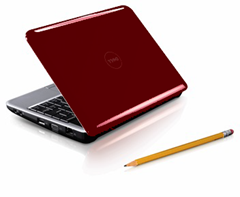
I have been hearing about netbooks so decided to check them out.  Acer makes one called the Aspire One.  It sells at Costco for $349.00.  This is a fully functional Windows XP notebook with 1 GB of RAM, a160GB hard drive that is net ready and weighs about 2 pounds.  And it has a great screen with brilliant colors.

Heck, with that capacity, it is a lot more robust than a couple of the laptops we have laying around. 

Because it has the XP operating system it can read protected Mobipocket, PDF and Microsoft reader eBooks.  Because it is net ready you really don't need to buy an software.  All you need to do is access email and Google Docs are you are ready to go.

Of course, if you want to work offline, you can always load Star Office (for free) and have a fully functioning road machine. 

Sony and Cybook readers are in the same price range and do a whole let less. 

Rumor has it that Dell and a couple of other companies are getting ready to introduce lighter, faster, cheaper models next year.

I would love to finish this piece by telling you that I bought Henri a net book and we are both very happy. But that is not what really happened.  What really happened is that I put off the decision and the purchase for a couple of months.

And Henri, lucky man, got a new shirt. . . .


Tuesday, November 11, 2008

Google and the Very Long Tail

Henri is never short on opinions!  Now, the Google settlement has given him a lot to think about.  Here's his take:  if you agree or disagree be sure to let him know.  He loves a good discussion!

Of all of the services that Google has done for mankind in the name of profit and good business practices this one may be the most important yet. I am talking about the recent settlement of its lawsuit related to putting a lot of copyrighted material online without first seeking rights from each individual owner. Google and everyone with any interest in the past won and the forces of darkness lost big.

Oh yes it cost Google an eighth of a billion dollars and some big lawyer’s fees. The project itself is also expensive and will take a long time. On the other hand the library at Alexandria is never going to burn again. The massive literary and knowledge base built in our past on paper will be safer from war and fire and the ravages of time than ever before in history. Even more important it will be accessible to innumerable scholars in the future.

The unprecedented access offered by this settlement is worth anything Google and all of the rest of us could pay for it. I have a serious love affair with the written word and a vast (And possibly useless) eclectic knowledge base derived from struggling with great libraries and depositories. They yield up their secrets reluctantly. I am definitely a biased observer.

That said, how else could anyone have penetrated the maze of laws and rights that buried so much merit in dusty treasure troves with no hope of release until Google came along? The laws governing use of once published and still copyrighted material made little sense in the digital age. Unless they allow for a much broader access path they are merely inhibitory, not protective in any meaningful sense of the word.

So Google ignored them and invited lawsuits as the most efficient way to sort out that mares nest of laws, regulations and garbage. It is a messy mélange of rules that we have assembled around protecting Disney and other huge companies against unreasonable use of their long lived intellectual property assets.

Google did not want those assets; they wanted the poor huddled masses of books and papers languishing in vast dusty depositories. And now they have them and are moving to free them for the fun and profit of all of us including of course Google. It is a story worthy of greater pens than mine and it will continue to be written for a very long time.

Money was not the only point of this action but it will flow back into Google’s coffers in plentitude over time. Those of us who could only dream of this day until now are living a dream of vast access brought on by smart young businessmen and women. clapping

If I could tell any young entrepreneur how to succeed here would be  the three things I would recommend. Have fun, do something good for people and the world they live in and make money doing it. Google is a good example of that ideal and this project shows what can be accomplished with the right people and the right level of access to capital. Bravo Fortissimo, Encore!!!!!!

Monday, October 27, 2008

eBooks, Amazon and Oprah

It's been quite a week for Amazon. On Thursday they announced a revised projection for 4th quarter sales: somewhere between $6 and $7 billion. I don't care who you are; that is a LOT of money!

oprah kindleBefore you start feeling sorry for them; consider that on Friday Oprah endorsed the Kindle. Called it a "life changing" product, no less! She says it changed her life and even says "It's absolutely my new favorite favorite thing in the world."

Oprah is, of course, a marketing machine and this endorsement is sure to help Amazon's bottom line. And you can be sure that publishers are hoping it helps them as well.

The thing that really strikes me is that when it comes to eBooks, Amazon has fixed it so that they realize revenue off of almost every eBook sold for portable devices. Take a look at the chart listing the various popular reading devices and the reading software that they use to read DRM protected eBooks.

Adobe eReader MobiMS ReaderPropr- ietary Palm
BeBook

X

Cybook

X

iPhone

X

Illiad

X

Kindle

X

Nokia Phones

X

Palm

X

X

PocketPC

X

X

SonyPRC

X

X

Almost all of them use Mobipocket as the reader of choice. And just guess who owns Mobipocket. Amazon, or course. So, as long as publishers insist on using DRM on their titles, Amazon wins big!

It might be inaccurate to say that Jeff Bezos has bet the farm on digital reading, but however you look at it, he has certainly hedged his bets!

This is very good for Jeff and Amazon, I am not so sure that it that good for authors, publishers or even readers. Amazon is in the extraordinary position of control both access to the market (authors and publishers) and product placement in the market (readers). It always makes me nervous when any company has that much control (or even influence) in a particular market.

Monday, October 20, 2008

The Shrinking Library and eBooks

home library 1We have a lot of books! Since we are contemplating a move after many years in our home the issue of what to do with our books has arisen once again. I am seriously and surprisingly moved by my attachment to these things that seldom leave the shelves after we read their final pages.

Admittedly once in a while I have to use some of the more factual books to look up something I vaguely remember that I once knew. Rarely do I disturb these denizens of our library room otherwise. I can trace my progression of interests by simply looking at the titles on a few shelves. The book collection is as eclectic as our lives have been; a montage of experiences with a range and breadth that we both cherish.

The current debate is whether or not to sell this house and simply move on in our lives. It makes little economic sense to hold onto either the books or the house.  On the other hand a lot of memories live in both.

If we sell the house the books will go. We have both agreed that getting rid of the books is the best solution to the problem of owning a ton or two of printed matter that really don’t matter anymore. Our lives have moved on to digital books and that library is a little lighter and easier to carry.

Books have been such a huge piece of both our lives that just contemplating dismantling our library slows us down. It is a room with all of the walls lined with Red Oak shelves around every wall from floor to ceiling. Of course there are books in every room in our house but this room was given over to its main function years ago.

The idea that it is possible to carry a whole collection of books, (a 2007 tower collection bigger than the one in this room,) around on a key chain hasn’t really sunk in to Henri's consciousness.  The idea that I can access more information than exists in the Library of Congress by just hooking up to the Internet still boggles the mind.

We are not hoarders -- have never found acquiring things to be particularly satisfying. Tools for Henri, shoes for Gigi and books are the only weak points in our armor against consumerism.

The tools and the shoes are already leaving for our daughters homes. Their husbands will find use for them, or not. The girls will wear the shoes.   But the books, our precious books, are hard to part with and even harder to leave behind.

I guess what it comes down to is the the emotionally wrenching choice that getting older brings to everyone. How do you give up your past one piece at a time?

We need a microchip for our memories. I am told that too will come eventually. See that book over there written by Ray Kurzweil. It talks about that very thing. Meanwhile we are agonizing over the options for the only room we both have ever truly loved and may just simply dismantle soon.

It is not nearly as pleasant as I would like it to be, but then change is sometimes the only option even if it is not at all comforting.

Monday, October 6, 2008

The Sony PRS 700 and the eBook Reader Market

sony_prs-700_readerLast week Sony proudly announced the 3rd generation PRS series eBook Reader.  It has some nice features; particularly the reading light and the fact that it has a touch screen.

And yet I can't help thinking that something is broken in the marketplace! This new Sony readers and the rumored Kindle device prove to me that the Reader design world is stuck in neutral.

There is little happening in the narrowly focused electronic reading world that makes sense to me. It is now nearly twenty years after we tried putting books on a CD ROM disc to stimulate reading opportunities. Over time the Internet and cheap hard drive space have removed the CD disc from the equation.

Today, the digital publishing is still very much alive and growing rapidly (if not broadly). The best reader that money can buy is still very expensive ($800) and excruciatingly dumb.

The consumer is quite happy with a multifunction device that has about three inches of screen space.  After all you can read books, handle email, surf the net and listen to music all with one device.  And that doesn't even take into consideration the convenience of being able to make and receive phone calls!

Reading devices are still being designed by people who know some technology.  What they don't seem to know much about is the consumer generally or publishing specifically.  And therein lies the rub.

So where is publishing headed? Debates about that vary from the sublime to the ridiculous as do most debates. The one thing everyone seems to agree on is that the Internet or its children will provide the delivery vehicle.

Cell phones with substantial screens or projection capabilities are going to hit the market soon. With their programmability based on open operating systems they almost certainly will become the device of choice for both computing and reading. They will also probably take over the world of TV show presentation to major audiences everywhere.

So what is possibly wrong in that world? The idiots that keep designing readers persist in building devices that will not compete. They are holding back the market that they need to develop before it is too late for them. Goodbye Sony reader: Goodbye Kindle: Hello open systems and the new old revolution.

All that cell phones really still need to own this market should appear in the next generation phones. I am hoping that happens because the brain dead place holders made by Amazon, Sony and Phillips make no sense. Or maybe they make as much sense in this market as one hundred thousand dollar CD recorders would make in today’s data transfer marketplace. Yes folks,  twenty years ago a CD Recorder cost a hundred g’s.

Cell phones are following that cost and value curve and dedicated reading devices are not.  Wether they recognize it or not -- this game is already over.  The spindle, ah the bindle, no the, don’t help me, I’ll get it. . . oh yeah, THE KINDLE,  that’s it, is dead. It was slaughtered by a real market before it mattered to anyone anywhere except a few engineers and those of us early adopters who bought their bad designs.

Monday, September 29, 2008

What Is A Book Worth?

 books on trees There is no intrinsic measure of what a book is worth that really defines what people should pay for an author’s loving work. There has been a lot of buzz on the Internet and in newspapers, magazines and even on radio and TV talk shows about what should be charged for a book. We talk a lot more about such things today than we have in the recent past. Maybe that is just another measure of our current fear of financial ruin.

I still read some newspapers and magazines in their paper form. I also still buy some paper books although I am slowly and reluctantly converting my reading habits to staring at a screen rather than turning a page. I’m studying Spanish using my computer and the package provided by Rosetta Stone instead of books I bought long ago.

The truth about my reading habits is that I have long ago run out of adventure authors and science fiction that meets my standards. A book comes along once in a while that piques my interest but not nearly often enough to fill my insatiable need to read.

Reading fills my time and even occasionally my mind with pleasure, even when the writing is moderately bad I usually find something to enjoy in a book. I have just had to broaden my horizons a bit. Now I read anything that has a story line or a plot that grabs me.

It is as clear to me as to most of you that the whole architecture of the publishing world in undergoing a vast change. From POD to digital books there are so many changes that anyone could have a hard time keeping up with the scorecard of who’s on first and who’s out these days. Amidst it all there is still one obvious fact, people will write even if there is no money in it.

There are over a million bloggers out there and the number is growing rapidly. How many of you were born after the word blog entered the common language? That is the first really huge new form of literary expression in a long time and it is almost always free to the reader. I think that makes my point.

The literary forms and their values are changing rapidly. I am loving this changing world of writing all more than I ever thought I would when I first saw the written word on a digital screen. I won’t even tell you how long ago that was but it was a long time before the word blog entered the language. And is literacy suffering? Not a bit if you pay attention to the fact that every child with a cell phone is writing to their friends every day even if we can’t understand their new language at all!

So what is a book worth? Less than it used to be, if all it does is sit there and wait for you to turn its pages. That is becoming obvious. But maybe a whole lot more if it offers a new vision of what is possible in the new digital world of literary forms and shapes we are building today. I hope you are enjoying these changes as much as I am. It’s a truly brave and interesting new world for those of us who are already living here. Why don’t you join us and try it out?

Tuesday, September 9, 2008

The New York Times Reports A New E-Newspaper Reader Echoes Look of the Paper

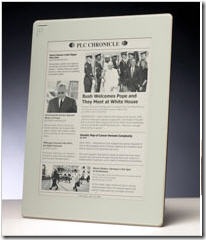
Yesterday eink newspaperPlastic Logic Corporation unveiled it's latest (and as yet unnamed) device:  a big light-weight plastic screen version of an eNewspaper.  Its light, portable and constantly updated.  The device should be on the market early next year.

The screen is close to 81/2 x 11 inches and is continually updated by a wireless link (where wireless is available).  Hundreds of pages can be stored to read at leisure for those who do not want to keep up to the minute.

The device is easy to read since it uses eInk technology.  The is the same technology that is used for Bookeen's Cybook, the Sony PRC reader, Irex Illad and other eBook readers. 

It will be fascinating to see which news organizations will be the first to implement.  Hearst already distributes versions of it's paper on the Kindle.  I have been wondering about that -- as a daily reader of the New York Times and Washington Post online, it would take a lot to convince me to buy an expensive device to view what I can now see for free.  But evidently Kindle and Hearst believe there is a market out there and are pushing ahead.

The more I think about it the more I am able to relegate it to an Interesting idea and fun technology.  But the real question for me is much more urgent:  Do any of us need one more device? 

I am the proud owner of a Cybook, an Irex Illiad, an eBookwise reader, a Palm, a Nokia based cell phone, a Blackberry, an ultra-mobile pc and 2 laptops.  Do I really need one more thing to carry around?  It has gotten to the point that when I travel I practically need a separate suitcase just to carry my cords, cradles and cables. 

None of the above mentioned devices is close to ideal for eBook reading let alone eNewspaper.  The eInk devices are nice but don't accommodate color and are not backlit.  The Blackberry, cellphone and Palm work fine, but the screen is way small.  The UMPC is heavy and overkill as are the laptops. 

I find that the device I read from most often in my Palm.  It is backlit, has beautiful color with a great touch screen, connects to the Internet from almost anywhere and has multiple useful programs and functions besides. I can even hook up to skype and use it as a phone.  My only complaint is the size of the screen -- very small. 

Makes me think that it is easy to get gadget blind and lose track of the real objective -- information!


Monday, September 1, 2008

As I Live and Breathe the Cell Phone is Taking over the Center

Henri has been doing some thinking about kids, cell phones, open systems and the PC.  Here are his reflections. . .

cellphone Nothing has given me greater pleasure in life than the birth of my children. My youngest daughter turned thirty two this month. The next events in line have all had to do with the birth of revolutionary ideas in the world that I have lived in for sixty five years so far.

Let’s see, there was the birth of computing as a business support system. Then there was the ongoing revolution in electronics. The development of the human genome from the first days of the shape and form of DNA to the publication of the first actual readout of the genome itself was as fundamental a breakthrough in human knowledge.

Along the way there have been many gratifying moments and more than a few terrifying discoveries. The Ozone hole, global Warming and other threats to the ecosystems that sustain us all are among the scariest. Of course even the greatest gains in knowledge can be perverted by misuse or abuse. The idea that scientists are responsible for their creations is still gaining traction. Codes of ethics and other means of controlling misuse of great ideas are still in their infancy.

Meanwhile the Personal Computing revolution has given birth to the Internet and the Cell phone revolution has been playing around with the power that network offers. Now we are about to watch the birth of a new stage in that set of gains in human communication.

The PC King is dying and a new Queen is about to take over. Open systems are coming to cell phones. Taken together with the still growing power of handheld devices this will end the reign of King PC. Cell phones are the new center of Personal Computing. The iPhone is the earliest prophet of this revolution but the next wave will blow away all doubt.

You can start with the Android Operating System contributed by Google and end with the ever evolving nature of handheld devices themselves. It has been years since anything like the vitality that exists in the competition for market share in Cell Phones existed anywhere else in the electronic world.

There are reasons to believe that this next revolution in Personal Computing will bring on revolutions in education, publishing, government and too many other human institutions to mention here.

cellphone girlI am hoping to watch and continue to work to help those revolutionary times achieve the best possible results for the most people possible. There are millions of people who like me see these changes as positive. I hope you are among them.

Monday, August 4, 2008

eBooks have Arrived, and How!

Here is an excellent guest post from Heather Johnson -- all about eBooks.  She is probably "preaching to the choir" here, but the points she makes about eBooks are worth revisiting and remembering.  This is a great article to pass along to your friends and relatives to explain the importance of eBooks.

ereaders

The world we live in is increasingly becoming digital, and books are no exception. Paper and print have transitioned into bits and bytes that are floating around in cyberspace ready to be downloaded to your computer or mobile device at the click of a button. You no longer have to set foot in a bookstore if you choose – your reading habits are taken care of by your friendly cyber-neighborhood e-store. True connoisseurs of the art of reading are yet to become eBook aficionados, but what they do not realize is that there are various advantages to the electronic version of books that their papery counterparts do not offer:

· Most of them are free: The Gutenberg Project, the brainchild of the inventor of eBooks Michael Hart, is an initiative to convert as many books to eBooks that are available to all as free downloads.

· They last forever: Paperback novels and books tend to tear and lose pages with time and improper handling. Digital books are not prone to such damages.

· They take up no shelf space: Your eBooks need virtually zero physical space and don’t demand shelves and libraries. They only occupy space on your hard disk which is a part of your computer anyway.

· They reside on your computer: Anywhere you take your laptop, your whole library comes along. You don’t have to tote heavy books in your luggage just so that you have something to read on long flights and journeys.

· They can be read with PDAs: Various eBooks are available as downloads on your personal digital assistants and smartphones. The Gutenberg Project offers free software called Plucker to help read your eBooks on your mobile handheld device.

· They are also available as audio files: Most eBook readers provide options to listen to the books as audio files.

· They protect the environment: eBooks do not consume paper which means that a smaller number of trees have to be cut in order to produce books.

· They are cheaper to publish: Anyone can make eBooks of their work and get it published online with just the minimum number of resources.

· They have a larger reach: With the popularity of the Internet, eBooks reach more people than regular books ever will.

The Internet has made avid readers out of those who have never before shown interest in the habit of reading, and it’s all due to the easy availability and access that eBooks provide.

By-line:

This post was contributed by Heather Johnson, who writes on the subject of teaching certificate. She invites your feedback at heatherjohnson2323 at gmail dot com.

Monday, July 14, 2008

The Future of Digital Reading? The Scroll!

Henri watched the video from last week and then came across this story in the New York Times:

One new mobile device, the Readius, designed mainly for reading books, magazines, newspapers and mail, is the size of a standard cellphone. Flip it open, though, and a screen tucked within the housing opens to a 5-inch diagonal display. The screen looks just like a liquid crystal display, but can bend so flexibly that it can wrap around a finger.


That started him thinking!


Scrolls and scholars and scribes, oh my! The world of books is starting to wend its way back into the future. Pre paper and even pre printing press most of the books in the world were written by hand on sheets of something, typically vellum made from lambskin, that rolled up easily and stored well called a scroll.
The world of computing has a notebook that can use a voice based interface or can be written on directly by a stylus. The next generation will have screens that roll up into the small device which holds their memory and communications technologies. The Scroll is on the way back. One big difference is that the whole library at Alexandria would fit into the chip that will store all of the data residing on the device.

Older people, like me, can hardly comprehend a world in which my personal digital assistant can read to me, take dictation and manage all of myreading and writing needs. Gigi tells me that it can be done.

By the time I catch up, I am sure that the roll-up screen will be more ubiquitous than massive CRT monitors once were. You remember them, they used to reside on our desks and dispense data and eyestrain with their big ugly screens, green letters and not an image in sight! Well maybe you don't remember them; you are probably a lot younger than I. But I remember them all too well.

Several types of new roll-able technologies are vying for a piece of the thin roll-up screen market. This will be a piece of the next e-reader revolution that will eventually resonate throughout the whole computing market.

eInk, OLED, (organic light emitting diodes printed on plastic) and other technical solutions will all be tried. What will eventually emerge looks like it might be an interesting variation on the original book, the scroll.

Whatever it turns out to be, it will not very likely resemble any prior solution to reading needs. It will, no doubt, be infinitely better than the current tiny screens with their even tinier keyboards found on our cell phones.

The wonder of it all! Soon our computing and communication needs will be met by devices that are the size of a large pen. With the advent of that technology one can only hope that the interface that connects directly to the human brain will not be far behind.

Otherwise our public places will be full of people talking not to one another but to their PDA's and other devices. That might be too annoying to be bourn even by a technology addict like my wife.

Monday, June 30, 2008

2008 Global Student eBook Survey, the Popularity of eTexts and a New Look for eBooks

librarian

2008 Global Student eBook Survey

 2008 Global Student Survey on eBooks is a study designed by 150 librarians.  The study explores how students use digital information and eBooks.  The study offers the perspectives of nearly 6,500 college and university students about eBook usage, benefits and needs.

The attitudes and awareness about eBooks is definitely changing.  Most notable for me was the finding that eBooks were in second place (78%) as the most used resource for research/class assignments. In first place was Google and other search engines; print books followed closely at 77%.  Basically Google tops books of any sort.

Students are beginning to see eBook on a parity with print books.  Faculty members, however, do not seem to be as convinces.  Last year the 2007 Global Faculty Survey showed that teachers put eBooks in 6th place on a list of electronic resources they use. 

Maybe this is a case where the students can teach the teachers a thing or two.

eTexts: Why Students like them

And on the subject of eBooks in education.  We should note that In the last year there has been a 400% increase in digital textbook adoption.  Ingram Digital wanted to find out why.  So they did a survey of  680 e-Book Users to find out why.  Key findings:

  • 47% of those surveyed believe that "cost in relation to print copies" is very important.
  • 46% stated the convenience of e-books is a big attraction
  • 45% sited interactive features (45%) as being very important.

Price, convenience and interactivity seem to trump the smell or feel of a book.

A New Look for eBooks

Finally, last week researchers at Maryland and Berkeley Universities announced a new prototype eBook.  One that let's you turn pages just like you can with a print book.

Why anyone thinks this is a good idea absolutely mystifies me!   Evidently there are people who are still clinging to the idea that if you somehow make the digital reading experience more like the paper experience you will get people to eBooks.

Maybe they should refer to the student survey about why eBooks are popular with them:  price, convenience and interactivity.  This design does nothing to enhance any of those stated reasons.

Personally, I would like to see all of that creative energy go into figuring out how to create the $100 eBook reader that reads every format (with or without DRM).  

Or better yet, use that creativity to create real content that people want.  Content with enhanced interactivity at a lower price would be a good start.

Monday, June 2, 2008

Book Expo America 2008 version

Just in case you are wondering -- here is how the biggest book show in the US looks on opening day:

Book Expo is one of those things that is virtually impossible to explain.  Thousands of people; hundreds of publishers and all the free books you can carry.  Pretty much a book lovers ultimate fantasy.

This year, however, the crowd was small compared to the shows in New York and Washington DC.  I'm told that the Los Angeles show is always smaller.  Personally, I didn't find it much of a "problem" since I could actually walk around rather freely. 

We were lucky to see a number of fine authors as they talked about their new books.  The standouts were:  Alec Baldwin, Magic Johnson, Neil Gaiman, Dennis Lehane and Phillipa Greggory.  Look for their new titles in the coming months.

The floor was abuzz with rumors about Scott McClelland's book and the party thrown by Prince; sadly I was not invited.

Amazon had one of the most crowded booths -- everyone wanted to see and feel the Kindle.  Publishers are noticeably nervous about Amazon, eBooks and falling book sales.  Ironically there was a great deal of discussion about the book industry going Green.  Of course they are talking about using recycled paper and do not want to hear about eBooks. 

I had a wonderful time, learned a whole lot and am totally exhausted.  Not only from all the hours on my feet but also from the over stimulation.  It is going to take a few days for all of the info and impressions to settle. 

For more stories about BEA check out Publisher's Weekly and the New York Times

Monday, May 26, 2008

One Laptop Per Child - Version 1.5

olpc Nicholas Negroponte had a good idea: a cheap laptop for the poor children of the world loaded with software and connected to the Internet.

With this in mind, he (along with a few friends) formed a nonprofit group.  They called it OLPC:  One Laptop Per Child.  The organization's mission statement says:

Any nation's most precious natural resource is its children. We believe the emerging world must leverage this resource by tapping into the children's innate capacities to learn, share, and create on their own. Our answer to that challenge is the XO laptop, a children's machine designed for “learning learning.”

Last December OLPC began shipping first version of the XO laptop. 

Version 1 is an amazingly powerful machine for a hundred dollars.   OK, so it actually ended up costing twice as much as projected ($200) and it looks a little like Kermit.  But it is rugged, Internet connected and has great battery life.  All in all a pretty impressive achievement.

Naturally there critics and detractors.  Those who disparage the machine as too simplistic and not powerful enough.  Those who question Nicholas Negraponte's motives. There are Techies who are scandalized that OLPC decided to go ahead and use Microsoft Windows as an alternative operating system.  And to be fair the first version has had it's share of hardware failures and distribution problems.  But all in all, it is a wonderful idea and an impressive achievement.

Of course any technology you can buy is already obsolete.  So last week at the MIT Media Lab, OLPC announced a new version of the laptop.  Dubbed Version 1.5, it is slated for release in 2010 at the low, low price of $75.00. 

Guess what -- the thing is an eBook!

The ideaolpc2 is pretty interesting.  You take two DVD type player screens, add touch capacity and hinge them together.  The book-like configuration can be easily used to simulate book reading.    olpckeyboard  


Or you can turn it sideways, bring up a touchable image of a keyboard to use for typing and position the other side as a traditional laptop screen. 

Pretty cool, from my point of view!  Makes me wish I were a kid again (sort of).  I can't think of a better way to get a child to learn or to read a book for that matter.

Note:  OLPC (like all non profits) can use your help to make this dream a reality.  Find out how you can participate!

Google
 

Subscribe Now: Feed Icon