Showing posts with label ebooks about scifi. Show all posts

Friday, March 20, 2009

Without Warning By John Birmingham eBook edition
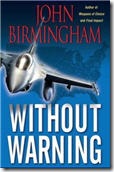
parent-9780345502896 Removing the USA from the world political scene is a daunting task. Birmingham does a credible job of showing what a dangerous place the world would become without our power base.

This book examines a recent past in which the mainland USA was taken out of the world power equation. The plot devices and characters are well enough developed that by the end of this book you are ready for the sequel. Unfortunately, that next book is at least one year away from being published.

I like some of the story lines better than others. By and large though if you are a Science Fiction fan or a fan of the disaster novel this is a good read following an interesting premise.

Without the USA in play the world degrades quickly into disorder, as you might expect. Some outcomes seem likely and strategically correct. Others stretch credulity a bit but are plausible enough to carry your attention.

All in all Birmingham does a good job of drawing lines between the disappearance of the majority of US military power and the increase of chaos worldwide. This is a great spring break distraction or a really nice find if you haven’t read any of Birmingham’s other books. They are all worth reading if military fiction is one of the types of novels you enjoy. His knowledge base is solid and his writing skills are first class, so enjoy.

In Kuwait, American forces are stacked up, locked and loaded for the invasion of Iraq. In Paris, a covert agent, a woman who inhabits a twilight of lies and death, is close to cracking a terrorist cell. And just north of the equator, a forty-foot wood-hulled sailboat, manned by a drug runner, a pirate, and two gun-slinging beauties, is witness to the unspeakable. In one instant, all around the world, for politicians and peasants, from Gaza to Geneva, things will never be the same. A wave of inexplicable energy has slammed into the continental United States.


America, as we know it, is gone. . . . WITHOUT WARNING

Now U.S. soldiers are fighting a war without command or control. A correspondent records horrors for no one. Washington is gone and the line of succession is in tatters; the functioning remnants of government are in Pearl Harbor, Guantanamo Bay, and one desperate, isolated corner of the Northwest. For the jihads, it’s Allah’s miracle. For Saddam, it’s a chance to attack. Iran declares war on an America that doesn’t exist–except in the hearts and souls of the men and women who want it to.

In this astounding work of alternate fiction, John Birmingham hurtles us into a scenario that is unimaginable but shatteringly real: a world of financial ruin where a cloud of noxious waste–from America’s burning cities–darkens Europe, while men and women in offices around the globe struggle to make decisions that cannot hold and opportunists unleash their secret demons.

From a slick Texas lawyer who happens to be in the right place at the right time to a hard-working city engineer in Seattle who becomes his terrified city’s only hope, from the cancer-stricken secret agent to a drug runner off the Mexican coast and a U.S. general in Cuba, Without Warning tells a fast, furious story of survival, violence, and a new, soul-shattering reality. The first in an epic trilogy that will leave readers breathless and astounded, Without Warning offers a world without its policeman, its Great Satan, or its savior–as an unknowable future struggles to be born.

Friday, February 27, 2009

The Sharing Knife Series by Lois Bujold eBook editions

sharing knife

The writing of Lois McMaster Bujold is among the best in characterization. She creates a personal connection for the reader that runs deeper than is common for this genre.

Her Vorkosigan Saga dominated by the character of Miles Vorkosigan has always amused and absorbed me when new bits of the series were released. I recommend it to anyone with an ounce of romance in their soul.

She has switched themes and is moving down a path dedicated to exploring historical fantasy worlds.

While I miss Miles and other characters brought to life in her earlier work, I still await her new books with appropriate anticipation. For anyone who likes SF or Fantasy she is in the top ten at her craft.

The presence of her Vor society will stand alongside many of the greatest series in the history of SF. The same will probably be true of her newer venture into Fantasy writing. I do hope that she will revisit Miles a few more times in moments in the future. While he is now happily married in her most recent piece of work on him and certainly more mature there is still a lot of life left in the little man.

I have watched a lot of authors come and go in fifty years of reading SF and Fantasy. The truth is that great writing is not what Science Fiction is all about. Even the greatest SF writers usually lack some literary hallmarks that live more often in other genre types and literature in general.

Bujold is one of the exceptions and whatever she serves up will be well worth reading, often more than once.

Friday, February 6, 2009

Smoke and Shadows eBook by Tanya Huff

Tanya Huff whose Science Fiction and Fantasy novels have occasionally delighted me in the past has developed a relatively new series.

The Smoke Trilogy begins with, Smoke and Shadows and I hope continues for a long time. So what is an old guy like me doing reading books aimed at a largely far younger audience?

Well, I have this eleven year old granddaughter who is writing a vampire story. I just thought reading a bit of the genre wouldn’t hurt too much.

In fact when I picked up the book I was quickly delighted by the fact that Huff has captured the weirdness and clarity necessary to write interesting fantasy novels. She is capable of populating them with characters that ring true under the wildest circumstances imaginable. I have no limits on what I will read if the author will just make the characters believable. The angst and fury of saving the world with the help of a prince of a vampire falls on a young man, Tony Foster. Ms. Huff populates the world around him with vivid and lively characters.

Tony is working in Television on the set of a vampire series while developing his career interest in TV production. He meets a wizard, works out the nature of the problem threatening our world, engages the help of his vampire friend/lover, a real prince of a fellow and, well, read the book!

Remember this was a research project for me. But in doing it I gave my granddaughter a gift of a new author, something we can never have enough of in life. I also understand her fascination with the whole Goth thing and the vampire genre as well a great deal better now.

I’ve liked Huff as an author since she broke into the SF/Fantasy scene sometime in the 1980’s. I have up to now ignored her vampire books. Now I find myself buying them all not just to give to my granddaughter but to read for my own enjoyment.

If you want to understand a culture read its literature in the native language. The subculture that fascinates this particular grand-daughter right now is Goth. The literature is populated with wizards, and warlocks and vampires and other interesting human and nonhuman types. Certainly that would have interested me at her age. It still does! I find that is true much to my amusement and gratification.

Give it a try, what’s a little bloodletting among friends?

In 1991, a new series soared into the fantasy firmament with the publication of Blood Price, the first novel in Tanya Huff's acclaimed five-volume masterwork, which followed the exploits of Vicki Nelson, private investigator, and vampire Henry Fitzroy.

Together, Vicki and Henry faced and survived perils ranging from demons, werewolves, and mummies to zombies and restless spirits crying out for revenge. In their trials they were aided-willingly or not-by an assortment of allies. Among these allies was a street kid named Tony Foster. Claimed by Vicki as a reliable snitch and by Henry as "one of his own," Tony found himself rescued from his dead-end existence and given a chance for a better life.

Relocating to Vancouver with Henry, and forced to get his act together, Tony embarked on a career in Vancouver's burgeoning TV industry, landing a job as a production assistant at CB Productions. In an example of art echoing life, the syndicated TV series Tony worked for was "Darkest Night," a show about the adventures of a vampire detective.
Except for his unrequited crush on the show's handsome costar, Lee Nicholas, Tony was pretty content, at least until the day everything started to fall apart on the set. It began with shadows-shadows that seemed to be where shadows didn't belong, shadows that almost seem to have an existence of their own....
Tony tried to ignore it, to tell himself it was all in his imagination-until he found Nikki Waugh's body... and felt the shadow's touch....
And when shadow appeared to cast its claim on Lee, and a crash stunt went wrong for no discernible reason, Tony could no longer ignore what was happening. He had to find out what was threatening everyone on the "Darkest Night" set. And, of course, he needed Henry's help.

It wasn't long before the trail left to CB Productions own special effects wizard, Arra Pelindrake-and a frightening explanation which only a young man with Tony's unique background could accept. But knowing what he faced was only half the battle-finding a way to survive the unsurvivable, and defeat the undefeatable-that was the real challenge!

Friday, December 19, 2008

Under Reported eBooks -- eBooks I have Read This Year but Haven't Reviewed

This morning I looked through the past book review postings on the site.  From the reviews posted you would think that about the only things I read are Romances, Biographies and Literary Fiction.  It would be a fair evaluation, although not exactly accurate. 

There are a number of books that I have read, but for various reasons have not reviewed.  For example, I don't know how to review a Mystery without giving away the plot.  Or (for another example) I try to stay away from political controversy so I never review books about politics or current events. 

Then there are the books that are either so bad I can't finish them, or the ones I struggle to finish because. . . well, just because.  I almost never review those either.  I mean what's the point; after all I want you to read the books I write about.

Which brings me to the point. . .listed below are some of the books I have read this year and not reviewed.  I am going to confine it to only the ones I have enjoyed.  Maybe one of these days I will post a list of the ones I couldn't finish. . . .

 Musicophilia by Sacks, Oliver

First of all I am a huge fan of Oliver Sacks and his work so this was a natural.  Added to the fact that I come from a family of musicians and music is a big part of our family culture.  Sacks explores the connection between the brain and music. 

Outliers by Gladwell, Malcolm

This was a fascinating study on intelligent people and how raw intelligence may actually be overrated.  It is also a study of how culture, environment, education and personality interplay with intelligence.  The stories are enthralling.  This was a book I read in fits and starts over several weeks. 

Team of Rivals: The Political Genius of Abraham Lincoln by Goodwin, Doris Kearns

Kerns is another favorite author.  Several years ago I did a reading project: I read at least one book about each of the US Presidents.  I wish that this book had been around then. But it is good reading now!

T is for Trespass by Grafton, Sue

I have read very one of Grafton's novels and am always anxious to get my hands on the latest one.  Now, however, I am starting to get worried since we are up to T;  are there really only six left?  Oh no!  Grafton is a master at building and holding tension and hasn't written a bunk one yet.  If you haven't read her books -- do yourself a favor and start one today!

DownHill Lie by Carl Hiaasen

I'm not a golfer, a golf watcher or even a Tiger Woods fan, but this take on golfing had me laughing out loud. . . 


So, there you have it.  A few of the other books I have enjoyed this year and highly recommend.

Tuesday, October 14, 2008

Misspent Youth eBook edition

This latest offering by Peter Hamilton, left me wondering where Science Fiction might be headed. Of course it actually has been on a wrong course since it was clumped together with fantasy way back when. And Misspent Youth is more fantasy than science.  Basically it pulls more from Greek Tragedy than putting forward and exploration of the future.

The only problem with the hopelessness and angst evident in its pages is that it is used badly. Blending those ingredients with the sexual dysfunction of a rejuvenated jerk turned this book into a geek tragedy.

I find it hard to fathom where Hamilton thinks the future is going from many of his novels. This one makes it clear where he sees things developing in Britain and it is obvious that he is not happy.

His tendency to blend the mystical with the far future science of his dreams is evidently over for now. This book is social commentary in the most Orwellian vein. Amazingly Hamilton has never found this approach before while injecting his ideas into the heart of scientific inquiry. Perhaps he should abandon it before it ages him badly with his audience. There is evidently no return from the process of aging if he is to be believed.

Instead of one central theme the reader is left with a mix of: Here the theme is the destruction of intellectual property, there it is the destruction of freedom by the European central nanny state, next it is the innocence of real youth versus the decadence of false youth. None of these themes ever really take over and this book stumbles from Geek Tragedy to Morality Play to the sadly inevitable failure of science in rebuilding youth in an aged human body.

I think it is interesting in the way most morality plays turn out to be interesting in what it tells us about the author and his times. His characters left me as cold as his denouement for Jeff, his main victim. His plot mumbled when it did not shout. His themes rambled and his grasp of the future failed to inspire anything but despair for his future as a writer of Science Fiction. I do not recommend this book especially for fans of Hamilton who deserve better.

The publisher says:

Readers have learned to expect the unexpected from Peter F. Hamilton. Now the master of space opera focuses on near-future Earth and one most unusual family. The result is a coming-of-age tale like no other. By turns comic, erotic, and tragic, Misspent Youth is a profound and timely exploration of all that divides and unites fathers and sons, men and women, the young and the old.


2040. After decades of concentrated research and experimentation in the field of genetic engineering, scientists of the European Union believe they have at last conquered humankind’s most pernicious foe: old age. For the first time, technology holds out the promise of not merely slowing the aging process but actually reversing it. The ancient dream of the Fountain of Youth seems at hand.


The first subject for treatment is seventy-eight-year-old philanthropist Jeff Baker. After eighteen months in a rejuvenation tank, Jeff emerges looking like a twenty-year-old. And the change is more than skin deep. From his hair cells down to his DNA, Jeff is twenty–with a breadth of life experience.
But while possessing the wisdom of a septuagenarian at age twenty is one thing, raging testosterone is another, as Jeff discovers when he attempts to pick up his life where he left off. Suddenly his oldest friends seem, well, old. Jeff’s trophy wife looks better than she ever did. His teenage son, Tim, is more like a younger brother. And Tim’s nubile girlfriend is a conquest too tempting to resist.


Jeff’s rejuvenated libido wreaks havoc on the lives of his friends and family, straining his relationship with Tim to the breaking point. It’s as if youth is a drug and Jeff is wasted on it. But if so, it’s an addiction he has no interest in kicking.
As Jeff’s personal life spirals out of control, the European Union undergoes a parallel meltdown, attacked by shadowy separatist groups whose violent actions earn both condemnation and applause. Now, in one terrifying instant, the personal and the political will intersect, and neither Jeff nor Tim–or the Union itself–will ever be the same again.

Monday, March 24, 2008

Sir Arthur Clarke - 1918-2008

Henri Reynard is the SciFi reader in our house.  We think he read everything Clarke ever wrote.  As a "fan" and admirer of Clarke he wrote this special obituary for this blog.

Gigi

The world is always losing great human beings. Life and death dictate that fact for all of us. Even the greatest of lives comes to an end. Arthur Clarke’s life has ended. He left behind a legacy that few human beings achieve. As a scientist, writer and philosopher he impacted billions of lives. His invention of the satellite communications systems in such broad use today was only one small element of his wide ranging interest in the future of humanity.

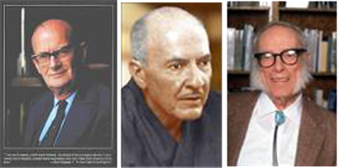
image Clarke, Asimov, Heinlein, these men were the trinity of Science Fiction when I was young. The genre was sometimes then, and occasionally today remains, steeped in the logic and fundamental understanding of what science has meant to humanity. From extended life spans full of warmth, light and knowledge; to systems that offer us the hope of solving problems as far reaching as global warming or asteroid impact, these men were seminal in their vision of hope for the future.

I grew up in that atmosphere of hope along with a lot of young men and women, we are all old now. In a tiny blink of that ancient dragon time’s eye all of those years have fled. What they have left with me thanks to the men and women like Clarke who taught me so much about life and dreaming and working for a better future is still that hope and concern for humanity that their work expressed.

I will miss this great human being whom I never knew personally more than a lot of the people who inhabited places far closer to my life. I suspect that is a measure of how many of the people who were touched by his writings feel today. The delight of discovery that his work and times imbued in me remains and will be with me as long as my synapses are still snapping away.

I read with great interest his final interview.  The most iconic moment in the interview was when the interviewer, Sawato R. Das, asked whether Clarke had ever "suspected that these satellites would one day prove to be so valuable to telecommunications."

He laughed and said:

“I'm often asked why I didn't try to patent the idea of communications satellites. My answer is always, ‘A patent is really a license to be sued.' ”

Thank you Arthur and God speed your being into whatever the best of all your futures might bring. Perhaps there won't be any lawyers there.

Google
 

Subscribe Now: Feed Icon