Showing posts with label book marketing. Show all posts

Monday, April 13, 2009

Amazon Ranking and Censorship

Itopt is hard to overestimate the importance of rank to an Amazon author or bookseller. It is an objective measure of a book's popularity and salability.  Everyone wants to be #1 (or a least in the top 1000).

Readers use rank as an unofficial  guide reading guide.  Authors and booksellers use it as a quick calculator for sales --  If you rank 1-10 you can expect to sell a book every few minutes.  If you have a high ranking like 50,000 you might sell your books in a year or so.   Booksellers use rank as a buying guide when ordering inventory for their stores.

Rank is everything.

So what happens when Amazon "de-ranks" a title?  Pretty much, the books chances of being sold are 0. 

Last week Mark Probst noticed a curious thing.  His book, a young adult romance title, The Filly, mysteriously lost rank.

So he wrote Amazon and asked them why.  Here is their answer:

In consideration of our entire customer base, we exclude "adult" material from appearing in some searches and best seller lists. Since these lists are generated using sales ranks, adult materials must also be excluded from that feature.

Hence, if you have further questions, kindly write back to us.

Best regards,

Ashlyn D

Member Services

Amazon.com Advantage

thefilly Oh, did I mention that The Filly is a Western and that the romance is between two men? That other than being a "gay-themed" story it is strictly G rated?  It seems that all of the sudden Amazon has gotten into the business of censorship! 

With one simple algorithm change they have de-ranked GLBT titles and any of those where the publisher has labeled the books as erotica.  As of today Brokeback Mountain, Rubyfruit Jungle, The Well of Loneliness, some of the teen books by Alex Sanchez, and Heather Has Two Mommies have been de-ranked. 

I find this deeply disturbing and actually offensive.  Even if I personally do not read gay themed erotica, I will fight to the death to preserve your right to read it.

Mostly it has been the government who has indulged in this kind of censorship (aka book banning).  Now a major corporation has entered the culture wars and unilaterally decided what is appropriate.

Maybe you don't care about erotica or GLBT literature.  But if Amazon can abruptly affect the market for these books today; what or who will they decide to target tomorrow?

Monday, September 29, 2008

What Is A Book Worth?

 books on trees There is no intrinsic measure of what a book is worth that really defines what people should pay for an author’s loving work. There has been a lot of buzz on the Internet and in newspapers, magazines and even on radio and TV talk shows about what should be charged for a book. We talk a lot more about such things today than we have in the recent past. Maybe that is just another measure of our current fear of financial ruin.

I still read some newspapers and magazines in their paper form. I also still buy some paper books although I am slowly and reluctantly converting my reading habits to staring at a screen rather than turning a page. I’m studying Spanish using my computer and the package provided by Rosetta Stone instead of books I bought long ago.

The truth about my reading habits is that I have long ago run out of adventure authors and science fiction that meets my standards. A book comes along once in a while that piques my interest but not nearly often enough to fill my insatiable need to read.

Reading fills my time and even occasionally my mind with pleasure, even when the writing is moderately bad I usually find something to enjoy in a book. I have just had to broaden my horizons a bit. Now I read anything that has a story line or a plot that grabs me.

It is as clear to me as to most of you that the whole architecture of the publishing world in undergoing a vast change. From POD to digital books there are so many changes that anyone could have a hard time keeping up with the scorecard of who’s on first and who’s out these days. Amidst it all there is still one obvious fact, people will write even if there is no money in it.

There are over a million bloggers out there and the number is growing rapidly. How many of you were born after the word blog entered the common language? That is the first really huge new form of literary expression in a long time and it is almost always free to the reader. I think that makes my point.

The literary forms and their values are changing rapidly. I am loving this changing world of writing all more than I ever thought I would when I first saw the written word on a digital screen. I won’t even tell you how long ago that was but it was a long time before the word blog entered the language. And is literacy suffering? Not a bit if you pay attention to the fact that every child with a cell phone is writing to their friends every day even if we can’t understand their new language at all!

So what is a book worth? Less than it used to be, if all it does is sit there and wait for you to turn its pages. That is becoming obvious. But maybe a whole lot more if it offers a new vision of what is possible in the new digital world of literary forms and shapes we are building today. I hope you are enjoying these changes as much as I am. It’s a truly brave and interesting new world for those of us who are already living here. Why don’t you join us and try it out?

Monday, April 7, 2008

The HarperCollins Experiment

Bob Miller was restless and frustrated with the same old publishing paradigms.  He was already the founder of a successful publishing company, Hyperion, but evidently he wanted more.  In a surprise move last week it was announced that he would be moving over to HarperCollins to try something new.

His new (and as yet unnamed) venture is conceived of as more of a studio than a publishing venture. He is proposing some revolutionary (for the stodgy publishing industry) ideas:

  • 50/50 profit share with authors (and minimal advances)
  • selling everything on a non-returnable basis
  • taking full advantage of the internet for sales, marketing and distribution
  • selling hardback books at around $20 per copy
  • experimenting with selling other formats
  • releasing eBook and Audio book for free when you buy the hardback edition (this is very speculative)
  • publishing books that might not otherwise emerge because new authors find it harder and harder to be published at all

The Wall Street Journal, New York Times and every publishing blog spent most of last week commenting on how unique and wonderful his idea is. 

Hmmmm -- seems to me that there are many independent and eBook publishers that have been doing all these things for quite some time.  So what's the big deal?

Aside from my cynicism, there is one big deal in all of this -- the selling things on a non-returnable basis.  The most shocking thing to me as a new publisher was the whole returns/remainder thing. 

Did you know that when a bookstore orders 20 books if only 2 of them sell that the bookstore can just ship them back to the publisher for full credit?  How strange is that!  I do not know of any other business where a retailer can stock inventory at virtually no risk -- if it doesn't sell you send it back. 

All costs associated with returns and destruction of the unused books is the publisher problem. This is like consignment selling on steroids. 

And you wonder why the the cost of books is so high!

Ending the practice of returns would go a long way towards putting money in the authors pockets. 

And speaking of the high cost of books, another big offender is the advances.  Millions of dollars get paid to a Bill Clinton or Carl Rove but the ordinary author is lucky to get his book published, never mind the advance!

I would love to know what percentage of the advance money is actually realized and how much of it is "wasted" on books that don't make the anticipated sales.  

Even the authors who get big advances have to "pay back" advances from books sales using an accounting system that no one really understands.  The point at which an author actually pays back the advance is a moving target . And then to add injury to insult an author will typically only receive 15% of sales in royalties. 

Although I would argue that Miller's "revolutionary" publishing concept has been used for years by ePublisher and small presses, I do applaud his stand against "Big Publishing." 

Here's to you, Bob.

Monday, March 31, 2008

Amazon -- eBooks, POD & Killing the Competition

amazon logo If you have been paying attention, you probably figured out long ago that Amazon has a pretty simple business strategy:  to become the biggest and most complete publishing and books distribution company in the world. 

In the ideal Amazon world, an author can upload their completed manuscript to Amazon's digital content management system.  By doing so they grant Amazon the right to sell this content on demand as a physical object (hardback/paperback book)  or digital file (eBook or AudioBook).  They agree to let Amazon set price and margins in return for utilizing the biggest book distribution and marketing channel in the world.

Over the last 3 years Amazon has been very busy -- they have acquired Mobipocket for eBooks, BookSurge to print books and Audible for audio books. 

In the eBook world, they acquired Mobipocket and for months nothing happened.  Amazon continued to use Ingram's eBook service to sell eBooks in PDF, MS-Reader and Palm formats.  The Mobipocket site continued to live in it's own little world pretty much untouched by Amazon.  Same primitive website with no big changes.

Then one day in July, 2006 Amazon notified Ingram (who notified the rest of us) that  "Amazon.com has decided to discontinue its use of Ingram’s e-Book delivery services effective mid-July for new e-Book sales and the end of August for prior e-Book sales."  And poof -- the only way to buy eBooks on Amazon was to be redirected to the Mobi site. 

eBook authors and publishers were outraged and the blogosphere hummed with indignation and vague threats against Amazon.  But outrage only lasts a little while and soon authors and publishers got to work setting up their own sites, finding other eBook distributors and getting on with life.

Last week, Amazon turned it's sites on Print On Demand (POD) publishers.  These are the guys who print, bind and ship very small quantities of books.  POD is a strictly just in time system where the printing is done as needed on an order by order basis:  from one book to hundreds of books.

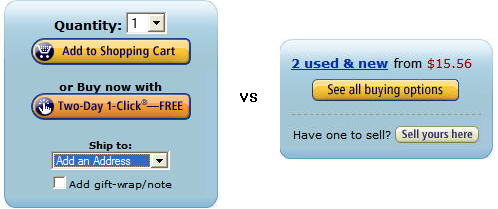
Very quietly they started to remove the Add to Shopping Cart Button with the See all Buying Options button on selected books.

 image

Everything else is unchanged,  you sill see the cover, book information and both editorial and reader reviews.  Just no quick shipment or shipping discounts available;  you will have to find the book in the Amazon Marketplace. 

The selected books just happened to be books from a prominent POD publisher -- Publish America with over 30,000 titles listed on Amazon.  A day later Whiskey Creek Press was similarly turned off.  I suspect Lulu will be next.  

Evidently, Amazon has a new policy for writers -- if you want to publish your print on demand title and sell it directly on Amazon you must go through BookSurge. 

Predictably authors and POD publishers are outraged and the blogosphere is humming with indignation and vague threats against Amazon.  But outrage only lasts a little while and soon publishers will get to work and set up their own sites, find other distribution channels and get on with life.

Obviously, Jeff Bezos and the management team at Amazon believe that slashing and burning the competition is a viable business strategy.  In the short term they might even be right. 

Over the long term it looks less likely.  Slash and Burn techniques hurt both the general publishing/bookselling market and Amazon.  Amazon stands to loose the goodwill and cooperation of publishers, distributors, authors and a portion of the buying public.  And that will hurt over time.

History shows us that when you make enough people mad because you are a monolithic, monopolistic business eventually they fight back. The result is that the company is either weakened or seriously injured. 

The good news is that right now there are individuals and businesses out there who are highly motivated to develop new competitive strategies.  They are looking for new ideas and advantages and their focus is aimed directly at Amazon. 

del.icio.us Tags: ,,,,,

Thursday, March 20, 2008

Publishing World Odds and Ends

Seems like there have been an inordinate number of interesting and creative people how have left us in the last month or so.  In my more depressive moments, I look around at the world we live in and wonder if they don't have the right idea.  And then I snap out of it.

Arthur C. Clarke

Arthur C. Clarke was someone who looked around and saw opportunities.  I think he saw the world and the humans in it as raw material. 

I am not a big Science Fiction fan but I am sure I have seen 2001:  A Space Odyssey at least ten times.  For my generation it was a rite of passage. 

Between the movie and his appearances with Walter Cronkite during the space walks I knew who he was.  As a bookseller he was hard to miss with over 100 titles that he either wrote or co-authored.

My main connection to him, however is more personal.  It is in the form of a placard on my desk.  It has been there for over 20 years and was given to me by a couple of programmers. Once in the middle of a project I asked them to explain to me exactly what they were doing and how the software they had written worked.  After listening to a long convoluted explanation I finally concluded that it was just easiest to say that what they did was magic.   

The next day they presented me with a placard that simply says:

"Any sufficiently advanced technology

is

indistinguishable from magic.”

Arthur C. Clarke was an original who produced his how kind of magic.

Another One Bites the Dust

I wasn't sure how to characterize this piece of information.

audible    

It's official:  Amazon now owns Audible.  Amazon has said they completed their acquisition of Audible.com at the $11.50 a share offering price. Audible is now a wholly-owned subsidiary of Amazon.  Evidently media consolidation is proceeding everywhere; even on the Internet.

Audible just celebrated a solid ten year anniversary.  That is a long time in internet years.  It is hard to remember now, but 10 years ago MP3 was an unproven technology.  Players were primitive and CD's ruled the audio market. iPods did not exist. Most people saw this as a good idea, but no one was sure if it would really catch on.

So here were are ten year later.  MP3 music and books are ubiquitous.  It makes me very happy to see that the early believers in an unproven technology are getting compensation for their faith.

On A Lighter Note

This is too good to have made up. . .

Publishers assign each book to a specific category.  I routinely get lists that show me the Title of a Book, the ISBN number, the Author, the Publisher and the category (as assigned by the publisher).  Here is my current favorite:

image

I almost left it there; but then who would find it? 

Tuesday, October 30, 2007

Blogging Heros -- no eBook yet

Interested in Blogging? Well, here’s the deal: if you have the time and energy you might actually snag all of Blogging Heros, a collection of interviews with 30 top bloggers, "for free.”

It’s up to you: preorder it from the Publisher, wait and buy it on December 10 or download chapters and start reading now.

Here’s is the story:

Michael Banks spent months interviewing Bloggers and asking them for advice on how to start and maintain a blog, what tools to use, how to research, how to attract and measure audiences, and how to make money from blogging. He even asked them to share the single most-important element to their success.

Last week John Wiley and Sons, his publisher, started an active marketing campaign. One of their ploys is to encourage each of the Bloggers interviewed to post their interview on their own blog so that anyone who is interested can download it for free. Very smart idea!

The Wiley site gives you a partial list of bloggers intereviewed and sites:

  • Thomas Dolby (thomasdolby.com)
  • David Rothman (Teleread.org)
  • Chris Anderson, Editor-in-Chief of Wired
  • Mark Frauenfelder (BoingBoing.com)
  • Michael Arrington (techcrunch.com)
  • Robert Scoble (scobleizer.com)
  • Peter Rojas (engadget.com)
  • Ina Steiner (AuctionBytes.com)
  • Gina Trapani (Lifehacker.com)
  • Alex Pareene (wonkette.com)

As an interested reader I checked them out. . . I’ll save you a little work here – as of this morning only four of the ten have put up a chapter.

These are great interviews and they certainly whetted my appetite for more. This is a book I will end up buying. The good news is that the PDFs loaded on my UMPC so I am good to go.

My only disappointment is that the publisher, John Wiley, has not announced an eBook edition (yet).

Google
 

Subscribe Now: Feed Icon