Showing posts with label books. Show all posts

Monday, April 20, 2009

As April Comes to An End -- Celebrate Reading!

April ends with two notable reading initiatives for you to check out. You won't be disappointed!

READ WITH KIDS -- Last year I wrote a longish piece on an organization called Reading is Fundamental (RIF). RIF is the oldest child literacy program in the US. There current drive is to log 5 million minutes spent reading to kids. Love of books and reading is perhaps the greatest gift you can give a child. So here's the deal: for a second year, Reading Is Fundamental (RIF) and US Airways are working together to help children nationwide discover the joy of reading. Starting April, adults are invited to join the 2009 Read with Kids Challenge and help collectively log 5 million minutes spent reading with kids. You’ll have the chance of winning a family vacation to the Walt Disney World Resort® and more great prizes. Get on board!

UNESCO WORLD BOOK DAY -- 23 April: The idea for this celebration originated in Catalonia where on 23 April, Saint George's Day, a rose is traditionally given as a gift for each book sold. The success of the World Book and Copyright Day will depend primarily on the support received from all parties concerned (authors, publishers, teachers, librarians, public and private institutions, humanitarian NGOs and the mass media), who have been mobilized in each country by UNESCO National Commissions, UNESCO Clubs, Centres and Associations, Associated Schools and Libraries, and by all those who feel motivated to work together in this world celebration of books and authors.

wolrdbook

This is a symbolic date for world literature for on this date and in the same year of 1616, Cervantes, Shakespeare and Inca Garcilaso de la Vega all died. It is also the date of birth or death of other prominent authors such as Maurice Druon, K.Laxness, Vladimir Nabokov, Josep Pla and Manuel Mejía Vallejo. It was a natural choice for UNESCO's General Conference to pay a world-wide tribute to books and authors on this date, encouraging everyone, and in particular young people, to discover the pleasure of reading and gain a renewed respect for the irreplaceable contributions of those who have furthered the social and cultural progress of humanity.

Monday, April 13, 2009

Amazon Ranking and Censorship

Itopt is hard to overestimate the importance of rank to an Amazon author or bookseller. It is an objective measure of a book's popularity and salability.  Everyone wants to be #1 (or a least in the top 1000).

Readers use rank as an unofficial  guide reading guide.  Authors and booksellers use it as a quick calculator for sales --  If you rank 1-10 you can expect to sell a book every few minutes.  If you have a high ranking like 50,000 you might sell your books in a year or so.   Booksellers use rank as a buying guide when ordering inventory for their stores.

Rank is everything.

So what happens when Amazon "de-ranks" a title?  Pretty much, the books chances of being sold are 0. 

Last week Mark Probst noticed a curious thing.  His book, a young adult romance title, The Filly, mysteriously lost rank.

So he wrote Amazon and asked them why.  Here is their answer:

In consideration of our entire customer base, we exclude "adult" material from appearing in some searches and best seller lists. Since these lists are generated using sales ranks, adult materials must also be excluded from that feature.

Hence, if you have further questions, kindly write back to us.

Best regards,

Ashlyn D

Member Services

Amazon.com Advantage

thefilly Oh, did I mention that The Filly is a Western and that the romance is between two men? That other than being a "gay-themed" story it is strictly G rated?  It seems that all of the sudden Amazon has gotten into the business of censorship! 

With one simple algorithm change they have de-ranked GLBT titles and any of those where the publisher has labeled the books as erotica.  As of today Brokeback Mountain, Rubyfruit Jungle, The Well of Loneliness, some of the teen books by Alex Sanchez, and Heather Has Two Mommies have been de-ranked. 

I find this deeply disturbing and actually offensive.  Even if I personally do not read gay themed erotica, I will fight to the death to preserve your right to read it.

Mostly it has been the government who has indulged in this kind of censorship (aka book banning).  Now a major corporation has entered the culture wars and unilaterally decided what is appropriate.

Maybe you don't care about erotica or GLBT literature.  But if Amazon can abruptly affect the market for these books today; what or who will they decide to target tomorrow?

Monday, December 22, 2008

"Of course, I've Read that Book!" or Readers Lie

Shocking news last week!

pinocchio According to a BBC poll 46% of men and 33% of women admit to lying about what they have read. In other words about 40% of the population would rather impress you than tell the truth about their reading habits.

Seems men want to appear intellectual or romantic and women want to make a good first impression.  Men are impressed by women who read news sites and women are impressed by men who read Shakespeare.  Hmmmm!

Of course this brings up a question for me.  What do you do about those books that you just can't make your self finish?  You know, the ones you bought, read the first (and possibly the last chapter) and then quit.  Does that count as having read it?

This is my dilemma:  Is it necessary to read every word of a book to consider it read?  Does skimming count?

Did I really read A Thousand Splendid SunsI read the first three chapters, skimmed the middle and read the last chapter. . . I wanted to read it; but somehow I just couldn't make myself do it. My mind kept wandering.

Does it count that I picked up The Forgotten Man and after a couple of chapters found it too depressing to keep going on?

I mean, I really wanted to like My Jesus YearBut unfortunately Benyamin Cohen is no A. J. Jacobs. And no matter how much I would like it to be, My Jesus Year is no substitute for The Year of Living Biblically.  I actually made it about half way through; did I read it?

Then of course there is the problem of memory.  As a life long prodigious reader, I would be hard put tell you exactly what I have read or not read.

And finally, there is the movie adaptation thing. . . Did I read The Hours or do I just remember the movie?  Actually this is one I know.  I read the first couple of chapters and threw the book in the trash in disgust.  Turns out, however, that I loved the movie.  Can I say I read it?

No matter how you answer these questions, the fact remains that the desire to look good will always trump the thirst for knowledge.  Always has, always will.  And not all books or writers are equal.  For every great best seller there is one that is "literary" and boring. And face it, some books make better movies than books.

And -- just so you know -- I almost never write reviews of books I haven't read.

Monday, December 15, 2008

The Book as a Form of Presentation Art

I have received a batch of emails related to the paper book as an artifact of past glory in paper publishing over the holiday weekend. One of the rather more prominent members of the group contributing to the thread involved called books in paper form a fetish. I was, in fact, quite amused by much of the content of that thread. The future is seldom what we expect it to be.

2007 tower Paper publishing is obviously being altered and even threatened by digital publishing. Of course every form of information will be altered or replaced by newer, more complex digital forms over time. The key qualifier here is, “Over time,”; and the key question in the thread is how long will this replacement process take in the case of the written word presented in book form?

The continued use of paper is clearly more expensive in many cases than the simple act of moving a digital file from one place to another. It is also clear that many more forms of digital information can be included in publications that enjoy the flexibility of digital publishing over paper. Still and all old habits die hard. I still have several newspapers delivered to my driveway even as I use the Internet to read several more each day.

How fast will all of the replacement of paper take place and how soon will I be forced to do without my many pages of birdcage liners that grace my weekly recycling contribution? I am reading about the future as I have done most of my adult life. In the future virtual reality will eventually take over the process of transferring complete information about any life experience.

Technology in terms of the presentation of information is clearly expanding our options. I wonder if any of the people contributing to that thread really understand exponential growth in technology and what it means to all of us. The capacity of single computers will exceed the capacity of the human brain somewhere in the next two decades if Ray Kurzweil is to be believed.

From that point to the point in time where exponential growth in data transfer technology and computing capacity lead to human minds with millions of times the capacity for data transfer and data manipulation of the current human mind is short indeed. I suspect that most of the people contributing to that thread can no more comprehend a world where living thousands of virtual lives in one short period of time will be a common experience than can I.

The time devoted to reading one book might instead be devoted to experiencing the lives of all of the characters in a lifeline presentation series in that world. Of course this idea presupposes that someone could be bothered to produce such a presentation in a world where the computers are the majority of the conscious minds around.

Exponential growth in computing power and data transfer capabilities dictates that such a world will be upon us before the next generation grapples with its somewhat diminished mortality. If, as Ray suspects, we are mere decades from downloading human consciousness into those immensely expanded computers mortality itself will be drastically altered if not eliminated.

So I find myself amused by the parochial nature of the discussion in that thread. It is not only the art of the book or the written word that is under duress here. It is more appropriate to consider what will happen to the art of experiencing life itself and how that will be transferred in such a world as will exist before this century is half over.

We do live in interesting times don’t we?

Monday, December 8, 2008

Books, eBooks and the Reading Public

Ever wonder who buys books and why? 

Well, if you have, there is a nifty service out there that tracks that kind of info.  The service, PubTrack, does online surveys of the book buying public.  And the results for 2007 were reported last week by Publishers Weekly.

stats Much to Henri's amusement, I am a person who is fascinated with statistics like these.  And yes, I know about "Lies, Damn Lies and Statistics."  I guess it is the accountant buried in my soul that loves to quantify things.

I love the fact that fourteen billion dollars was spent on books!  It is interesting that only 3.2 billion (23%) was spent online. And I (for one) am less than thrilled to find out that only 3% of book purchases were non print (eBook and Audio Book) versions. 

PubTrack breaks the reading public into five groups:  Teens (13-17), Gen Y (18-28), Gen X (29-40), Boomers (41-59) and Matures (60 and up).  The statistics are then broken up to reflect buying habits and attitudes.  Each group has some noteworthy feature:

  • Only 9% of Teens actually buy books and when they do they primarily read fiction.
  • Gen Y consumers buy only 14% of the books sold but they buy about 1/3 of all those books online and are the biggest group (4%) of non print book buyers.
  • Gen X is interesting in the fact that there is nothing unusual or particularly interesting about them and that they closely mimic the statistics of the matures.
  • Boomers are the largest segment of the population (33%) and spend the most money on books. 
  • Matures read the most fiction of any group -- 56% and purchase very little online. 

Mildly interesting stuff. But as I looked over the stats I begin to wonder about trends, since these age groups are a moving target.  So just for fun I took a look at what happened when you combined the stats for Teens and Gen Y or what happens when you combine Boomers and Matures.  Probably only interesting to me. . .

Except that the trends when you combine Teens and Gen Y are probably a  peak into the future.  Like everyone in publishing, I have a great curiosity about what is going to happen.

When you reduce all the statistics to some simple percentages the picture becomes pretty clear. 


Teens

+GenY

GenX

Boomers

Mature

Population

25%

21%

33%

21%

# of books buyers

29%

24%

23%

24%

# of books purchased

18%

22%

32%

28%

$$ spent

24%

24%

30%

22%

% purchased online

49%

26%

22%

14%

% non-print

6%

3%

3%

2%

 
I'll save your eyes and point out the really clear points about the combination of Teens and Gen Y:
  • They purchase only 18% of books
  • 49% of those books are purchased online
  • 6% of books bought are non-print version
Obviously, the future of printed books and they way they are bought is changing and will continue to change as the matures die out and are replaced with teens.  This is a pretty grim picture if you are a traditional publisher or one of the big three book retailers.  But if you are Jeff Bezos or an Amazon shareholder you probably feel pretty good about yourself.
 
Just one more piece in the growing evidence that publishers are going to have to change or perish.

Monday, December 1, 2008

Is the Digital Era creating New Life for P-Books?

After a very long weekend of too much food, too many relatives and too little sleep, I woke up yesterday, poured a cup of coffee and started reading the New York Times.  The first article to catch my attention was How to Publish Without Perishing.

nytlogo153x23 In this piece James Gleick opines that there is a bright future for printed, bound books:

I think, on the contrary, we’ve reached a shining moment for this ancient technology. Publishers may or may not figure out how to make money again (it was never a good way to get rich), but their product has a chance for new life: as a physical object, and as an idea, and as a set of literary forms. . . .

Go back to an old-fashioned idea: that a book, printed in ink on durable paper, acid-free for longevity, is a thing of beauty. Make it as well as you can. People want to cherish it.

Really?!

While I find this an interesting view, I wonder if Mr. Gleick has been out and about in the real world lately.  Has he been to his local bookstore?  Does he have any contact at all with "the younger generation"?

Later in the day I found myself inside the local Barnes and Noble.  In our town, they have the best selection of CDs and it is Christmas time. 

The store was moderately busy.  A few people in the coffee shop, a few people sitting in the oversize chairs (mostly they looked like they were waiting for someone), a bustling staff and a handful of customers. 

barnes chars I took a seat and did some intense people watching over the next half hour.  Anything was better than facing the chaos in my house!

I found the demographics very telling.  I saw children (approximately 5-13) accompanied by parents; I saw middle aged women, and I saw old men and women.  Aside from the staff, I did not see one person between the age of about 13 and 30.  None!

I was willing to chalk it up to a very unscientific survey and leave it at that.  I decided I better quite procrastinating.  So I started gathering my stuff and getting ready to go clean up my house.  And then I saw her.  A real life teenage girl.  She just appeared before my eyes. I was so intrigued by the sight I just stared.

She looked around for a moment, and then she threw herself into a chair with a big sigh.  She routed around in her jean's pocket and pulled out a cell phone.  Within seconds she was texting away.  Totally ignoring all the beautifully bound books along with everyone in the store.

I for one, am unwilling to bet that she will someday wake up and find a book a thing of beauty; something to cherish.  I doubt that she will see a book as an idea or a set of literary forms.

She may see it as furniture (a great way to warm up a room and give it a little class).  Kind of like the antique rolltop desk I inherited from my grandmother.  Beautiful but with very limited usability.   

Friday, October 31, 2008

eBook Discounts - Regular Discount Page on hold this week. A different kind of eBook discount. . .

image

This picture represents the current state of my hand.  Am doing all typing -- hunt and peck with my left hand. . . .not very efficient! 

So this week, as my body is healing we are offering a 20% discount on every book in the Mind Body section that at $9.95 or more.

Use discount code GigiHand4 to get your discount.  The more you buy the more you save. 

Wednesday, October 1, 2008

Banned Books Week

I do not want to let this week pass with out noting that it is Banned Books Week.  This is a time set aside to celebrate the freedom to read . 

This annual event was created to remind us not to take this precious democratic freedom for granted.

Banned Books Week (BBW) celebrates the freedom to choose what you want to read.  And the freedom to express your opinion even if it is considered strange, unpopular or just plain wrong.  It is your opinion and you have the right to write about it or alternatively to read about it. As the ALA points out:

Intellectual freedom can exist only where these two essential conditions are met.

It is a quirk of human nature that we seem to want to try to suppress opinions and ideas that we don't agree with.  In our modern world we have developed a new language for banning books -- we call it a challenge. 

A challenge is defined as a formal, written complaint, filed with a library or school requesting that materials be removed because of content or appropriateness. 

I think that is a lot like banning, don't you?

I am fascinated by the “10 Most Challenged Books of 2007.”

  • 1) “And Tango Makes Three,” by Justin Richardson/Peter Parnell
    Reasons: Anti-Ethnic, Sexism, Homosexuality, Anti-Family, Religious Viewpoint, Unsuited to Age Group
  • 2) The Chocolate War,” by Robert Cormier
    Reasons: Sexually Explicit, Offensive Language, Violence
  • 3) “Olive’s Ocean,” by Kevin Henkes
    Reasons: Sexually Explicit and Offensive Language
  • 4) “The Golden Compass,” by Philip Pullman
    Reasons:  Religious Viewpoint
  • 5) “The Adventures of Huckleberry Finn,” by Mark Twain
    Reasons:  Racism
  • 6) “The Color Purple,” by Alice Walker
    Reasons: Homosexuality, Sexually Explicit, Offensive Language,
  • 7) "TTYL,” by Lauren Myracle
    Reasons: Sexually Explicit, Offensive Language, Unsuited to Age Group
  • 8) "I Know Why the Caged Bird Sings,” by Maya Angelou
    Reasons:  Sexually Explicit
  • 9) “It’s Perfectly Normal,” by Robie Harris
    Reasons:  Sex Education, Sexually Explicit
  • 10) "The Perks of Being A Wallflower,” by Stephen Chbosky
    Reasons:  Homosexuality, Sexually Explicit, Offensive Language, Unsuited to Age Group

I find it interesting that books that are sexually explicit or unsuited to an age group make up 8 of the 10 titles. 

Makes me wonder about two things:

  1. What ever happened voting with your pocketbook (or just not buying/picking up/reading a book)?
  2. And where are the parents of these kids -- isn't protecting them and teaching them about making responsible choices what parents do?

Monday, September 29, 2008

What Is A Book Worth?

 books on trees There is no intrinsic measure of what a book is worth that really defines what people should pay for an author’s loving work. There has been a lot of buzz on the Internet and in newspapers, magazines and even on radio and TV talk shows about what should be charged for a book. We talk a lot more about such things today than we have in the recent past. Maybe that is just another measure of our current fear of financial ruin.

I still read some newspapers and magazines in their paper form. I also still buy some paper books although I am slowly and reluctantly converting my reading habits to staring at a screen rather than turning a page. I’m studying Spanish using my computer and the package provided by Rosetta Stone instead of books I bought long ago.

The truth about my reading habits is that I have long ago run out of adventure authors and science fiction that meets my standards. A book comes along once in a while that piques my interest but not nearly often enough to fill my insatiable need to read.

Reading fills my time and even occasionally my mind with pleasure, even when the writing is moderately bad I usually find something to enjoy in a book. I have just had to broaden my horizons a bit. Now I read anything that has a story line or a plot that grabs me.

It is as clear to me as to most of you that the whole architecture of the publishing world in undergoing a vast change. From POD to digital books there are so many changes that anyone could have a hard time keeping up with the scorecard of who’s on first and who’s out these days. Amidst it all there is still one obvious fact, people will write even if there is no money in it.

There are over a million bloggers out there and the number is growing rapidly. How many of you were born after the word blog entered the common language? That is the first really huge new form of literary expression in a long time and it is almost always free to the reader. I think that makes my point.

The literary forms and their values are changing rapidly. I am loving this changing world of writing all more than I ever thought I would when I first saw the written word on a digital screen. I won’t even tell you how long ago that was but it was a long time before the word blog entered the language. And is literacy suffering? Not a bit if you pay attention to the fact that every child with a cell phone is writing to their friends every day even if we can’t understand their new language at all!

So what is a book worth? Less than it used to be, if all it does is sit there and wait for you to turn its pages. That is becoming obvious. But maybe a whole lot more if it offers a new vision of what is possible in the new digital world of literary forms and shapes we are building today. I hope you are enjoying these changes as much as I am. It’s a truly brave and interesting new world for those of us who are already living here. Why don’t you join us and try it out?

Monday, July 7, 2008

Book Technology: the movie

Either some virus got me or I had too much 4th of July (not sure which) so today's post is short and simple.

A friend sent me this marvelous video about book technology that is very worth watching.  Enjoy!


The more things change, the more they stay the same!

Tuesday, July 1, 2008

Henri's Lament: The Death of the Sunday Morning Bookstore Run

Gigi and I used to go to the bookstore nearly every Sunday morning.

Obviously, we both read a lot. The biggest hour in our week was spent browsing the shelves of whatever bookstore we chose on that particular Sunday. That morning period was something we looked forward to with great anticipation on most weeks of the year.

Now it is over! She reads eBooks, and thinks that I am still stuck in the past.

I still get to the bookstore; I’ve been doing that since found out that I could buy a book in the used paperback store on Lake street in Minneapolis for a dime, back in the 1950’s. I haunt the used stores and the new stores whenever I can, but it’s not the same.

The used book stores are going now, disappearing every day. I went back to one last week and it was gone. So was the owner, disappeared into the past like the onsite book trade is threatening to these days. The new stores are not far behind. Some great ones have fallen in the last two years, in New York, Boston, Pasadena and San Francisco to name just a few places where I have lost old friends.

Sure I can use the Internet. I buy books there occasionally, but I still like the feel and smell of a real bookstore. Gigi on the other hand could care less; she buys all of her books eBooks About Everything.  At least it pays for her books and mine and a usually a little more. We started it on a whim and it has grown into a real, if small, Internet business.

But I don’t want to read eBooks!!!!!!! I don’t want to buy from Amazon.com or any of the other stores on the Internet that are demolishing the bookstores that I still frequent!!!! I am the man without hope because the way of life that brought me so much joy is disappearing. In every town I ever visited someone used to make a decent living selling books. New books, used books, great books, awful books and every kind in between were all available in those stores.

Too much joy and pain passed through my mind that was carried by the books I purchased in those stores for me to ever want to give them up for something on the Internet. The Internet cannot convey the smell and feel of walking into a different store with the dream of discovering a new author or an unread tome by a favorite writer.

An now, added to that, I am in mourning most of all for all of those wonderful Sunday mornings with my lovely wife spent together searching for books to read on a lazy summer afternoon.

Monday, May 5, 2008

eBook Reading reported

Last month Tickermine took a random poll about reading; electronic reading on eBook readers in particular.  I know that random self selected polling is not exactly scientific.  But it is an interesting snapshot of those who have strong opinions on any given subject. 

kindle and sony

I was fascinated by both the questions and the responses.  

  • Do you own a copy of an eBook?
    • 33% said they owned an eBook 67% said they did not.
  • Do you plan to own one?
    • 37% said they planned to buy one in the future
    • 63% said they would not
  • What is the most you would be willing to pay for one?
    • 57% said they would be willing to pay under $100
    • 23% said they would pay $100-$200.
    • 11% stated $200-$300
    • 6% capped their price at $300-$400.
    • 3% said they would be willing to pay over $400.
  • Which factors influence your decision to purchase an eBook?
    • 32% cited how many books it can hold
    • 26% answered wireless downloading of the material
    • 14% were concerned with battery
    • 11% stated the size
    • 6% responded that weight was the primary concern
  • How would you use an eBook?
    • 60% said reading books
    • 11% said web content
    • 9% said they would read magazines
    • 9% said  reading blog
    • 6% said documents
    • 5% said newspapers.
  • Which brand would you prefer buying?
    • 37% chose Kindle
    • 34% preferred Sony Reader. 
    • 29% said they prefer reading on printed paper.

The people who chose to answer this poll, were for the most part people who did not own and eBook and did not plan to buy one and yet they have very strong opinions about what they are willing to pay and which reader they prefer. 

The thing that strikes me hardest is that only 6% were willing to pay $300-$400 for the reader and yet 37% picked the $400 Kindle.  Only 11% were willing to pay $200-$300 and yet 34% picked the Sony reader.  You might say that only 17% were actually willing to pay for either of the two most well know readers on the market.

The second thing I find curious is that the biggest influencing factor is the number of books the device will hold.  Only 11% were concerned with screen size.  If you had asked me to guess I would have reversed those two results. 

I am not sure exactly what this all means. Clearly there is a large disconnect between what people want and what eBook Reader manufacturers are charging.

I can't help but wonder about the influencing factors for buying an eBook reader.  Both the Kindle and the Sony claim to hold 200 books on the device and yet they both have additional memory card capability which infinitely expand storage capacity.  The most notable answer is the answer about wireless access.  Kindle has done a great job of promoting that particular feature.  The problem of course is that it doesn't necessarily work well in real life. 

In the final analysis, eBooks have a long way to go before they are priced low enough and before eReading will be a generally accepted reading method.

Sunday, April 27, 2008

Reading is Fundamental

As I get older there are fewer and fewer things that bring out my inner activist.  But last week I found one.  A very simple little news item:

Bush's '09 Budget Eliminates RIF Funding
President Bush's proposed 2009 budget eliminates all the funding for Reading Is Fundamental's book distribution program that has, since 1966, provided more than 325 million books to more than 30 million underprivileged children.

That got me mad -- like in mad enough to do something! Mad enough to talk about it to everyone I know.  Mad enough to write my Congressperson and Senators.  Mad enough to write Margaret Spilling at the US Department of education.  Mad enough to write both Barbara and Laura Bush.  Mad enough to write about it here.

Reading is Fundamental is an awesome program!  riflogo It is the oldest and largest nonprofit children's literacy program in the world.   Their mission is to motivate kids to read.  An important part of the program is providing books for children to explore, read and keep. 

The program was started in 1966 by Margaret McNamara.  While her husband was busy messing up the Vietnam War at the Defense Department she volunteered to tutor a group of Washington D.C. children in reading.  One day she took a bag of used books with her.  At the end of the session she told each of the children that they could pick a book and keep it.  The kids were thrilled.  These children (an most of their classmates) had never owned a book! 

Margaret McNamara was so moved by their enthusiasm and awe that she got busy.  She recruited her friends, raised money everywhere she could and started collecting books to give away.  For the next nine years her efforts created a program that gave away books to children in the Washington D.C. public school system. 

In 1975 the US Congress passed a bill that provided matching funds to RIF. Congress has continued to fund the organization for the last 33 years in a row.  Reading is Fundamental now serves children and families in every state, district and territory of the US.  In 2007 the program gave away 16 million free books to 4.5 million children!

Now, the Bush administration has decided to eliminate RIF's funding!  Evidently it is more important to rebuild Iraq, bail out corporations and build Bridges to Nowhere than it is to promote literacy here at home.

Incredibly, this is the second time that this President who has made a bid deal about leaving no child behind, has attempted to cut funding for RIF.  The first time (in 2001) there was such a public outcry that the administration finally backed down.

This story becomes even more curious when you consider that Barbara Bush served on RIF’s board of directors from 1980 to 1988 and then on its national advisory board from 1989 to 1992 .  Add to that the fact that  Laura Bush served on RIF’s national advisory council from 1996 to 2001.

It's time for a huge public outcry!  PLEASE go to the RIF site and voice your opinion. 

The site provides links to find  your senator and representative and gives you information about how to send an e-mail message to them.  Join me and thousands of others in making our voices heard!  Write to Barbara and Laura for good measure!  But hurry, there is not a lot of time because the appropriation committee will be meeting in May and June to decide on budgets.

Oh yeah, I should mention that  this item even made me mad enough to actually make a donation to RIF.  This is an organization that deserves our support!

The families and children affected by this cut in funding are the weakest and most vulnerable members of our society. There aren't any lobbyists   in Washington advocating for them!  They have little voice or power and they need for us to speak up.  To give them a voice.

So get busy -- write, call, spread the word, donate.  Let's make sure that kids get the chance to have free books to explore, read and keep!  Let's make the outcry so loud that we can't be ignored!

Thank you for your support!

Monday, April 7, 2008

The HarperCollins Experiment

Bob Miller was restless and frustrated with the same old publishing paradigms.  He was already the founder of a successful publishing company, Hyperion, but evidently he wanted more.  In a surprise move last week it was announced that he would be moving over to HarperCollins to try something new.

His new (and as yet unnamed) venture is conceived of as more of a studio than a publishing venture. He is proposing some revolutionary (for the stodgy publishing industry) ideas:

  • 50/50 profit share with authors (and minimal advances)
  • selling everything on a non-returnable basis
  • taking full advantage of the internet for sales, marketing and distribution
  • selling hardback books at around $20 per copy
  • experimenting with selling other formats
  • releasing eBook and Audio book for free when you buy the hardback edition (this is very speculative)
  • publishing books that might not otherwise emerge because new authors find it harder and harder to be published at all

The Wall Street Journal, New York Times and every publishing blog spent most of last week commenting on how unique and wonderful his idea is. 

Hmmmm -- seems to me that there are many independent and eBook publishers that have been doing all these things for quite some time.  So what's the big deal?

Aside from my cynicism, there is one big deal in all of this -- the selling things on a non-returnable basis.  The most shocking thing to me as a new publisher was the whole returns/remainder thing. 

Did you know that when a bookstore orders 20 books if only 2 of them sell that the bookstore can just ship them back to the publisher for full credit?  How strange is that!  I do not know of any other business where a retailer can stock inventory at virtually no risk -- if it doesn't sell you send it back. 

All costs associated with returns and destruction of the unused books is the publisher problem. This is like consignment selling on steroids. 

And you wonder why the the cost of books is so high!

Ending the practice of returns would go a long way towards putting money in the authors pockets. 

And speaking of the high cost of books, another big offender is the advances.  Millions of dollars get paid to a Bill Clinton or Carl Rove but the ordinary author is lucky to get his book published, never mind the advance!

I would love to know what percentage of the advance money is actually realized and how much of it is "wasted" on books that don't make the anticipated sales.  

Even the authors who get big advances have to "pay back" advances from books sales using an accounting system that no one really understands.  The point at which an author actually pays back the advance is a moving target . And then to add injury to insult an author will typically only receive 15% of sales in royalties. 

Although I would argue that Miller's "revolutionary" publishing concept has been used for years by ePublisher and small presses, I do applaud his stand against "Big Publishing." 

Here's to you, Bob.

Monday, March 31, 2008

Amazon -- eBooks, POD & Killing the Competition

amazon logo If you have been paying attention, you probably figured out long ago that Amazon has a pretty simple business strategy:  to become the biggest and most complete publishing and books distribution company in the world. 

In the ideal Amazon world, an author can upload their completed manuscript to Amazon's digital content management system.  By doing so they grant Amazon the right to sell this content on demand as a physical object (hardback/paperback book)  or digital file (eBook or AudioBook).  They agree to let Amazon set price and margins in return for utilizing the biggest book distribution and marketing channel in the world.

Over the last 3 years Amazon has been very busy -- they have acquired Mobipocket for eBooks, BookSurge to print books and Audible for audio books. 

In the eBook world, they acquired Mobipocket and for months nothing happened.  Amazon continued to use Ingram's eBook service to sell eBooks in PDF, MS-Reader and Palm formats.  The Mobipocket site continued to live in it's own little world pretty much untouched by Amazon.  Same primitive website with no big changes.

Then one day in July, 2006 Amazon notified Ingram (who notified the rest of us) that  "Amazon.com has decided to discontinue its use of Ingram’s e-Book delivery services effective mid-July for new e-Book sales and the end of August for prior e-Book sales."  And poof -- the only way to buy eBooks on Amazon was to be redirected to the Mobi site. 

eBook authors and publishers were outraged and the blogosphere hummed with indignation and vague threats against Amazon.  But outrage only lasts a little while and soon authors and publishers got to work setting up their own sites, finding other eBook distributors and getting on with life.

Last week, Amazon turned it's sites on Print On Demand (POD) publishers.  These are the guys who print, bind and ship very small quantities of books.  POD is a strictly just in time system where the printing is done as needed on an order by order basis:  from one book to hundreds of books.

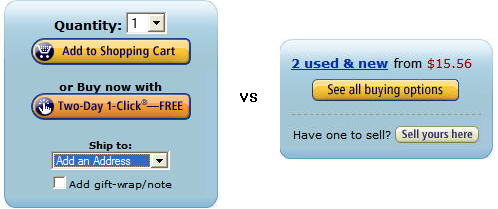
Very quietly they started to remove the Add to Shopping Cart Button with the See all Buying Options button on selected books.

 image

Everything else is unchanged,  you sill see the cover, book information and both editorial and reader reviews.  Just no quick shipment or shipping discounts available;  you will have to find the book in the Amazon Marketplace. 

The selected books just happened to be books from a prominent POD publisher -- Publish America with over 30,000 titles listed on Amazon.  A day later Whiskey Creek Press was similarly turned off.  I suspect Lulu will be next.  

Evidently, Amazon has a new policy for writers -- if you want to publish your print on demand title and sell it directly on Amazon you must go through BookSurge. 

Predictably authors and POD publishers are outraged and the blogosphere is humming with indignation and vague threats against Amazon.  But outrage only lasts a little while and soon publishers will get to work and set up their own sites, find other distribution channels and get on with life.

Obviously, Jeff Bezos and the management team at Amazon believe that slashing and burning the competition is a viable business strategy.  In the short term they might even be right. 

Over the long term it looks less likely.  Slash and Burn techniques hurt both the general publishing/bookselling market and Amazon.  Amazon stands to loose the goodwill and cooperation of publishers, distributors, authors and a portion of the buying public.  And that will hurt over time.

History shows us that when you make enough people mad because you are a monolithic, monopolistic business eventually they fight back. The result is that the company is either weakened or seriously injured. 

The good news is that right now there are individuals and businesses out there who are highly motivated to develop new competitive strategies.  They are looking for new ideas and advantages and their focus is aimed directly at Amazon. 

del.icio.us Tags: ,,,,,

Thursday, March 6, 2008

Odds and Ends for March 6, 2008

So many things have gone on in the last week or so that it is difficult to choose a few of the most notable:  William F. Buckley Jr. and Gary Gygax passed on; one more fake memoir, the Oprah-Tolle webinar; the Beautiful Children give away and so much more.

Passed On

William F. Buckley Jr. was an accomplished human being.  A writer, television host, magazine founder and political pundit.  He was embodiment of how to disagree without being disagreeable.  He was a prolific writer and I am sad to say that we only have two of his titles in our store:

I love The Rake and recommend it highly.  This is last book and epitomized his wit, style and use of language.

Gary Gygax was the creator of Dungeons and Dragons.  I am not a gamer but have been surrounded by a lot of them in my life.  You can't work with Techies all your life and not know a few.  He is one of those people I have a special feeling for, probably with not good reason.  No matter what else you can say, this man with a great imagination a sense of fun.


The Oprah-Tolle Webinar

Technology -- love it when it works and hate it when it doesn't.  A lot of the Oprah=Tolle webinar attendees woke up Tuesday, hating it.  Seems there was a little bandwidth problem. 

A statement of apology was issued saying that they"recognize that interactive Internet broadcasting to a mass audience is still an emerging medium" and they "deeply regret that some of our audience did not have an optimal viewing experience and apologize for any inconvenience this may have caused.

Don't worry. . . you can still get a copy of the webinar for viewing on Oprah.com or for downloading as a podcast on Oprah.com or iTunes . 

At first the fact that response was so great it killed the system surprised me.  But the more I thought about it the more I realized that for most people watching or listening to the webinar is a FAR BETTER experience than actually having to read the book! 

Fake Memoirs

Every year we have at least one of them -- a made up memoir.  A  perfectly great piece of fiction passed off as the real deal.  When this happens I start to ruminate on the difference between an autobiography and a memoir. . .

I have a long standing prejudice against autobiographies.  Usually they are an opportunity for the author to rationalize the big events in their life until they come out settling scores and looking good.  Or at least they figure they have offered a rational explanation for shoddy or indefensible behavior. 

So what exactly is the difference between an autobiography and a memoir?  Well, the official definition goes like this:

A memoir covers a shorter period of time or a more specific aspect of life. An autobiography has a wider range of both.

So how short a period of time qualifies?  A childhood, teen years, the years of addiction, a long illness?  Who knows. 

And I also wonder about truth vs emotional truth.  No one remembers things accurately, not really.  We see the past through our own emotional filters that color everything. 

Is there such a thing as a truthful memoir?

Wednesday, February 13, 2008

Valentines = Romance eBook Sale

ebooks about Romance


Celebrate Valentines Day with a Romance eBook.

ALL Romance Titles are 14% off for the next week (until February 20). 

Use code BeMine at check out to receive this discount.

New titles for your consideration include:

Go to the New Releases Page and take a look.  They come up randomly.  Hit F5 to rotate the selections and see new ones.

Enjoy!

Tuesday, January 29, 2008

Literary Fiction or Genre Fiction

prizes The review comparing and contrasting the The Senator's Wife and Mermaids in the Basement got me to thinking about how publishers (and readers) classify fiction.  For example, The Senator' Wife is considered by the publisher as literary while Mermaids in the Basement is genre (romance) fiction.

The publishing industry uses two broad categories: 

  • Literary fiction: loosely described as award winning and critically acclaimed.  This is fiction that addresses serious issues and is more generally character centric than plot driven. And finally, these are works that use beautiful language that is rich in vocabulary and lyrical in description. 
  • Genre fiction or "popular" fiction: SciFi, Romance, Horror, Mysteries etc.  This is narrative and plot driven writing which is often formulaic, uses simple language and is calculate to create an immediate emotional response.

Here is my rule of thumb:  Has the New York Times reviewed it? 

Yes, means it was either written by a mega-selling author or it is classified as a literary work.  No, almost certainly means it is a popular/genre title.

The thing that keeps coming up for me is that Charles Dickens, Jane Austen, the Bronte sisters, Mary Shelly and  Mark Twain were never considered "literary" in their time. I am not sure that Jonathan Swift, Alexander Dumas or Sir Thomas Mallory were either.

What these authors have in common is that they have have all written books that people are reading and enjoying decades later. 

The best definition of literary fiction I have heard is:

Literary fiction is fiction that endures; books that are read and enjoyed a hundred years later.

I would love to be around in 2100 to find out what books have endured and are considered "classics". 

What writers will be remembered and read? Will it be Nora Roberts, Steven King, John La Carre or (heaven forbid), Dan Brown?

Which of the award winning titles from the last few years will be read and enjoyed?  Will it be Gilead (Marilynne Robinson), The Corrections (Jonathan Franzen) or The Blind Assassin (Margaret Atwood)?  

Or will the whole idea of literary fiction and books be a quaint old fashioned curiosity?

Wednesday, January 2, 2008

Reading in 2007 -- Gigi's Recap of 2007 Books read

09basics_600 First a disclaimer -- I do not claim to be a typical reader.  I recognize that not very many people read as fast or as prodigiously as I do.  That said, I will tell you that every year I write down each book I read with a short synopsis and a rating. 

This morning I spent some time reviewing my my 2007 book list.  Here is what I discovered:

  • I have read 116 books this year
  • That is  an average of one book every three days.
  • 20% of the books are non-fiction / 80% are fiction.
  • 50% were eBooks / 50% print books
  • There are only 30 I would recommend
  • 75% of them -- varying degrees of OK to dreadful.

Which got me thinking. . .

There is a myth that just because it is a book, it is valuable; and that books are somehow more worthy and intellectual than watching TV, playing video games or surfing the net.

Trust me on this -- most of the stuff I read was not particularly intellectual and its only value was that it distracted me for a few hours.  Of course, there are some exceptions.  Most of them (at least those in eBook form) have been highlighted in my Blog. 

Back to the list. . .

I am struck by how few of the "older" books are in eBook format.  For example, I reread Rebecca last summer; I ended up with a beat up $1.00 paperback since it was no where to be found in eBook format. Anita Burgh, Taylor Cauldwell, and Jean Plaidy are good authors.  And yet their work is hard to find in paper, never mind electronic form. 

Publishers are forever crying the blues about book sales. So why don't they get it that a good story is timeless?   There are a host of books that are as vital and interesting today as they were when they were originally published.  eBooks are an inexpensive way to keep book perpetually "in print" and boost sales

Academics and publishers decry the lack of literacy in our culture.  Publishers, in particular, might just try being a little grateful.  Lack of literacy is the only explanation for most of their income.  Just take a look at the current bestseller list -- Clancy, Balducchi, Evanovich, Koonz, Roberts and Patteron!   Let's face it, most of us are willing to read crap just for a few hours of entertainment.

Here's to 2008  and a new list. 

Friday, December 21, 2007

A Special Ornament -- A Book

My friends love to send me odd links -- things they think will catch my fancy.  Yesterday I got one of those emails. 

It was titled "The Perfect Ornament for Your Tree."

After a couple of "Bah! Humbug"s I opened the email and followed the link to this YouTube video:


It looked simple enough and I thought it would be fun to hang one on my very big and quite bare tree.

I swear I followed the directions exactly -- only to find out that I am not any better at following directions than I ever was.

Google
 

Subscribe Now: Feed Icon
