Showing posts with label literacy. Show all posts

Monday, January 19, 2009

The NEA says there are more readers and many of them read digitally!
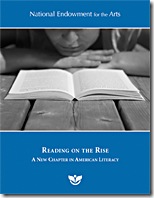
CoverReadingonRise This may be the first good news about reading that I have seen in years!

A new National Endowment for the Arts (NEA) study reveals that for the first time in 25 years American adults are reading more.  How about that!

The biggest increase is among young adults (18-24).  A full 21% over the last six years (2002-2008). The NEA is quick to credit reading programs such as their own "Big Read" initiative for this dramatic turn around.

I am somewhat skeptical about this conclusion.  Conspicuously absent is any reference to the publishing phenomena of J K Rowling or Stephanie Meyers.  I remember that Scholastic, the publisher of the Harry Potter series, reported a significant loss in earnings every quarter they did NOT have a new Harry Potter title.

My (admittedly limited) exposure to this particular age group tells me that they are reading J K Rowling and Stephanie Meyers and not a whole lot else.  I think the NEA is perhaps slightly more impressed with themselves than is truly warranted. 

The most curious increase to me is this:  15% for readers in the 75+ age demographic.  I would love an explanation here.  Large print books?  Seems unlikely.  Faulty polling in earlier polls?  Not that they would admit to!

One part of the report that is not necessarily highlighted is the statistics that correlate book reading and online reading.  Of course, I find these worth these worth taking a close look at:

  • 84% of adults who read literature (fiction, poetry, or drama) on or downloaded from the Internet also read books, whether print or online.
  • Nearly 15% of all U.S. adults read literature online in 2008.
  • For adults who read online articles, essays or blogs, the reading rate is 77%.

It seems that perhaps the Internet will not be the death of books.  Or at least not yet. 

Which brings me to my final observation about this report.  The NEA carefully defines a book as something between physical covers.  It does not account for eBooks or audio books.  In the case of audio books because (evidently) listening is not really reading.  In the case of eBooks because of their strictly defined poll format.  They are proud to let you know that the questionnaire has "remained fundamentally consistent for 26 years." 

A lot has changed in the last 26 years!  In 1982 the internet as we know it did not exist.  There were no Ipods, MP3 players, or cell phones.  I would like to see the NEA catch up with current technology and include eBooks and even audio books in their computations. 

Probably a small complaint in the scheme of things!  Because in the end, any increase in reading is a good thing!

Thursday, October 2, 2008

e-Reading - the changing landscape

springer logo

I stumbled on a white paper publisher by Springer.  It is a very interesting synopsis of two studies about eBook adoption and benefits.  Springer asked librarians and users about their views on eBooks.  The original study was done in 2007 and focused on librarians. The followup study was done in 2008 and addressed users. 

The executive summary concludes:

The survey uncovered some encouraging results regarding eBook adoption. Most users were aware of eBooks and had accessed them at least once. Respondents also overwhelmingly said that eBooks are useful and that they would like to incorporate eBooks into their information experience more frequently.
Some of the other points of interest include: 
  • The main use for eBooks is for research and study
  • eBook usage is still less concentrated than online journal usage
  • Users find eBooks through using Google or accessing their library
  • The primary benefits of eBooks as sited by readers are convenience, accessibility, and enhanced functionality
  • Current users expect to prefer eBooks to other reading formats over the next five years
The study summary is as follows:

Users are not reading eBooks cover-to-cover in the traditional sense but instead approach them as a resource for finding answers to research questions.

I have been thinking about this for the last few days.  Thinking about how I read and how my reading habits have changed as I have adopted eBooks.

What I realize is that how I read for pleasure has not really changed much.  But the way I read for information has undergone a profound change. 

If I wanted a specific piece of information in the past I would go to the library and use the card index or microfiche, spend hours of time and more often than not end up frustrated. 

Now, if I want a specific piece of information I Google it.  Usually I can find it very quickly.  And then a funny thing happens -- I start browsing related links.  Before long I have spent hours of time, but I have enriched my knowledge base in a significant way.

If I want a specific piece of information from a book, I search on key words or phrases and it generally pops up pretty quickly.

Nice to know that I have become a typical reader <g>.

Wednesday, October 1, 2008

Banned Books Week

I do not want to let this week pass with out noting that it is Banned Books Week.  This is a time set aside to celebrate the freedom to read . 

This annual event was created to remind us not to take this precious democratic freedom for granted.

Banned Books Week (BBW) celebrates the freedom to choose what you want to read.  And the freedom to express your opinion even if it is considered strange, unpopular or just plain wrong.  It is your opinion and you have the right to write about it or alternatively to read about it. As the ALA points out:

Intellectual freedom can exist only where these two essential conditions are met.

It is a quirk of human nature that we seem to want to try to suppress opinions and ideas that we don't agree with.  In our modern world we have developed a new language for banning books -- we call it a challenge. 

A challenge is defined as a formal, written complaint, filed with a library or school requesting that materials be removed because of content or appropriateness. 

I think that is a lot like banning, don't you?

I am fascinated by the “10 Most Challenged Books of 2007.”

  • 1) “And Tango Makes Three,” by Justin Richardson/Peter Parnell
    Reasons: Anti-Ethnic, Sexism, Homosexuality, Anti-Family, Religious Viewpoint, Unsuited to Age Group
  • 2) The Chocolate War,” by Robert Cormier
    Reasons: Sexually Explicit, Offensive Language, Violence
  • 3) “Olive’s Ocean,” by Kevin Henkes
    Reasons: Sexually Explicit and Offensive Language
  • 4) “The Golden Compass,” by Philip Pullman
    Reasons:  Religious Viewpoint
  • 5) “The Adventures of Huckleberry Finn,” by Mark Twain
    Reasons:  Racism
  • 6) “The Color Purple,” by Alice Walker
    Reasons: Homosexuality, Sexually Explicit, Offensive Language,
  • 7) "TTYL,” by Lauren Myracle
    Reasons: Sexually Explicit, Offensive Language, Unsuited to Age Group
  • 8) "I Know Why the Caged Bird Sings,” by Maya Angelou
    Reasons:  Sexually Explicit
  • 9) “It’s Perfectly Normal,” by Robie Harris
    Reasons:  Sex Education, Sexually Explicit
  • 10) "The Perks of Being A Wallflower,” by Stephen Chbosky
    Reasons:  Homosexuality, Sexually Explicit, Offensive Language, Unsuited to Age Group

I find it interesting that books that are sexually explicit or unsuited to an age group make up 8 of the 10 titles. 

Makes me wonder about two things:

  1. What ever happened voting with your pocketbook (or just not buying/picking up/reading a book)?
  2. And where are the parents of these kids -- isn't protecting them and teaching them about making responsible choices what parents do?

Monday, September 29, 2008

What Is A Book Worth?

 books on trees There is no intrinsic measure of what a book is worth that really defines what people should pay for an author’s loving work. There has been a lot of buzz on the Internet and in newspapers, magazines and even on radio and TV talk shows about what should be charged for a book. We talk a lot more about such things today than we have in the recent past. Maybe that is just another measure of our current fear of financial ruin.

I still read some newspapers and magazines in their paper form. I also still buy some paper books although I am slowly and reluctantly converting my reading habits to staring at a screen rather than turning a page. I’m studying Spanish using my computer and the package provided by Rosetta Stone instead of books I bought long ago.

The truth about my reading habits is that I have long ago run out of adventure authors and science fiction that meets my standards. A book comes along once in a while that piques my interest but not nearly often enough to fill my insatiable need to read.

Reading fills my time and even occasionally my mind with pleasure, even when the writing is moderately bad I usually find something to enjoy in a book. I have just had to broaden my horizons a bit. Now I read anything that has a story line or a plot that grabs me.

It is as clear to me as to most of you that the whole architecture of the publishing world in undergoing a vast change. From POD to digital books there are so many changes that anyone could have a hard time keeping up with the scorecard of who’s on first and who’s out these days. Amidst it all there is still one obvious fact, people will write even if there is no money in it.

There are over a million bloggers out there and the number is growing rapidly. How many of you were born after the word blog entered the common language? That is the first really huge new form of literary expression in a long time and it is almost always free to the reader. I think that makes my point.

The literary forms and their values are changing rapidly. I am loving this changing world of writing all more than I ever thought I would when I first saw the written word on a digital screen. I won’t even tell you how long ago that was but it was a long time before the word blog entered the language. And is literacy suffering? Not a bit if you pay attention to the fact that every child with a cell phone is writing to their friends every day even if we can’t understand their new language at all!

So what is a book worth? Less than it used to be, if all it does is sit there and wait for you to turn its pages. That is becoming obvious. But maybe a whole lot more if it offers a new vision of what is possible in the new digital world of literary forms and shapes we are building today. I hope you are enjoying these changes as much as I am. It’s a truly brave and interesting new world for those of us who are already living here. Why don’t you join us and try it out?

Monday, July 28, 2008

The Sony eReader, DRM and Literacy

eBooks have been a hot topic this week. Much news about the Sony change in strategy and what it means for the Kindle. I have had a hard time getting this piece together. . . for some reason (probably the heat), I am having a difficult time thinking, much less getting inspired or passionate. But here goes. . .

The Sony eBook Reader now reads Adobe Digital editions eBooks!

Last week Sony announced a new way of thinking. It came in the form of a software (firmware) release. In what appears to be a direct challenge to the Amazon Kindle, Sony opened up the Sony eBook Reader so that their owners can buy from other retail outlets.

Until now, the only way to read a copy protected (DRM) eBook on the Sony was to buy a book in the Sony store. sony prc 505 Not true anymore. The latest update allows the Sony reader to handled protected Adobe files and any of the ePub formatted files.

For those who wonder, the ePub format is the new standard proposed by the International Digital Publishing Forum. The IDPF has spent a lot of time developing this "universal" standard as a way to eliminate the confusion caused by many proprietary formats.

I am thrilled that to be able to welcome Sony eBook owners to the eBooks About Everything store!

A few words about DRM

In the beginning, Sony and Amazon created their eBooks with proprietary reading software. If you owned a Sony you could only buy books from Sony. If you own a Kindle you can only buy a book from Amazon.

The lack of a standard eBook format has been even more hampered by the way publishers think about copy protection and their decision to use Digital Right Management.

Make no mistake, I am NOT a fan of DRM, but as a bookseller I am more or less forced into selling DRM protected books. The publishers insist that it will protect their intellectual property and prevent piracy. SO if I want to sell the latest titles from the big publishers like Random House, Simon & Schuster or Harper Collins I have no choice.

Most books in the eBooks About Everything store are offered in four formats -- adobe digital editions, palm eReader, MSReader and Mobipocket. Very cumbersome!

At least 95% of our customer support issues are related to DRM! That is a lot of time and energy.

microsoft-piracy-softwareAs much as it might pain me, I agree with Bill Gates about piracy. It is inevitable and probably helps more than hurts:

"And as long as they're going to steal it, we want them to steal ours. They'll get sort of addicted, and then we'll somehow figure out how to collect sometime in the next decade. . . They'll get addicted and we will collect."

The music industry has finally given in; it will be interesting to see how long the publishing industry holds out.

The New York Times and Literacy in the Digital Agenytlogo153x23

The Sunday edition of the New York Times has an excellent piece on literacy in the Digital Age: Literacy Debate: R U Really Reading.

This is an excellent piece on the pros and cons of digital reading and the largely generational divide in attitudes about literacy and online reading. Highly recommended!

Monday, June 16, 2008

Kids Read for Fun -- The Scholastic Report

girl reading

Last week Scholastic, the global children's publishing, education and media company, released a study on Kids and reading.  The report is a classic good news/bad news story.


The good news:

  • 68% of children think reading for pleasure is extremely important.
  • *2% of kids 5-8 "love to read.
  • 90% say that reading is important if you want to get into a good college.
  • 66% of tweens and teens (9-17) have extended their reading experience via the internet.
  • 79% of kids age 5-17 are going online; 33% go on line each day
  • Fully two in three children believe that within the next 10 years, most books which are read for fun will be read digitally – either on a computer or on another kind of electronic device.

The bad news:

  • Reading frequency declines after age 8.
  • Parents under-estimate the degree to which kids have trouble finding books they like and enjoy.
  • By age 17 only 21% of kids think that reading is fun or important.
  • Only 40% of parent with older teens think it is important for their kids to read "for fun".
  • 62% of parents say they have a hard time finding information about books their kids would enjoy reading.

The thing I find the most interesting about the study is the portion about kids, reading and technology.   As they look to the future most kids see technology as inevitable.  Two-thirds say that they think that most of the books they will read in ten years will be electronic.  And they are enthusiastic about being able to tag and share favorite parts of books with others. 

And yet two-thirds of the kids surveyed say that no matter what they can do online they will always was to read books printed on paper.

This seems to be a contradictory statement -- they know they will be reading and sharing books electronically but they will always want to read on paper. 

Somehow this doesn't stack up.  Makes me wonder where the disconnect is happening.  Is it a case of kids repeating what they hear from parents and teachers?  Is it a case of a woefully backward education system?  Is this finding a result of skewed survey results -- the report was written by the biggest children's publisher in the world?

I suspect there is no way to answer these questions.  I suppose that in the end, these results are a reflection of our entire society's attitudes about technology and reading.  It will be fascinating to watch how attitudes and ideas evolve over the coming years. 

Monday, May 19, 2008

Get Caught Reading Month

Dad_reading_to_child One of my earliest memories is sitting with my Dad as he read me my nightly bedtime story. 

Dad may have enjoyed our nightly ritual even more than I did.  It was his big chance to indulge in theatrics.  During his daytime life, my Dad was a rather conservative, soft spoken even humble man.  But when it was bedtime story time he became something else all together.  He whispered, roared, created voices and even sang once in a while. 

It is probably safe to say that my love of reading is forever entwined with my love for my Dad.  So, I think it is exquisitely appropriate that May (the month of his birthday) is the month for the "Get Caught Reading Month" campaign.

Dad would have loved it!

This is the ninth annual campaign since The American Association of Publishers decreed May as "Get Caught Reading Month".

get caught big

This year the Get Caught Reading website  offers a selection of pictures that show a celebrity (like Queen Latifa, Jenna Bush or The Miami Heat) reading. 

These images can be downloaded as a screen saver or ordered as posters.  Or you can use them to send an an ePostcard to a friend. 

One of the most interesting features of the website is the section dedicated to their literacy program.  The most fascinating piece is the Fact Sheet on The Importance of Reading to Young Children. Here are a few of the facts and figures!

Did you know that:

  • When you read to a child that in a matter of seconds, thousands of cells in these children's growing brains respond?
  • reading adds definition and complexity to the intricate circuitry of the brain that remain largely in place for the rest of these children's lives?
  • Literacy later in life depends heavily on a child's environmental influences?
  • Reading aloud to children is the single most important way for a child to develop literacy skills?
  • Many pediatricians prescribe reading activities at the time of well-child visits?

Evidently all that reading had a part in determining by eventual vocation and avocation.  And here I thought that Dad read to me just for fun!

Sunday, April 27, 2008

Reading is Fundamental

As I get older there are fewer and fewer things that bring out my inner activist.  But last week I found one.  A very simple little news item:

Bush's '09 Budget Eliminates RIF Funding
President Bush's proposed 2009 budget eliminates all the funding for Reading Is Fundamental's book distribution program that has, since 1966, provided more than 325 million books to more than 30 million underprivileged children.

That got me mad -- like in mad enough to do something! Mad enough to talk about it to everyone I know.  Mad enough to write my Congressperson and Senators.  Mad enough to write Margaret Spilling at the US Department of education.  Mad enough to write both Barbara and Laura Bush.  Mad enough to write about it here.

Reading is Fundamental is an awesome program!  riflogo It is the oldest and largest nonprofit children's literacy program in the world.   Their mission is to motivate kids to read.  An important part of the program is providing books for children to explore, read and keep. 

The program was started in 1966 by Margaret McNamara.  While her husband was busy messing up the Vietnam War at the Defense Department she volunteered to tutor a group of Washington D.C. children in reading.  One day she took a bag of used books with her.  At the end of the session she told each of the children that they could pick a book and keep it.  The kids were thrilled.  These children (an most of their classmates) had never owned a book! 

Margaret McNamara was so moved by their enthusiasm and awe that she got busy.  She recruited her friends, raised money everywhere she could and started collecting books to give away.  For the next nine years her efforts created a program that gave away books to children in the Washington D.C. public school system. 

In 1975 the US Congress passed a bill that provided matching funds to RIF. Congress has continued to fund the organization for the last 33 years in a row.  Reading is Fundamental now serves children and families in every state, district and territory of the US.  In 2007 the program gave away 16 million free books to 4.5 million children!

Now, the Bush administration has decided to eliminate RIF's funding!  Evidently it is more important to rebuild Iraq, bail out corporations and build Bridges to Nowhere than it is to promote literacy here at home.

Incredibly, this is the second time that this President who has made a bid deal about leaving no child behind, has attempted to cut funding for RIF.  The first time (in 2001) there was such a public outcry that the administration finally backed down.

This story becomes even more curious when you consider that Barbara Bush served on RIF’s board of directors from 1980 to 1988 and then on its national advisory board from 1989 to 1992 .  Add to that the fact that  Laura Bush served on RIF’s national advisory council from 1996 to 2001.

It's time for a huge public outcry!  PLEASE go to the RIF site and voice your opinion. 

The site provides links to find  your senator and representative and gives you information about how to send an e-mail message to them.  Join me and thousands of others in making our voices heard!  Write to Barbara and Laura for good measure!  But hurry, there is not a lot of time because the appropriation committee will be meeting in May and June to decide on budgets.

Oh yeah, I should mention that  this item even made me mad enough to actually make a donation to RIF.  This is an organization that deserves our support!

The families and children affected by this cut in funding are the weakest and most vulnerable members of our society. There aren't any lobbyists   in Washington advocating for them!  They have little voice or power and they need for us to speak up.  To give them a voice.

So get busy -- write, call, spread the word, donate.  Let's make sure that kids get the chance to have free books to explore, read and keep!  Let's make the outcry so loud that we can't be ignored!

Thank you for your support!

Thursday, March 27, 2008

Laptops, eBooks

I am the proud recipient of information -- lots of information. On any given day I get a minimum of 25 publishing related news items:   rss feeds, subscriptions newsletters and bits from friends and colleagues. Fortunately I read fast. . .

Here are the ones that caught my attention this week.

Is it a Laptop or an eBook


Of all the miscellaneous news items that have crossed my screen this week an article in Computer World is my favorite.  This is a long piece speculating on what a laptop will look like in 2015.  Very fun and thought provoking.  No matter how old I get, I guess I will always be a geek.  Someone asked me once what I would do if I won the lottery -- my answer:  "a new computer and some shoes".  Here are some great prospects!


Business Week Does eBooks


A great article in Business Week about Literacy had some  interesting info about eBooks.  This picture tells it all.

Harper Collins book widget


Also in my mailbox was a digital flyer from Harper Collins telling me I could read the entire book-- Double or Nothing by Tom Breitling for free. . .

Actually, they were trumpeting their new browse inside the book widget.  This is really a great idea for marketing. 

The whole book can read it, put the widget on your site, or tell your friends about it.  All very user friendly and convenient. 

Ten minutes of sitting at my desk and trying to read it at my computer, however, made me think that spending the money for an eBook version to put on my Cybook reader makes a lot of sense! 

Tuesday, February 5, 2008

Literacy and eBooks on Cellphones

Over the last couple of weeks I have come across these interesting factiods:

  • Half of the best selling novels in Japan last year were originally written on cellphones.   
  • In the first eight months of last year Goma Books sold over 1,000,000 copies of it's two most popular titles: The Red Thread by Mei and If You Could by Rin. 

tokyo_subway_468

  • The New York Times reports  that many cellphone novelists had never written fiction before, and many of their readers had never read novels before, according to publishers.
  • According to the novelist Rin:  “They  (young Japanese readers) don’t read works by professional writers because their sentences are too difficult to understand, their expressions are intentionally wordy, and the stories are not familiar to them.”
  • The CIA World Fact Book reports the rate of literacy in the US is 99%.
  • The NEA reports that the percentage of 17-year-olds who read nothing at all for pleasure has doubled over a 20-year period. Yet the amount they read for school or homework (15 or fewer pages daily for 62% of students) has stayed the same.

I use the word literacy often but if you asked me to define it I would probably stumble around and make a vague statement that about reading. I really think about it vague and somewhat academic terms. 

On impulse I went to the dictionary and looked it up.  My Dad would be so proud!.  Here is what I found:  Literacy is the ability to read, write, communicate, and comprehend words. 

Interesting. 

I don't see one word about reading books in that definition.  What I see is that literacy is about communication. 

There are millions of teen who text message every day.  Even my aunt tells me that her eight year old granddaughter texts her so often that she has had to learn how text back. 

These messages are written communications using words.  If you think about it, the text messagers are  by definition literate.  Who knows, that might even be as literate as a PhD who writes a thousand page tome on Henry James. 

Which brings me to the conclusion that the problem for publishers is not reading ability or lack of it.  It is more simply a case that most of the books produced aren't doing the job of communicating.

Thursday, January 3, 2008

Cybook, America's Most Literate Cities and Reading eBooks on A Cell Phone

Sandy's Chatter About the Cybook

Sandy Schwab sent me her most excellent two part review of the Cybook and has generously allowed me to use part of it on my blog.  Cybook-in-hand

In the first piece  --  Introducing the Cybook she  describes the experience of receiving and opening the package; between her description and the pictures you feel like you are opening the package with her. 

She follows up with The Cybook in Action.  The piece gives you a great feel for the actual experience of using the Cybook.  If you are wondering about buying a Cybook this is RECOMMENDED reading!

After having my Cybook for a while and reading more than twenty books on it, I have gotten used to the inconveniences of the button navigation that she complains about.  And aside from a slight cramp in my right hand and a sore thumb, I have no complaints.

America's Most Literate Cities

Yesterday USA Today released its annual review of America's Most Literate Cities.The top 10 are compiled each year by Central Connecticut State University President Jack Miller. 

Miller ranks the nation's largest cities based on their "support for and commitment to reading".  Here are the top ten for 2007:tower of books

  1. Minneapolis
  2. Seattle     
  3. St. Paul
  4. Denver
  5. Washington, D.C.
  6. St. Louis
  7. San Francisco     
  8. Atlanta
  9. Pittsburgh
  10. Boston

His methodology and conclusions are worth reading, so go visit the America's Most Literate Cities site.

eBooks On Your Cell phone

For those who are unconvinced about eBooks -- here is a way to test reading on your phone that won't cdimeost a dime --  BooksInMyPhone.  The site gives away public domain titles.  They can be downloaded directly to your phone or put them on your PC and then transfer them to the phone.  The books have been formatted especially for the small screen.  I was truly impressed.  After all, I paid the phone and the books are free. . . All of you cell phone owners that are wondering about eBooks, I say "try it; you'll like it".

Wednesday, January 2, 2008

Reading in 2007 -- Gigi's Recap of 2007 Books read

09basics_600 First a disclaimer -- I do not claim to be a typical reader.  I recognize that not very many people read as fast or as prodigiously as I do.  That said, I will tell you that every year I write down each book I read with a short synopsis and a rating. 

This morning I spent some time reviewing my my 2007 book list.  Here is what I discovered:

  • I have read 116 books this year
  • That is  an average of one book every three days.
  • 20% of the books are non-fiction / 80% are fiction.
  • 50% were eBooks / 50% print books
  • There are only 30 I would recommend
  • 75% of them -- varying degrees of OK to dreadful.

Which got me thinking. . .

There is a myth that just because it is a book, it is valuable; and that books are somehow more worthy and intellectual than watching TV, playing video games or surfing the net.

Trust me on this -- most of the stuff I read was not particularly intellectual and its only value was that it distracted me for a few hours.  Of course, there are some exceptions.  Most of them (at least those in eBook form) have been highlighted in my Blog. 

Back to the list. . .

I am struck by how few of the "older" books are in eBook format.  For example, I reread Rebecca last summer; I ended up with a beat up $1.00 paperback since it was no where to be found in eBook format. Anita Burgh, Taylor Cauldwell, and Jean Plaidy are good authors.  And yet their work is hard to find in paper, never mind electronic form. 

Publishers are forever crying the blues about book sales. So why don't they get it that a good story is timeless?   There are a host of books that are as vital and interesting today as they were when they were originally published.  eBooks are an inexpensive way to keep book perpetually "in print" and boost sales

Academics and publishers decry the lack of literacy in our culture.  Publishers, in particular, might just try being a little grateful.  Lack of literacy is the only explanation for most of their income.  Just take a look at the current bestseller list -- Clancy, Balducchi, Evanovich, Koonz, Roberts and Patteron!   Let's face it, most of us are willing to read crap just for a few hours of entertainment.

Here's to 2008  and a new list. 

Google
 

Subscribe Now: Feed Icon
