Showing posts with label digital reading. Show all posts

Tuesday, July 14, 2009

The eBook Reading Device Mystery solved

kindle mystery Interesting article in the Wall Street Journal yesterday about eBooks and how they are priced.

But the statement that really caught my attention wasn't about pricing at all. It was a prediction by Sarah Rotman Epps:

Ms. Epps, the Forrester analyst, estimates that by year end there will be more than three million dedicated e-reader devices in the U.S., with two million sold in 2009.

All of the press about the Kindle makes it sound like they are flying off the shelves and in fact almost everyone has one. Of course, I have yet to see one in real life. . . Until now I have just chalked it up to a vague idea that maybe I am just too sheltered; don't get out enough.

But this article has made me actually sit down and do the math.

The estimated US population in 307 million. An estimate three million devices means that approximately .01% of the population will own one by the end of the year. No wonder I haven't seen one yet!

Monday, May 4, 2009

eBooks, Digital Publications and Publishers

If you wonder why bookstores keep going out of business and why publishers are losing money, here is a clue:

I don't think I've ever heard a reader say: "I want more fancy digital stuff in my eBooks! I want videos and audio and animations!" . . . The publishing business ought to concentrate first on their core value: getting books people love to readers who love them. --- Anonymous "Publishing Professional"

First let me give the guy (I assume it is a guy) credit for the statement that he hasn't heard a reader say they want more "digital stuff" in their books.  This is a depressingly accurate statement.  Readers, the dying breed that still exist probably don't say that.

closed bookstore 

The problem is that there are several generations (GenX,Gen Y, the Millennials and whatever comes next) that have been raised to EXPECT digital stuff (videos and audio and animations and links) as a part of any media they consume.  What would FaceBook, MySpace or even Twitter be without digital stuff?

Sure, they read.  Text will always be with us.  But it is mostly a big stretch to call them readers.  They are in fact consumers and creators of digital stuff

They are not patronizing Borders or Barnes and Nobles.  They are increasing relying on information they download from the Internet.  Much of it free.  Who needs bookstores?

When it comes to publishing the problem is slightly different.  The Internet has enabled almost anyone with something to show, say or sing to publish their work.  This is incredibly artistically liberating.  It is, however, rarely lucrative.  Most of the owners of the intellectual property do not make any money at all. 

As people come to expect more interactive publications there is an unfortunate downside.  Many works of genius may never be commercially viable because the author lacks the skills or the ability to assemble a team. 

This is where Publishers become incredibly important.  Their role in this new world is to find those geniuses, help assemble teams and promote the finished publications.  If  the current batch of publishers want to remain in business they will have to substantially change their outlook and attitude.  I'm rooting for them!

Monday, April 6, 2009

eBooks, Blogs,Twitter and the Future of Digital Reading

My  favorite April Fool's joke this year was the announcement that The Guardian Newspaper was closing down their presses and set to start transmitting all news via Twitter.  The press release carefully noted that "experts" agree that you can tell any story in 140 characters. . .

brain I was still laughing about the Guardian faux press release when I stumbled upon an article by Gord Hotchkiss entitled The Wiring of the Digital Native

Mr. Hotchkiss argues young people are learning the language of digital technology from birth, the rest of us are trying to catch up as adults.  We may become quite proficient but will never have the fluency of the younger generation. In effect they are digital natives while the rest of us are immigrants. 

I know that my daughter and I have very different ways of finding and processing information.  She consumes her information in small rapid bursts. Google, blogs, tweets and wikis are her "go to" sources. She intuitively knows that all information is linked.  She also expects that she can easily find a community who knows something about anything she wants to know.  All she has to do is tweet.

I instinctively immerse myself in a topic and spend hours digging out the important bits. I know, intellectually, that information is linked but struggle to find out how.  Twittering doesn't occur to me because the idea that 140 characters is the key to communication is an anathema to me.

We look for, read and process information in very different ways. She has an ability to quickly grab information that I will never have. Her's was built in a connected world.  My abilities were honed in libraries with card catalogs, index cards and bibliographies. The pathways in our brains are incredibly different.

The implications for the future of education, publishing and reading are enormous.  In a world where readers believe that all information and people are linked, you can't help but wonder how long, one dimensional and analytical books will survive. 

Monday, March 2, 2009

iPhone, Compaq and Nokia

My friend Elizabeth gave me temporary custody of her iPhone last week. It is an impressive piece of technology -- smart, fast, graphics, touchable and just plain cool.

As I was playing with it I flashed on my first portable PC.  It was the size of a small suitcase and could be carried anywhere.  I was younger then and spent more time at the gym.  I loved it!

I suspect that in a few years I will think about my current 20 inch laptop with the same sort of nostalgic half smile.  It is so very clear to me that the iPhone (or something like it) is the computing device of the future.

Which brings me to Nokia.  According to Reuters, Nokia, the biggest cellphone maker, is planning to produce laptops.

At first I was really taken aback.  It seems counterintuitive to me to try and leverage your mobile phone base into PC's.  Actually it seems downright backwards.

But then again, maybe not.  A lot of companies have been playing with a tablet computer, but so far, no one has really gotten it right.  Nokia is in a unique position to get it right. . .

Nokia smartphones have screen technology down to a science, integrate voice commands and intelligently integrate phone and computing functions. And they understand small tight operating systems better than anyone.  The Symbian OS is a marvel all by itself!

This picture from MobileLinuxInfo probably says it all:

Monday, February 23, 2009

Adobe FINALLY Makes a Move

For months there has been this nagging little question at the back of my brain.  It is -- "What the hell is Adobe thinking!?"

One day, with no warning and for no apparent reason to the average reader, they switched the eBook reading format from Adobe Reader to Adobe Digital Editions. 

Now, Adobe Reader is a fine little piece of software.  Sure it has some problems with reflowing text.  It means that to read some text you have to to scroll around (from right to left) to read a full page.  A nuisance for sure, but not a deal killer. 

Adobe Reader functions on Windows, Mac and many Unix computers as well as on most hand held devices.  It allows you to change how pages display.  It even lets you rotate the page view from portrait to landscape.  The search function is peppy and and if you want it, you can have an automated voice read to you.  Pretty nifty.

But one day it was: Goodbye Reader; Hello Digital Editions (DE). 

digital editions

Initially DE only worked on Windows based computers. Now it works on a Mac, but still not Linux or Handhelds.  The big breakthrough was when they struck a deal with Sony so that the Sony eReader could actually accommodate DE.

And instead of a more or less intuitive menu structure DE pretty much did away with menus.  The DE interface gives new meaning to the idea of minimalist. The icons are hard to see and hard to decipher,  I suspect this is in an effort to hide the fact that they really aren't very useful.  Page display options are severely limited; search is deadly slow and there are no tools like zoom or automatic scroll.

It is apparently based on Flash and has the annoying characteristic of checking back to the Adobe site everytime you open it.

But here is my favorite part.  DE claims to have "Powerful markup features."  My question is where?  I have looked high and low, but so far have been unable to highlight, annotate or otherwise markup anything.  So I am not even sure what this claim means.

Almost every publisher creates an Adobe version of their title.  Very often the only available digital format is Adobe.  So why have publishers allowed Adobe to summarily change out the format and disenfranchise a big part of the market.  I know that we used to sell lots of Adobe versions to people with handhelds. 

The net result is a curious disconnect between book technology and book readers. Publishers love Adobe and none of the eReaders (with the exception of Sony) embrace it.  Very odd.

Evidently, that is about to changes.  Last week Adobe announced that they have a new SDK (software development kit) that will make it easy (?) to create Digital Editions formatted books for use on the Cybook, Illiad and Plastic Logic eReaders. 

I am always a little suspicious of technology that is referred to by initials:  SDK, OS and DRM come to mind. 

Adobe has a lot to prove!  Not to publishers, who evidently don't really care since eBooks are such a small part of their market.  But to eBook retailers like me who have seen our sales impacted at a time when no one can afford to take an economic hit.  And most importantly to readers who are increasingly frustrated by an industry that can not get it's act together.


Monday, February 16, 2009

Smartphones in the Classroom

This morning, the New York Times has a great piece on smartphones in the classroom.

One one side is the cellphone industry saying that using a smartphone improves math skills. The claim is based on a study conducted in four North Carolina schools. The schools were all located in low-income neighborhoods; and 9th and 10th-grade math students were given high-end cellphones. The phone were each preloaded with special algebra learning programs.

The students used the phones to study -- recording them solving problems and even posting videos of their work for other students to watch. Evidently the school had set up a private network just for these students. Now how cool is that!

But there's more. . . the students were allowed talk and texting minutes to use during their off time. And just to keep things safe, the messages were monitored by teachers to make sure that they were appropriate.

At the end of the year the students were given an algebra exam and the results showed that students with the phones performed 25 percent better than those without the devices.

Of course, there is the other side. This side includes the usual suspects, teacher unions such as the American Federation of Teachers, school administrators and some individual teachers who believe that cellphones are just a distraction from the real business of learning. Which explains why many states and school districts ban cellphones on school campuses.

I would be willing to bet that most of these detractors have never even used a smart phone. . .

After watching the teens around me, I have to say that giving them a cellphone sounds like a winner idea. They are smaller and cheaper than computers; they can be insured for very little money and the kids love them.

Most of the teens I know remind me Charleton Heston -- you will have to pry the cell phone out of their cold dead hands. It seems to me a winning strategy to use their passion for the devices and leverage it into an educational tool.

The cost of a smartphone, especially when bought in bulk, can't be much more expensive than the outrageous amount of money spent on textbooks and supplies.

From what I have seen in our local school system there is a lot of room for experimentation. When you have one third of the children in the district "left behind", the status quo is clearly NOT working.

Monday, February 9, 2009

eBooks in the News

It was busy, busy week for eBook news items. Here is a grab bag of the ones I found the most interesting.

Google Mobile

Google announced that it's library of 1.5 million scanned books is now available for the PC, the iPhone and the T-Mobile G1. These books are scanned so that there are no links but the image quality is pretty impressive.   Check out it out on the Google Book Search Blog.

Amazon Kindle 2.0 and Surprise Announcement

Rumor has it that Amazon will be releasing a new version of the Kindle next week.  More info and pictures can be found on the  Boy Genius blog

AND according to the New York Times, Amazon is now working on making Kindle titles available on a variety of mobile phones. Not surprising really. . . of course there is no time estimate but the idea has a lot of people watching this new development.

Computer World Predicts a Bright Future for eBooks

One of the most interesting articles I have read about the growth in the eBook market showed up over the weekend in Computer World.  Staff writer Mike Elgan makes a case for revolutionary growth in the eBook market.  He believes that six major trends will finally kick eBooks into the mainstream:

  • The economy
  • The environment
  • Publishing revolution
  • Aggressive eBook marketing
  • A rise in books written for electronic reading
  • The decline of the newspaper industry

An excellent and persuasive piece which is worth reading from top to bottom.  Click here to read it.

A Short History of eBooks

Another excellent piece is a rather long article by John Siracusa at ars technica.  He traces his experience with eBooks starting with his job at Palm in 2002 to the present.  My favorite quote:

Let me leave you with a quote from another Peanut Press founder, one which reflects his not-entirely unfounded optimism about the subtle seduction of e-books: "You know what we call people who finally try e-books after they've sworn they could never read on a handheld device? 'Customers.'"

It is an excellent history of eBooks and the story of his personal experiences with the content and the technology.  I actually laughed out loud a couple of time!

Cell Phones -- the Statistics

I know.  Lies, Damn Lies and Statistics.  I can not resist, however, quoting some statistics that back up my belief that cellphones are going to rule the world of eBook reading.  

  • 1.18 Billion new mobile phones were sold in 2008 (IDC 2009)
  • There are 4 Billion mobile phone subscribers
  • The world has about 6.7 Billion people, so this means that 60% of the world population has a cell phone

Admittedly some people own multiple phones but even so, that might take the percentage down to 50% (extremely low).

Tomi Ahonen and Alan Moore explore this phenomena in great detail on their blog. Check it out!

That's it for this week -- my top five stores.  Stay tuned for news and updates and follow the links to read the items mentioned here.

Monday, February 2, 2009

eBooks, eNovels & ePublishing for the cell phone

I admit to having an almost morbid fascination with the whole reading on cell phones thing.  So of course, this Galleycat title grabbed my attention:

86 Percent of Japanese High Schoolers Read Cell Phone Novels

Cell phone novels, called keital in Japanese are hot sellers with Japanese youth (particularly young women). The headline is just the beginning.  The article goes on to say that 75% of middle school and 23% of grade school girls read cell phone novels.

Last year ten of Japan's best selling paper novels started out as cell phone novels and sold about 400,000 copies each.  And in fact most of those sales were for expensive hardcover books.  The buyers had almost all read the novel on their phone before buying the book.

Japan is a country where a great portion of the population commutes on trains. Commuting and text messaging have become almost synonymous.  Talking on cell phones in a crowded space is considered rude and texting is cheaper than voice service. 

Get on any rush hour train and you will see literally hundreds of people peering at their phones.  It makes sense that the young have found their own form of entertainment -- evidently games for guys and cell phone novels for girls. 

These cell phone novels are usually written for the young by the young.  The novels text standard techniques:  short lines, simple vocabulary, and lots of mobile symbols (abbreviations).

But it is it literature?  Not according to the older generation or academics! 

But the older generation and academics are only a small portion of the Internet/cell phone population.  And in this day and age good ideas jump oceans and continents in a single bound.

Consider textnovel, the first English language cell phone novel site.  The site offers free subscriptions to serialized cell phone novels.  Last month cellphone novelist, Saoirse Redgrave, won $1000 for her novel 13 to Life: a Werewolf's Tale. 

It has started!  Stay tuned.

Monday, January 19, 2009

The NEA says there are more readers and many of them read digitally!

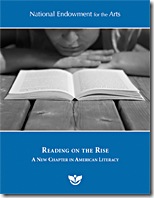
CoverReadingonRise This may be the first good news about reading that I have seen in years!

A new National Endowment for the Arts (NEA) study reveals that for the first time in 25 years American adults are reading more.  How about that!

The biggest increase is among young adults (18-24).  A full 21% over the last six years (2002-2008). The NEA is quick to credit reading programs such as their own "Big Read" initiative for this dramatic turn around.

I am somewhat skeptical about this conclusion.  Conspicuously absent is any reference to the publishing phenomena of J K Rowling or Stephanie Meyers.  I remember that Scholastic, the publisher of the Harry Potter series, reported a significant loss in earnings every quarter they did NOT have a new Harry Potter title.

My (admittedly limited) exposure to this particular age group tells me that they are reading J K Rowling and Stephanie Meyers and not a whole lot else.  I think the NEA is perhaps slightly more impressed with themselves than is truly warranted. 

The most curious increase to me is this:  15% for readers in the 75+ age demographic.  I would love an explanation here.  Large print books?  Seems unlikely.  Faulty polling in earlier polls?  Not that they would admit to!

One part of the report that is not necessarily highlighted is the statistics that correlate book reading and online reading.  Of course, I find these worth these worth taking a close look at:

  • 84% of adults who read literature (fiction, poetry, or drama) on or downloaded from the Internet also read books, whether print or online.
  • Nearly 15% of all U.S. adults read literature online in 2008.
  • For adults who read online articles, essays or blogs, the reading rate is 77%.

It seems that perhaps the Internet will not be the death of books.  Or at least not yet. 

Which brings me to my final observation about this report.  The NEA carefully defines a book as something between physical covers.  It does not account for eBooks or audio books.  In the case of audio books because (evidently) listening is not really reading.  In the case of eBooks because of their strictly defined poll format.  They are proud to let you know that the questionnaire has "remained fundamentally consistent for 26 years." 

A lot has changed in the last 26 years!  In 1982 the internet as we know it did not exist.  There were no Ipods, MP3 players, or cell phones.  I would like to see the NEA catch up with current technology and include eBooks and even audio books in their computations. 

Probably a small complaint in the scheme of things!  Because in the end, any increase in reading is a good thing!

Monday, January 12, 2009

eBooks on the Cell Phone/PDA (the 2009 version)

When I was younger I never went anywhere without a book.  Besides commuting there were two other basic reasons:

  • I was so enthralled with my book I could barely put it down
  • I never knew when I would get stuck somewhere and (Heaven forbid) I would have to just sit there. . . waiting

I am sure that some of my back problems as an adult come from years of lugging a heavy book in my shoulder bag.  But that is another story.

Life is different now!  Instead of a book, I carry my PDA with me (usually in a pocket). I am not exactly unique!  Walk down any city street, almost anywhere in the world, and you will see that almost everyone has a cell phone or PDA.  You see iPods, Blackberry''s, Pocket PCs, Palms and too many Smart Phones to name.

Closeup of young men and women holding cellphoneThe other thing you see is people peering at their screen; reading. 

You might think they were actually reading a book, until you notice their fingers flying over the keys as they answer the text, twitter or IM. 

Seems that for those under 30 there is much more peering than talking going on.

I am not a big texter or twitterer (no patience with those little buttons) and I rarely do IM, so it would seem logical that I would be reading more books.  Right?  Well, not exactly. I find that books have a lot of competition these days!

Now when I have to wait I have so many choices!  Most of them infinitely more interruptible activities than reading.  So, I usually opt for something easier:  do a sudoku, talk on the phone, answer email, surf the net, watch TV or (even occasionally) text. Reading has become something I do when I know I have a long stretch of time ahead of me -- like on a train or a plane.

I never carry a book around with me anymore.  And I find that reading on a handheld device has subtly changed my reading habits in other ways as well:

  • I read faster and with better comprehension when the text is in smaller chunks.
  • I actually look up words I don't know or want clarification on because I can do it easily and immediately.
  • I am reading the classics again.  They are almost always free (www.gutenberg.org)
  • I buy books I would not have ever bought before because they are relatively cheap

Which makes me wonder about you. 

Has reading on a digital device changed your reading habits?  And if so, how? 

Wednesday, January 7, 2009

eBooks and Screen Technologies

So a lot of power is wasted in displaying the images on our current cell phone screen. That makes building batteries that are compact enough and light enough but still powerful enough difficult. Now the technical whizzes who brought those tiny phones down to a size where you can lose them in a purse are fixing that problem. The eInk display and other power sipping device types are appearing in full color glory in prototypes today.

The article in the NY Times technology section today is only one source of this news. We are reading more and more about the power saving capabilities of various new technologies. This may actually be the year when some of these ideas turn into real phones. Reflecting light from outside sources selectively is the basis of some of these technical marvels. That makes the display brighter in sunlight than it is in a shady spot nearby.

The display design by Qualcomm based on MEMS technology is particularly interesting because it uses tiny mirrors that selectively reflect red, green or blue light. The amount of power used by this screen can be as low as one mw (milliwatt) versus over 200 mw in your current scriStock_000002038586XSmalleen. This type of screen is not backlit and thus will need a frontal light source if you are addicted to using it in the dark.

A higher energy use backlit screen but one that is still substantially lower than current technology uses LED lighting and tiny shutters to display images. This version of the future uses around 50 mw to supply a bright color display but is not as useable in daylight as the lower power choices. All of this technology is aimed at solving the recharge problem that plagues any serious cell phone user.

I’m still anxiously awaiting the new technology that allows me to read on a five by seven inch display for up to fifty hours without recharging my phone once. Of course it will still have to fit in my pocket so it should fold up or roll up when I am not using it. Ideally we ought to be able to build these displays so that they can generate power for recharging the whole device from ambient light like a calculator so we never have to plug the damn thing in at all.

Posing nearly impossible problems for engineers to solve is more fun than adapting to their latest and greatest idea in the form that it finally reaches the market. eInk is still slow and not available in full color. MEMS technology is still in the future. Flexible displays are still largely fantasy but reaching the realm of the possible quickly. I expect my ideal display will appear by the end of this decade if not sooner.

Electromechanical marvels like 300,000 tiny shutters on a small display do amaze me a bit. But then I think about all of those huge old monitors that are on the scrap heap today. We are living in a totally flat panel world now, and that happened in less than ten years. The pace is constantly accelerating and new technologies are competing for our interest daily. EBook dedicated readers will not survive long in this world.

That they appeared at all is a statement about how inefficient markets can be when they move this fast. Of course the truth is the gadget happy among us are driving this rate of change faster and faster. At what point can this all slow down enough to make it possible for me to learn how to use all of the features in my new phone before it is obsolete? Maybe that is just not important after all but it would be nice wouldn’t it?

Wednesday, December 31, 2008

GoodBye 2008!

I can't say I am sorry to be making the last post for 2008.  It has been an amazing year with terrific highs and lows. 

So, what is in store for 2009?  I checked my crystal ball and evidently it is broken since everything is cloudy.  Oh come on, it's a joke. . .

There are, however a couple of things that seem intuitively obvious to me: 

  • Digital books will become increasingly popular and the percentage of books sold this way will double (from 1% to at least 3%)
  • By January, 2010 the iPhone will up a more popular reading device than the Kindle

As additional "proof" for my predictions you only need to look at an article in the Huffington PostIt shows that five of the six most popular Christmas morning Google searches were iPhone, iTunes, and iPod Touch-driven. All six are:

  1. iTunes.com
  2. iTunes download
  3. iTunes store
  4. stores open on Christmas day
  5. www.itunes.com downloads
  6. iTunes gift card"

Add to that that TechCrunch is reporting rumors about a 7 inch - 9 inch iPod screen due out next fall. 

I want one of these!

So, Goodbye 2008 (and pretty much good riddance!) and Hello 2009!

Monday, December 15, 2008

The Book as a Form of Presentation Art

I have received a batch of emails related to the paper book as an artifact of past glory in paper publishing over the holiday weekend. One of the rather more prominent members of the group contributing to the thread involved called books in paper form a fetish. I was, in fact, quite amused by much of the content of that thread. The future is seldom what we expect it to be.

2007 tower Paper publishing is obviously being altered and even threatened by digital publishing. Of course every form of information will be altered or replaced by newer, more complex digital forms over time. The key qualifier here is, “Over time,”; and the key question in the thread is how long will this replacement process take in the case of the written word presented in book form?

The continued use of paper is clearly more expensive in many cases than the simple act of moving a digital file from one place to another. It is also clear that many more forms of digital information can be included in publications that enjoy the flexibility of digital publishing over paper. Still and all old habits die hard. I still have several newspapers delivered to my driveway even as I use the Internet to read several more each day.

How fast will all of the replacement of paper take place and how soon will I be forced to do without my many pages of birdcage liners that grace my weekly recycling contribution? I am reading about the future as I have done most of my adult life. In the future virtual reality will eventually take over the process of transferring complete information about any life experience.

Technology in terms of the presentation of information is clearly expanding our options. I wonder if any of the people contributing to that thread really understand exponential growth in technology and what it means to all of us. The capacity of single computers will exceed the capacity of the human brain somewhere in the next two decades if Ray Kurzweil is to be believed.

From that point to the point in time where exponential growth in data transfer technology and computing capacity lead to human minds with millions of times the capacity for data transfer and data manipulation of the current human mind is short indeed. I suspect that most of the people contributing to that thread can no more comprehend a world where living thousands of virtual lives in one short period of time will be a common experience than can I.

The time devoted to reading one book might instead be devoted to experiencing the lives of all of the characters in a lifeline presentation series in that world. Of course this idea presupposes that someone could be bothered to produce such a presentation in a world where the computers are the majority of the conscious minds around.

Exponential growth in computing power and data transfer capabilities dictates that such a world will be upon us before the next generation grapples with its somewhat diminished mortality. If, as Ray suspects, we are mere decades from downloading human consciousness into those immensely expanded computers mortality itself will be drastically altered if not eliminated.

So I find myself amused by the parochial nature of the discussion in that thread. It is not only the art of the book or the written word that is under duress here. It is more appropriate to consider what will happen to the art of experiencing life itself and how that will be transferred in such a world as will exist before this century is half over.

We do live in interesting times don’t we?

Monday, December 8, 2008

Books, eBooks and the Reading Public

Ever wonder who buys books and why? 

Well, if you have, there is a nifty service out there that tracks that kind of info.  The service, PubTrack, does online surveys of the book buying public.  And the results for 2007 were reported last week by Publishers Weekly.

stats Much to Henri's amusement, I am a person who is fascinated with statistics like these.  And yes, I know about "Lies, Damn Lies and Statistics."  I guess it is the accountant buried in my soul that loves to quantify things.

I love the fact that fourteen billion dollars was spent on books!  It is interesting that only 3.2 billion (23%) was spent online. And I (for one) am less than thrilled to find out that only 3% of book purchases were non print (eBook and Audio Book) versions. 

PubTrack breaks the reading public into five groups:  Teens (13-17), Gen Y (18-28), Gen X (29-40), Boomers (41-59) and Matures (60 and up).  The statistics are then broken up to reflect buying habits and attitudes.  Each group has some noteworthy feature:

  • Only 9% of Teens actually buy books and when they do they primarily read fiction.
  • Gen Y consumers buy only 14% of the books sold but they buy about 1/3 of all those books online and are the biggest group (4%) of non print book buyers.
  • Gen X is interesting in the fact that there is nothing unusual or particularly interesting about them and that they closely mimic the statistics of the matures.
  • Boomers are the largest segment of the population (33%) and spend the most money on books. 
  • Matures read the most fiction of any group -- 56% and purchase very little online. 

Mildly interesting stuff. But as I looked over the stats I begin to wonder about trends, since these age groups are a moving target.  So just for fun I took a look at what happened when you combined the stats for Teens and Gen Y or what happens when you combine Boomers and Matures.  Probably only interesting to me. . .

Except that the trends when you combine Teens and Gen Y are probably a  peak into the future.  Like everyone in publishing, I have a great curiosity about what is going to happen.

When you reduce all the statistics to some simple percentages the picture becomes pretty clear. 


Teens

+GenY

GenX

Boomers

Mature

Population

25%

21%

33%

21%

# of books buyers

29%

24%

23%

24%

# of books purchased

18%

22%

32%

28%

$$ spent

24%

24%

30%

22%

% purchased online

49%

26%

22%

14%

% non-print

6%

3%

3%

2%

 
I'll save your eyes and point out the really clear points about the combination of Teens and Gen Y:
  • They purchase only 18% of books
  • 49% of those books are purchased online
  • 6% of books bought are non-print version
Obviously, the future of printed books and they way they are bought is changing and will continue to change as the matures die out and are replaced with teens.  This is a pretty grim picture if you are a traditional publisher or one of the big three book retailers.  But if you are Jeff Bezos or an Amazon shareholder you probably feel pretty good about yourself.
 
Just one more piece in the growing evidence that publishers are going to have to change or perish.

Thursday, December 4, 2008

The Roiling Role of Publishers

 Here is Henri's take on James Glieck's New York Times Article How to Publish without PerishingEnjoy! 

I’m confident that James Glieck is sufficiently abused by now that he won’t mind serving as an object lesson. If you haven’t heard he consigned the world publishing industry to the Limbo of artisans in a marketplace where books in print are only bought because of their beauty. By doing so he entered the publisher free zone, called the blogosphere by some, without a helmet.

Of course his article was published in the NY Times so he at least had the services of an editor, thousands of coworkers and, oh yes, a publisher to get his article out to the public. The real discussion on the Internet related to this was whether to bury him in purple prose or a nice puce necktie made of paper.

A lot of amusing stuff got said at his expense but none of it will really matter. We are going to be so far beyond the printed word before long that a generation from now children will be asking, “What is a keyboard, daddy?” Being a good dad he will have to rummage around in his virtual garage to find one to show them.

The invention of writing was a real hallmark in the development of human society. It allowed ideas to stick around long enough to be dissed by the next generation as, “Old hat,” remember that phrase? Of course the next few generations are going to be developing total immersion virtual reality and that will probably put paid to the written word once and for all.

The extension of the human memory made possible by writing is now meeting the challenge of the extension of the human environment made possible by the computer. I’ve been reading a lot lately about how much impact computers will have on the human mind itself within a couple of decades.

It seems likely that within the next two generations computers will be directly connected to the human brain. In that world there will be no need for sitting at a keyboard, you will be able to write and edit text faster than the speed of thought. Computer time is significantly faster than the human finger or even the human mind.

As computers get more and more powerful eventually they will exceed the capacity of any single human mind. Some of the prophets out there are clearly of the faith that computers will pass up humans in thinking capacity by 2030 and never look back.

As for me,I will be so old that a virtual life may be the best option unless the optimistic among us are right and we will be able to rebuild our bodies by then. Of course I really doubt that I would ever voluntarily undergo the blessings of the kind of hormonal vitality that goes with excessive youth again for any reason.

I’ll probably wind up living my virtual life sitting in my perfectly comfortable virtual chair in front of my virtual fireplace petting my virtual cat and reading my copy of the one millionth virtual tome in my favorite series by the greatest virtual author of all time, myself. No publisher needed, thank you very much.

Monday, December 1, 2008

Is the Digital Era creating New Life for P-Books?

After a very long weekend of too much food, too many relatives and too little sleep, I woke up yesterday, poured a cup of coffee and started reading the New York Times.  The first article to catch my attention was How to Publish Without Perishing.

nytlogo153x23 In this piece James Gleick opines that there is a bright future for printed, bound books:

I think, on the contrary, we’ve reached a shining moment for this ancient technology. Publishers may or may not figure out how to make money again (it was never a good way to get rich), but their product has a chance for new life: as a physical object, and as an idea, and as a set of literary forms. . . .

Go back to an old-fashioned idea: that a book, printed in ink on durable paper, acid-free for longevity, is a thing of beauty. Make it as well as you can. People want to cherish it.

Really?!

While I find this an interesting view, I wonder if Mr. Gleick has been out and about in the real world lately.  Has he been to his local bookstore?  Does he have any contact at all with "the younger generation"?

Later in the day I found myself inside the local Barnes and Noble.  In our town, they have the best selection of CDs and it is Christmas time. 

The store was moderately busy.  A few people in the coffee shop, a few people sitting in the oversize chairs (mostly they looked like they were waiting for someone), a bustling staff and a handful of customers. 

barnes chars I took a seat and did some intense people watching over the next half hour.  Anything was better than facing the chaos in my house!

I found the demographics very telling.  I saw children (approximately 5-13) accompanied by parents; I saw middle aged women, and I saw old men and women.  Aside from the staff, I did not see one person between the age of about 13 and 30.  None!

I was willing to chalk it up to a very unscientific survey and leave it at that.  I decided I better quite procrastinating.  So I started gathering my stuff and getting ready to go clean up my house.  And then I saw her.  A real life teenage girl.  She just appeared before my eyes. I was so intrigued by the sight I just stared.

She looked around for a moment, and then she threw herself into a chair with a big sigh.  She routed around in her jean's pocket and pulled out a cell phone.  Within seconds she was texting away.  Totally ignoring all the beautifully bound books along with everyone in the store.

I for one, am unwilling to bet that she will someday wake up and find a book a thing of beauty; something to cherish.  I doubt that she will see a book as an idea or a set of literary forms.

She may see it as furniture (a great way to warm up a room and give it a little class).  Kind of like the antique rolltop desk I inherited from my grandmother.  Beautiful but with very limited usability.   

Monday, November 24, 2008

eReading and Paper Addiction

In the interest of full disclosure let me say that the Reynard household still has a few periodicals that arrive in the mail or on the front porch,  Breaking the paper addiction is hard to do! 

But we are working at it.  We have adopted a slow and steady approach as opposed to the "Cold Turkey" method. cold_turkey

Oh, come on, I had to get a turkey reference in here somewhere.  After all, Thanksgiving only comes once a year.

The first paper publication to go was the New York Times -- both Henri and I are early risers and were constantly irritated by having to wait for the paper delivery.  And then of course, there is the question about why we were wasting all that paper everyday.

In the last year we have slowly converted our subscriptions (as they come up for renewal) from paper to the online editions.  First it was The New Yorker and Publishers Weekly.  And in the last three months we have changed from paper to online editions for The Wall Street Journal, Science Magazine and The Economist.

We still get the local paper, Foreign Affairs,Time Magazine and a few others but I can see the end in sight.

imageEvidently we are part of a trend.  Last Week PC Magazine announced that is going 100% digital.  They carefully explained the benefits of this decision. 

This is a terrific explanation of why online publications are so great.  In fact I couldn't say it any better, so I have copied them.  Here they are:

  • It arrives in your e-mail automatically. Just click the link to either download the latest edition, or to view it entirely online.
  • It is portable. Once you've downloaded the issue (which takes a matter of seconds), just power up your PC and view it anywhere, on an airplane, in your hotel room, wherever.
  • It's lively and interactive. Our digital edition will eventually offer rich media options within a magazine format. So, for example, next to the product review you're reading in First Looks, you can easily view a slideshow of that product. Or while you're reading a Solutions article on Microsoft Outlook tips, our PC Labs experts can walk you through the steps of some of those tips in a video.
  •  It's searchable. Here's something PC Magazine print cannot do. Enter a search term and PC Magazine Digital will fill all the related pages.
  • A live TOC: The table of contents is not only a place to find out what's in this month's issue. You can use it to navigate directly to the stories you want to read.
  • It's Green: You can actually feel good about the amount of paper, ink, and gas we'll all be saving by not producing and consuming a physical magazine.

Maybe the comment about being Green is a little over the top.  My perspective is a little more down to earth -- no magazines means less clutter around my house.  But that is a minor point.  All in all, it is a great list. 

But then there is the great disconnect. I stared at these "benefits" in total disbelief!

  • It looks like the PC Magazine you're familiar and comfortable with. I know why you've stuck with us all these years. You like the magazine and you enjoy the format. Our digital platform makes it possible to deliver that same magazine experience on your PC. So you can "turn" the pages and view our features and departments as you do now.
  • Yes, you can print it. You can print as many pages of the magazine as you want.

What?

It looks like a magazine?  How is that a benefit?  Given all the listed advantages of digital they still want to recreate the paper experience. This makes NO sense to me! 

But the last one really knocked me back in my chair.  I can print it?!?  Hmmm, I suppose they figure better my money on paper and ink than theirs.  But still . . .

I guess I should go easier on us; obviously, breaking the paper addiction is harder than I thought!

,

Monday, November 17, 2008

Digital Reading and the Human Brain

There are times when I think that technology and living in the 21st century is just too cool for words.  Last week, I had once of those times. 

UCLA just completed a study about Internet usage and the human brain.  Specifically it was a study designed to see "if regular Internet usage was more effective than other intellectually stimulating tasks in keep the brain limber in aging test subjects."

Because they are a medical educational FMRIinstitution they have access  to the most amazing technology around --  fMRI (Functional Magnetic Imaging Resonance).  I won't pretend to understand why this is so cool.  All I know is that it gives researchers and amazing window into the human brain.  The fMRI actually lets us see activity in the human brain.   Very pretty pictures!

In terms I understand, this study tracked brain activity while adults did various online tasks including reading and "googling."  They wanted to find out if regular internet usage effectively keeps an aging brain more limber, more able to flex and and bend freely.

Evidently digital reading does keep the brain limber for those who do it often.  Interestingly, internet neophytes (people without previous Internet experience) showed little change on brain activity when reading vs when using the internet.

But real changes were seen in those who habitually use the Internet. Those subjects were evidently exercising their brains in a big way.  They showed a significant increase in activity in the frontal, temporal and cingulated areas of the brain.  These are the areas associated with complex reasoning.

The digital readers weren't just passively taking in information, they were actively engaged.  Online activity evidently engages multiple parts of the brain.

This is significant for the aging, but it has real, everyday value growing children and adults.  Consider this study as a piece of evidence that using the internet keeps us learning new things which in turn help us build new skill sets.This intellectual exercise keeps our brains flexible and able to adapt to our increasingly complex world. 

limberI have watched my world get larger and more complex with every passing year.  The flood of information can be almost overwhelming.  I used to read one or two newspapers each day and a half dozen trade journals in a month.  Now I read three or four newspapers a day, have several RSS feeds bringing me hourly news and information and read hundreds of blog pieces a week plus I have access to literally hundreds of journals.  Sometimes I wonder if my brain is up to the challenge.  AND I wonder what all this means for my children and their children.  It is conceivable that we will all just implode from too much info.

Evidently this is a rather foolish notion on my part.  Seems that the human brain is infinitely adaptable and the more we use it the more it expands.  I don't know about you, but I find this an enormously reassuring world view.  

Tuesday, November 11, 2008

Google and the Very Long Tail

Henri is never short on opinions!  Now, the Google settlement has given him a lot to think about.  Here's his take:  if you agree or disagree be sure to let him know.  He loves a good discussion!

Of all of the services that Google has done for mankind in the name of profit and good business practices this one may be the most important yet. I am talking about the recent settlement of its lawsuit related to putting a lot of copyrighted material online without first seeking rights from each individual owner. Google and everyone with any interest in the past won and the forces of darkness lost big.

Oh yes it cost Google an eighth of a billion dollars and some big lawyer’s fees. The project itself is also expensive and will take a long time. On the other hand the library at Alexandria is never going to burn again. The massive literary and knowledge base built in our past on paper will be safer from war and fire and the ravages of time than ever before in history. Even more important it will be accessible to innumerable scholars in the future.

The unprecedented access offered by this settlement is worth anything Google and all of the rest of us could pay for it. I have a serious love affair with the written word and a vast (And possibly useless) eclectic knowledge base derived from struggling with great libraries and depositories. They yield up their secrets reluctantly. I am definitely a biased observer.

That said, how else could anyone have penetrated the maze of laws and rights that buried so much merit in dusty treasure troves with no hope of release until Google came along? The laws governing use of once published and still copyrighted material made little sense in the digital age. Unless they allow for a much broader access path they are merely inhibitory, not protective in any meaningful sense of the word.

So Google ignored them and invited lawsuits as the most efficient way to sort out that mares nest of laws, regulations and garbage. It is a messy mélange of rules that we have assembled around protecting Disney and other huge companies against unreasonable use of their long lived intellectual property assets.

Google did not want those assets; they wanted the poor huddled masses of books and papers languishing in vast dusty depositories. And now they have them and are moving to free them for the fun and profit of all of us including of course Google. It is a story worthy of greater pens than mine and it will continue to be written for a very long time.

Money was not the only point of this action but it will flow back into Google’s coffers in plentitude over time. Those of us who could only dream of this day until now are living a dream of vast access brought on by smart young businessmen and women. clapping

If I could tell any young entrepreneur how to succeed here would be  the three things I would recommend. Have fun, do something good for people and the world they live in and make money doing it. Google is a good example of that ideal and this project shows what can be accomplished with the right people and the right level of access to capital. Bravo Fortissimo, Encore!!!!!!

Monday, October 27, 2008

eBooks, Amazon and Oprah

It's been quite a week for Amazon. On Thursday they announced a revised projection for 4th quarter sales: somewhere between $6 and $7 billion. I don't care who you are; that is a LOT of money!

oprah kindleBefore you start feeling sorry for them; consider that on Friday Oprah endorsed the Kindle. Called it a "life changing" product, no less! She says it changed her life and even says "It's absolutely my new favorite favorite thing in the world."

Oprah is, of course, a marketing machine and this endorsement is sure to help Amazon's bottom line. And you can be sure that publishers are hoping it helps them as well.

The thing that really strikes me is that when it comes to eBooks, Amazon has fixed it so that they realize revenue off of almost every eBook sold for portable devices. Take a look at the chart listing the various popular reading devices and the reading software that they use to read DRM protected eBooks.

Adobe eReader MobiMS ReaderPropr- ietary Palm
BeBook

X

Cybook

X

iPhone

X

Illiad

X

Kindle

X

Nokia Phones

X

Palm

X

X

PocketPC

X

X

SonyPRC

X

X

Almost all of them use Mobipocket as the reader of choice. And just guess who owns Mobipocket. Amazon, or course. So, as long as publishers insist on using DRM on their titles, Amazon wins big!

It might be inaccurate to say that Jeff Bezos has bet the farm on digital reading, but however you look at it, he has certainly hedged his bets!

This is very good for Jeff and Amazon, I am not so sure that it that good for authors, publishers or even readers. Amazon is in the extraordinary position of control both access to the market (authors and publishers) and product placement in the market (readers). It always makes me nervous when any company has that much control (or even influence) in a particular market.

Google
 

Subscribe Now: Feed Icon