Showing posts with label ebook hardware. Show all posts

Thursday, July 16, 2009

Solar Powered eBooks?

Ubergizmo is reporting that Neoluxiim is talking about integrating a solar cell into their newest eInk products.

They are promoting it as an advertising device; not an eBook device. It is inevitable, however, that eBooks will eventually be run on solar power.

This particular offering has a got-cha built in. Seems that the device dies after 18 months. Now there is a great example obsolescence if I ever saw one.

Solar is green -- very nice. The eighteen month life cycle more than wipes out any benefit when you think about the electronic waste involved. What are they thinking????????

Wednesday, July 8, 2009

New Bookeen Reader Soon -- The Opus

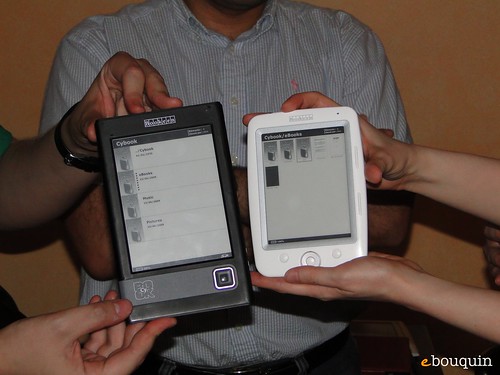
Bookeen, the maker of the Cybook, are showing off thier new reader called the Opus. Shown below is a picture that compares the current Cybook with the New Opus. Was originally supposed to be available in June . . .

MobileRead lists the new specs below:

  • 5" high definition e-ink screen (200dpi, 600x800 pixels)
  • Ultra light-weight : 150 grammes.
  • 1go internal memory (twice the capacity of the Cybook Gen3)
  • Truly pocket-sized !
  • Excellent ergonomy with convenient well-placed page-turning buttons on the side of the screen for one-handed use.
  • An accelerometer allows you to use it in either hand.
  • ePUB and PDF support (with or without DRM) via the Adobe Reader Mobile SDK. 12 different type sizes
  • Folder support !
  • User replaceable battery.
  • Memory card expansion slot (Micro SD).

Here are a lot more pictures (and more info if you read french)

Looks like an interesting alternative. Stay tuned for actual release date and pricing.

Monday, January 26, 2009

eBook and eReader update

Last September. Waterstone's, the British bookseller, began selling the Sony eReader. Last week they released sales information.

The chain claims to have sold almost 30,000 readers and their downloads have passed the 75,000 mark. Which works out to about 2 1/2 books per reader. Very interesting. . .

Particularly interesting since Amazon refuses to give out any sales numbers on the Kindle other than Jeff Bezos' statement that "sales are great." And an estimate that 12% of book sales are for the Kindle editions.

The one sure thing is that eBook sales are on the upswing, whatever anyone says about individual eReader sales. The IDPF (International Digital Publishing Foundation) reports that between January and November, 2008 sales were up 63.8%. The disclaimer on this is that the IDPF number reflects only the sales for 13 of the many trade book publishers.

Alternatively, Ingram's Education Solutions unit reported that eBook sales from January to May, 2008 surpassed the 2007 figures by 400 percent!

Both of these stats sound really great until you realize that eBooks sales are about .5% of all book sales. And when you consider the number of smart phones (including the iPhone) in use .5% is shockingly low.

My original supposition was that much of the reading on these devices are downloads from project Gutenberg on other free eBook sites. But if Juniper Research is correct, my supposition is dead wrong.

The Juniper analyst predicts that the worldwide mobile adult market will hit $4.9 Billion within the next five years. Hmmm. I suppose that is good news for Larry Flynt, but not so good for Amazon and the major publishers.

No matter what you choice of reading material is I want to remind you that Read an eBook Week starts March 8th. We will have more info about how you can help promote this week and make it a success.

Short post today -- have to spend the week getting all my tax info to the accountant. I do hate this time of the year!

Monday, January 12, 2009

eBooks on the Cell Phone/PDA (the 2009 version)

When I was younger I never went anywhere without a book.  Besides commuting there were two other basic reasons:

  • I was so enthralled with my book I could barely put it down
  • I never knew when I would get stuck somewhere and (Heaven forbid) I would have to just sit there. . . waiting

I am sure that some of my back problems as an adult come from years of lugging a heavy book in my shoulder bag.  But that is another story.

Life is different now!  Instead of a book, I carry my PDA with me (usually in a pocket). I am not exactly unique!  Walk down any city street, almost anywhere in the world, and you will see that almost everyone has a cell phone or PDA.  You see iPods, Blackberry''s, Pocket PCs, Palms and too many Smart Phones to name.

Closeup of young men and women holding cellphoneThe other thing you see is people peering at their screen; reading. 

You might think they were actually reading a book, until you notice their fingers flying over the keys as they answer the text, twitter or IM. 

Seems that for those under 30 there is much more peering than talking going on.

I am not a big texter or twitterer (no patience with those little buttons) and I rarely do IM, so it would seem logical that I would be reading more books.  Right?  Well, not exactly. I find that books have a lot of competition these days!

Now when I have to wait I have so many choices!  Most of them infinitely more interruptible activities than reading.  So, I usually opt for something easier:  do a sudoku, talk on the phone, answer email, surf the net, watch TV or (even occasionally) text. Reading has become something I do when I know I have a long stretch of time ahead of me -- like on a train or a plane.

I never carry a book around with me anymore.  And I find that reading on a handheld device has subtly changed my reading habits in other ways as well:

  • I read faster and with better comprehension when the text is in smaller chunks.
  • I actually look up words I don't know or want clarification on because I can do it easily and immediately.
  • I am reading the classics again.  They are almost always free (www.gutenberg.org)
  • I buy books I would not have ever bought before because they are relatively cheap

Which makes me wonder about you. 

Has reading on a digital device changed your reading habits?  And if so, how? 

Wednesday, December 31, 2008

GoodBye 2008!

I can't say I am sorry to be making the last post for 2008.  It has been an amazing year with terrific highs and lows. 

So, what is in store for 2009?  I checked my crystal ball and evidently it is broken since everything is cloudy.  Oh come on, it's a joke. . .

There are, however a couple of things that seem intuitively obvious to me: 

  • Digital books will become increasingly popular and the percentage of books sold this way will double (from 1% to at least 3%)
  • By January, 2010 the iPhone will up a more popular reading device than the Kindle

As additional "proof" for my predictions you only need to look at an article in the Huffington PostIt shows that five of the six most popular Christmas morning Google searches were iPhone, iTunes, and iPod Touch-driven. All six are:

  1. iTunes.com
  2. iTunes download
  3. iTunes store
  4. stores open on Christmas day
  5. www.itunes.com downloads
  6. iTunes gift card"

Add to that that TechCrunch is reporting rumors about a 7 inch - 9 inch iPod screen due out next fall. 

I want one of these!

So, Goodbye 2008 (and pretty much good riddance!) and Hello 2009!

Monday, December 29, 2008

eReaders -- Have you considered a "Netbook?"

image


Last week Stacey Higginbotham wrote an interesting blog piece on notebook computing and what that might mean for the electronics industry.

She notes that notebook PC sales have overtaken the sales of desktop type machines.  This is the direct result of WiFi and the almost ubiquitous access to the Internet.

This is of interest to me, because Henri needs a new eBook reader.  It's time. . .

I figured that it would be a great Christmas present, so I started looking very closely at all the eReaders -- Kindle (never), Sony, Cybooks, Irex, BeBook and a few others. 

From my perspective the best available option is the Irex.  It has a touch screen, is able to connect by WiFi to the Internet and allows you to make notes and annotations.  It reads protected Mobipocket files and unprotected PDF.  All in all, contrary to my first opinion, it has turned out to be a great machine.  Or at least it is until you check out the price -- $700!!!

Well, let me think!  Here is a pretty much single use device that costs more than a fully powered, big screen laptop.  Too rich for my blood!

But the laptop thought triggered an idea.

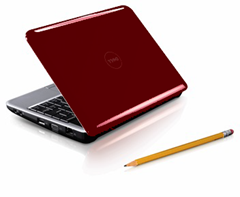
I have been hearing about netbooks so decided to check them out.  Acer makes one called the Aspire One.  It sells at Costco for $349.00.  This is a fully functional Windows XP notebook with 1 GB of RAM, a160GB hard drive that is net ready and weighs about 2 pounds.  And it has a great screen with brilliant colors.

Heck, with that capacity, it is a lot more robust than a couple of the laptops we have laying around. 

Because it has the XP operating system it can read protected Mobipocket, PDF and Microsoft reader eBooks.  Because it is net ready you really don't need to buy an software.  All you need to do is access email and Google Docs are you are ready to go.

Of course, if you want to work offline, you can always load Star Office (for free) and have a fully functioning road machine. 

Sony and Cybook readers are in the same price range and do a whole let less. 

Rumor has it that Dell and a couple of other companies are getting ready to introduce lighter, faster, cheaper models next year.

I would love to finish this piece by telling you that I bought Henri a net book and we are both very happy. But that is not what really happened.  What really happened is that I put off the decision and the purchase for a couple of months.

And Henri, lucky man, got a new shirt. . . .


Monday, October 27, 2008

eBooks, Amazon and Oprah

It's been quite a week for Amazon. On Thursday they announced a revised projection for 4th quarter sales: somewhere between $6 and $7 billion. I don't care who you are; that is a LOT of money!

oprah kindleBefore you start feeling sorry for them; consider that on Friday Oprah endorsed the Kindle. Called it a "life changing" product, no less! She says it changed her life and even says "It's absolutely my new favorite favorite thing in the world."

Oprah is, of course, a marketing machine and this endorsement is sure to help Amazon's bottom line. And you can be sure that publishers are hoping it helps them as well.

The thing that really strikes me is that when it comes to eBooks, Amazon has fixed it so that they realize revenue off of almost every eBook sold for portable devices. Take a look at the chart listing the various popular reading devices and the reading software that they use to read DRM protected eBooks.

Adobe eReader MobiMS ReaderPropr- ietary Palm
BeBook

X

Cybook

X

iPhone

X

Illiad

X

Kindle

X

Nokia Phones

X

Palm

X

X

PocketPC

X

X

SonyPRC

X

X

Almost all of them use Mobipocket as the reader of choice. And just guess who owns Mobipocket. Amazon, or course. So, as long as publishers insist on using DRM on their titles, Amazon wins big!

It might be inaccurate to say that Jeff Bezos has bet the farm on digital reading, but however you look at it, he has certainly hedged his bets!

This is very good for Jeff and Amazon, I am not so sure that it that good for authors, publishers or even readers. Amazon is in the extraordinary position of control both access to the market (authors and publishers) and product placement in the market (readers). It always makes me nervous when any company has that much control (or even influence) in a particular market.

Monday, October 20, 2008

The Shrinking Library and eBooks

home library 1We have a lot of books! Since we are contemplating a move after many years in our home the issue of what to do with our books has arisen once again. I am seriously and surprisingly moved by my attachment to these things that seldom leave the shelves after we read their final pages.

Admittedly once in a while I have to use some of the more factual books to look up something I vaguely remember that I once knew. Rarely do I disturb these denizens of our library room otherwise. I can trace my progression of interests by simply looking at the titles on a few shelves. The book collection is as eclectic as our lives have been; a montage of experiences with a range and breadth that we both cherish.

The current debate is whether or not to sell this house and simply move on in our lives. It makes little economic sense to hold onto either the books or the house.  On the other hand a lot of memories live in both.

If we sell the house the books will go. We have both agreed that getting rid of the books is the best solution to the problem of owning a ton or two of printed matter that really don’t matter anymore. Our lives have moved on to digital books and that library is a little lighter and easier to carry.

Books have been such a huge piece of both our lives that just contemplating dismantling our library slows us down. It is a room with all of the walls lined with Red Oak shelves around every wall from floor to ceiling. Of course there are books in every room in our house but this room was given over to its main function years ago.

The idea that it is possible to carry a whole collection of books, (a 2007 tower collection bigger than the one in this room,) around on a key chain hasn’t really sunk in to Henri's consciousness.  The idea that I can access more information than exists in the Library of Congress by just hooking up to the Internet still boggles the mind.

We are not hoarders -- have never found acquiring things to be particularly satisfying. Tools for Henri, shoes for Gigi and books are the only weak points in our armor against consumerism.

The tools and the shoes are already leaving for our daughters homes. Their husbands will find use for them, or not. The girls will wear the shoes.   But the books, our precious books, are hard to part with and even harder to leave behind.

I guess what it comes down to is the the emotionally wrenching choice that getting older brings to everyone. How do you give up your past one piece at a time?

We need a microchip for our memories. I am told that too will come eventually. See that book over there written by Ray Kurzweil. It talks about that very thing. Meanwhile we are agonizing over the options for the only room we both have ever truly loved and may just simply dismantle soon.

It is not nearly as pleasant as I would like it to be, but then change is sometimes the only option even if it is not at all comforting.

Monday, October 6, 2008

The Sony PRS 700 and the eBook Reader Market

sony_prs-700_readerLast week Sony proudly announced the 3rd generation PRS series eBook Reader.  It has some nice features; particularly the reading light and the fact that it has a touch screen.

And yet I can't help thinking that something is broken in the marketplace! This new Sony readers and the rumored Kindle device prove to me that the Reader design world is stuck in neutral.

There is little happening in the narrowly focused electronic reading world that makes sense to me. It is now nearly twenty years after we tried putting books on a CD ROM disc to stimulate reading opportunities. Over time the Internet and cheap hard drive space have removed the CD disc from the equation.

Today, the digital publishing is still very much alive and growing rapidly (if not broadly). The best reader that money can buy is still very expensive ($800) and excruciatingly dumb.

The consumer is quite happy with a multifunction device that has about three inches of screen space.  After all you can read books, handle email, surf the net and listen to music all with one device.  And that doesn't even take into consideration the convenience of being able to make and receive phone calls!

Reading devices are still being designed by people who know some technology.  What they don't seem to know much about is the consumer generally or publishing specifically.  And therein lies the rub.

So where is publishing headed? Debates about that vary from the sublime to the ridiculous as do most debates. The one thing everyone seems to agree on is that the Internet or its children will provide the delivery vehicle.

Cell phones with substantial screens or projection capabilities are going to hit the market soon. With their programmability based on open operating systems they almost certainly will become the device of choice for both computing and reading. They will also probably take over the world of TV show presentation to major audiences everywhere.

So what is possibly wrong in that world? The idiots that keep designing readers persist in building devices that will not compete. They are holding back the market that they need to develop before it is too late for them. Goodbye Sony reader: Goodbye Kindle: Hello open systems and the new old revolution.

All that cell phones really still need to own this market should appear in the next generation phones. I am hoping that happens because the brain dead place holders made by Amazon, Sony and Phillips make no sense. Or maybe they make as much sense in this market as one hundred thousand dollar CD recorders would make in today’s data transfer marketplace. Yes folks,  twenty years ago a CD Recorder cost a hundred g’s.

Cell phones are following that cost and value curve and dedicated reading devices are not.  Wether they recognize it or not -- this game is already over.  The spindle, ah the bindle, no the, don’t help me, I’ll get it. . . oh yeah, THE KINDLE,  that’s it, is dead. It was slaughtered by a real market before it mattered to anyone anywhere except a few engineers and those of us early adopters who bought their bad designs.

Tuesday, September 9, 2008

The New York Times Reports A New E-Newspaper Reader Echoes Look of the Paper

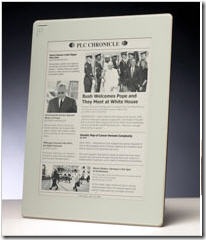
Yesterday eink newspaperPlastic Logic Corporation unveiled it's latest (and as yet unnamed) device:  a big light-weight plastic screen version of an eNewspaper.  Its light, portable and constantly updated.  The device should be on the market early next year.

The screen is close to 81/2 x 11 inches and is continually updated by a wireless link (where wireless is available).  Hundreds of pages can be stored to read at leisure for those who do not want to keep up to the minute.

The device is easy to read since it uses eInk technology.  The is the same technology that is used for Bookeen's Cybook, the Sony PRC reader, Irex Illad and other eBook readers. 

It will be fascinating to see which news organizations will be the first to implement.  Hearst already distributes versions of it's paper on the Kindle.  I have been wondering about that -- as a daily reader of the New York Times and Washington Post online, it would take a lot to convince me to buy an expensive device to view what I can now see for free.  But evidently Kindle and Hearst believe there is a market out there and are pushing ahead.

The more I think about it the more I am able to relegate it to an Interesting idea and fun technology.  But the real question for me is much more urgent:  Do any of us need one more device? 

I am the proud owner of a Cybook, an Irex Illiad, an eBookwise reader, a Palm, a Nokia based cell phone, a Blackberry, an ultra-mobile pc and 2 laptops.  Do I really need one more thing to carry around?  It has gotten to the point that when I travel I practically need a separate suitcase just to carry my cords, cradles and cables. 

None of the above mentioned devices is close to ideal for eBook reading let alone eNewspaper.  The eInk devices are nice but don't accommodate color and are not backlit.  The Blackberry, cellphone and Palm work fine, but the screen is way small.  The UMPC is heavy and overkill as are the laptops. 

I find that the device I read from most often in my Palm.  It is backlit, has beautiful color with a great touch screen, connects to the Internet from almost anywhere and has multiple useful programs and functions besides. I can even hook up to skype and use it as a phone.  My only complaint is the size of the screen -- very small. 

Makes me think that it is easy to get gadget blind and lose track of the real objective -- information!


Monday, September 1, 2008

As I Live and Breathe the Cell Phone is Taking over the Center

Henri has been doing some thinking about kids, cell phones, open systems and the PC.  Here are his reflections. . .

cellphone Nothing has given me greater pleasure in life than the birth of my children. My youngest daughter turned thirty two this month. The next events in line have all had to do with the birth of revolutionary ideas in the world that I have lived in for sixty five years so far.

Let’s see, there was the birth of computing as a business support system. Then there was the ongoing revolution in electronics. The development of the human genome from the first days of the shape and form of DNA to the publication of the first actual readout of the genome itself was as fundamental a breakthrough in human knowledge.

Along the way there have been many gratifying moments and more than a few terrifying discoveries. The Ozone hole, global Warming and other threats to the ecosystems that sustain us all are among the scariest. Of course even the greatest gains in knowledge can be perverted by misuse or abuse. The idea that scientists are responsible for their creations is still gaining traction. Codes of ethics and other means of controlling misuse of great ideas are still in their infancy.

Meanwhile the Personal Computing revolution has given birth to the Internet and the Cell phone revolution has been playing around with the power that network offers. Now we are about to watch the birth of a new stage in that set of gains in human communication.

The PC King is dying and a new Queen is about to take over. Open systems are coming to cell phones. Taken together with the still growing power of handheld devices this will end the reign of King PC. Cell phones are the new center of Personal Computing. The iPhone is the earliest prophet of this revolution but the next wave will blow away all doubt.

You can start with the Android Operating System contributed by Google and end with the ever evolving nature of handheld devices themselves. It has been years since anything like the vitality that exists in the competition for market share in Cell Phones existed anywhere else in the electronic world.

There are reasons to believe that this next revolution in Personal Computing will bring on revolutions in education, publishing, government and too many other human institutions to mention here.

cellphone girlI am hoping to watch and continue to work to help those revolutionary times achieve the best possible results for the most people possible. There are millions of people who like me see these changes as positive. I hope you are among them.

Monday, August 18, 2008

The Android Phone -- It’s Alive and It’s Going to TAKE OVER THE WORLD

Henri is excited about Google's new Android operating system and the new Google phone.  Here he tells us why.

google android phone1 Intelligent design has everything to do with the new Google Android phone about to be released by T Mobile. Of course this is only the first in a series of phones using Google’s Android software. The T Mobile version is being manufactured by HTC one of the largest cell phone manufacturer’s in the world.

I'll bet you are wondering why I chose this seemingly ridiculous title.  It is simply because the operating system software in this cell phone is designed around an open systems approach. That means that any application software written by anyone for the Android operating system will work on any phone.

This is the cell phone equivalent of the release of Microsoft’s DOS operating system for the PC.  DOS revolutionized c0mputing. The ability to write unlimited third party software drove the Personal Computing revolution.  Oh yeah, that was back when Microsoft had one revolutionary bone in its still tiny body.

Of course the iPhone has recently attempted to do this same sort of thing.  But that is really only ian attempt to preempt the real revolution in application software for the cell Phone:  free operating software in every sense of the word free. Google’s software will open up the cell phone world to all of the creative forces that drove personal computing and more. Even more than that it is going to mean the end of dominance by the systems, hardware and software of computing as it is defined today.

This living breathing model for computing in the future is clearly android phone 2going to do away with the multiple devices that clutter my home. With the power of the Smartphone and the flexibility of the Google Android Operating System who needs a PC? Or for that matter who needs a GPS System a dedicated eBook Reader or any of the other clutter that we deal with daily in the electronic world?

How long will it be before these phones attach to anything your PC can hook up to and run it without a glitch? If I know Google it will be less than a year if not immediately. Driver software for any device that runs on a PC will mean no need to haul a five pound device around just to print or otherwise deal effectively with data.

The freedom of really open computing on a Cell Phone will lead to places we have never gone before. Being able to hook this Phone up to a screen of any suitable size will be wonderful. Soon enough it will be a screen that can be rolled up into the size of a pencil and unrolled to display your images and video. Being able to project those images unto any flat or other reflective surface will also happen quickly.

There will be more to come in my projection of the new world of computing that this approach to Cell Phone Operating Systems will usher in. This is only the first in a series of blogs directed at drawing a line in the sand that the PC will have a hard time crossing.

Who needs a clunky, usually connected, device that sort of uses a network approach to computing? Let’s step out into the brave new world where all we really need is the computing core device that fits into our pocket and connects to everything in the world. This is going to be fun!!!!!!!!!

Monday, August 11, 2008

Good News for Sony eBook Readers . . .

sony_reader2 As reported a couple of weeks ago the new generation of Sony eBook readers can read protected Adobe Digital Edition eBooks. 

That was great news for those thinking about buying a new eBook and wondering about the Sony. 

The Sony is readily available at Borders.  And at $299,  is about the cheapest eInk reader around. 

The major drawback had always been that if you owned a Sony eReader you had to buy all your books from the Sony Connect store.  So opening up the reader to a new format and other retail outlets was great news for new purchasers.  The really early adopters, those with older Sony readers, however, were still stuck with the Sony Connect store. 

Evidently Sony decided to do something about it has just announced that they are offering a $100 rebate to all first Generation purchasers of the Sony Reader who upgrade to the newest Sony Reader.

MobileRead has all of the details:

  • Customers doing the upgrade will buy the 505 first and then send in their old 500 to get the credit. This means you may have to wait a bit to get the credit, but it also means that you won’t ever be without a Reader.
  • There is a shipping cost to send back your old unit. But when buying the new unit, SonyStyle.com often offers free shipping.
  • This is a Sony-only promotion, which means you can buy online at SonyStyle.com or in person at a SonyStyle store, not third party retailers.
  • If you bring the old unit into the store and do the trade right then and there, the credit will be applied at purchase. If you do the trade later or purchase online, the credit comes back when Sony receives the 500.
  • This is a US-only promotion. (Not good for UK 505 purchases.)
  • Extended warranties do not appear to be transferrable to the new device
  • The offer is good until January 31, 2009

If you are the owner of a first generation Sony and wondering if it is worth it -- go take a look at the eBooks About Everything store and see all the great titles you will suddenly be able to buy and read.

How's that for shameless self-promotions?!

Monday, August 4, 2008

eBooks have Arrived, and How!

Here is an excellent guest post from Heather Johnson -- all about eBooks.  She is probably "preaching to the choir" here, but the points she makes about eBooks are worth revisiting and remembering.  This is a great article to pass along to your friends and relatives to explain the importance of eBooks.

ereaders

The world we live in is increasingly becoming digital, and books are no exception. Paper and print have transitioned into bits and bytes that are floating around in cyberspace ready to be downloaded to your computer or mobile device at the click of a button. You no longer have to set foot in a bookstore if you choose – your reading habits are taken care of by your friendly cyber-neighborhood e-store. True connoisseurs of the art of reading are yet to become eBook aficionados, but what they do not realize is that there are various advantages to the electronic version of books that their papery counterparts do not offer:

· Most of them are free: The Gutenberg Project, the brainchild of the inventor of eBooks Michael Hart, is an initiative to convert as many books to eBooks that are available to all as free downloads.

· They last forever: Paperback novels and books tend to tear and lose pages with time and improper handling. Digital books are not prone to such damages.

· They take up no shelf space: Your eBooks need virtually zero physical space and don’t demand shelves and libraries. They only occupy space on your hard disk which is a part of your computer anyway.

· They reside on your computer: Anywhere you take your laptop, your whole library comes along. You don’t have to tote heavy books in your luggage just so that you have something to read on long flights and journeys.

· They can be read with PDAs: Various eBooks are available as downloads on your personal digital assistants and smartphones. The Gutenberg Project offers free software called Plucker to help read your eBooks on your mobile handheld device.

· They are also available as audio files: Most eBook readers provide options to listen to the books as audio files.

· They protect the environment: eBooks do not consume paper which means that a smaller number of trees have to be cut in order to produce books.

· They are cheaper to publish: Anyone can make eBooks of their work and get it published online with just the minimum number of resources.

· They have a larger reach: With the popularity of the Internet, eBooks reach more people than regular books ever will.

The Internet has made avid readers out of those who have never before shown interest in the habit of reading, and it’s all due to the easy availability and access that eBooks provide.

By-line:

This post was contributed by Heather Johnson, who writes on the subject of teaching certificate. She invites your feedback at heatherjohnson2323 at gmail dot com.

Monday, July 28, 2008

The Sony eReader, DRM and Literacy

eBooks have been a hot topic this week. Much news about the Sony change in strategy and what it means for the Kindle. I have had a hard time getting this piece together. . . for some reason (probably the heat), I am having a difficult time thinking, much less getting inspired or passionate. But here goes. . .

The Sony eBook Reader now reads Adobe Digital editions eBooks!

Last week Sony announced a new way of thinking. It came in the form of a software (firmware) release. In what appears to be a direct challenge to the Amazon Kindle, Sony opened up the Sony eBook Reader so that their owners can buy from other retail outlets.

Until now, the only way to read a copy protected (DRM) eBook on the Sony was to buy a book in the Sony store. sony prc 505 Not true anymore. The latest update allows the Sony reader to handled protected Adobe files and any of the ePub formatted files.

For those who wonder, the ePub format is the new standard proposed by the International Digital Publishing Forum. The IDPF has spent a lot of time developing this "universal" standard as a way to eliminate the confusion caused by many proprietary formats.

I am thrilled that to be able to welcome Sony eBook owners to the eBooks About Everything store!

A few words about DRM

In the beginning, Sony and Amazon created their eBooks with proprietary reading software. If you owned a Sony you could only buy books from Sony. If you own a Kindle you can only buy a book from Amazon.

The lack of a standard eBook format has been even more hampered by the way publishers think about copy protection and their decision to use Digital Right Management.

Make no mistake, I am NOT a fan of DRM, but as a bookseller I am more or less forced into selling DRM protected books. The publishers insist that it will protect their intellectual property and prevent piracy. SO if I want to sell the latest titles from the big publishers like Random House, Simon & Schuster or Harper Collins I have no choice.

Most books in the eBooks About Everything store are offered in four formats -- adobe digital editions, palm eReader, MSReader and Mobipocket. Very cumbersome!

At least 95% of our customer support issues are related to DRM! That is a lot of time and energy.

microsoft-piracy-softwareAs much as it might pain me, I agree with Bill Gates about piracy. It is inevitable and probably helps more than hurts:

"And as long as they're going to steal it, we want them to steal ours. They'll get sort of addicted, and then we'll somehow figure out how to collect sometime in the next decade. . . They'll get addicted and we will collect."

The music industry has finally given in; it will be interesting to see how long the publishing industry holds out.

The New York Times and Literacy in the Digital Agenytlogo153x23

The Sunday edition of the New York Times has an excellent piece on literacy in the Digital Age: Literacy Debate: R U Really Reading.

This is an excellent piece on the pros and cons of digital reading and the largely generational divide in attitudes about literacy and online reading. Highly recommended!

Thursday, March 27, 2008

Laptops, eBooks

I am the proud recipient of information -- lots of information. On any given day I get a minimum of 25 publishing related news items:   rss feeds, subscriptions newsletters and bits from friends and colleagues. Fortunately I read fast. . .

Here are the ones that caught my attention this week.

Is it a Laptop or an eBook


Of all the miscellaneous news items that have crossed my screen this week an article in Computer World is my favorite.  This is a long piece speculating on what a laptop will look like in 2015.  Very fun and thought provoking.  No matter how old I get, I guess I will always be a geek.  Someone asked me once what I would do if I won the lottery -- my answer:  "a new computer and some shoes".  Here are some great prospects!


Business Week Does eBooks


A great article in Business Week about Literacy had some  interesting info about eBooks.  This picture tells it all.

Harper Collins book widget


Also in my mailbox was a digital flyer from Harper Collins telling me I could read the entire book-- Double or Nothing by Tom Breitling for free. . .

Actually, they were trumpeting their new browse inside the book widget.  This is really a great idea for marketing. 

The whole book can read it, put the widget on your site, or tell your friends about it.  All very user friendly and convenient. 

Ten minutes of sitting at my desk and trying to read it at my computer, however, made me think that spending the money for an eBook version to put on my Cybook reader makes a lot of sense! 

Tuesday, January 22, 2008

A real eReader -- What This Woman Wants.

I have spent five (long) years looking for a really good eBook reader. Not perfect; just good. And yet I keep looking.

Lately I have gadgetsbecome convinced that that eReaders are pretty much irrelevant given current technology.

I have lot of gadgets! Why do I want one more?

What it comes down to it, I don't want a new eReader no matter now fancy. What I want is a robust device that I can use for a variety of things including, reading eBooks.

The new devices needs to have these characteristics:

A logical hardware package:

  • Light (5-8 oz.) ergonomic design. The ability to EASILY hold the device in one hand. AND to be able to comfortably do basic navigation with the same hand. Doesn't matter if it uses buttons, flip bar, finger or pointer.
  • Enough processor speed and RAM to make it snappy -- this changes so fast I won't bother with specification.
  • A 6-8 inch TOUCH screen with internal lighting.
  • High resolution screen for text, graphics, and video.
  • Clear audio capabilities for both listening and recording.
  • Always-on connectivity -- WiFi works great
  • Generous storage 40-80GB; I personally like the solid state hard drives.
  • Long battery life and easy battery replacement.
  • All the standard hardware things you would expect like SD card slot(s) and USB ports.

A robust operating environment:

  • A full operating system (Palm, Windows Mobil or Linux come to mind)
  • Basic functional software -- Internet browser, email, contacts, calendar, notes, photo gallery etc.
  • A full compliment of readily available productivity software, GPS capabilities, and games.
  • Easy writing/note taking ability with real annotation ability -- handwriting recognition and on screen keyboard plus the ability to use a keyboard and mouse if desired.

eBook-specific software included:

  • The ability to read least 2 of the common protected eBook formats: PDF, MS Lit, Palm and Mobipocket
  • The ability to buy books "over the air" from any source, anytime, anywhere.
  • Great search capability that includes not only searching of the eBook text but all annotations as well.
  • The ability to share my annotations with others.
  • All the obvious software features you would expect: changing font type, font size, highlighting and bookmarking, dictionary lookup.

And I want it all for a decent price -- less than $500.

OK, that might be a little optimistic but certainly the capability can be had for close to $800. And as far as add-on capability (more RAM, larger hard drive, more slot); that can be as pricey as the manufacturer can get away with.

The most intriguing possibilities on the horizon are the tablet and ultra-mobile devices. Here are a couple of possibilities shown by Engadget in the last month.

The iriver prototype tablet

iriver prototype

or the Inventec UMPC 7A


inventec_umpc_7a


I keep wondering why Sony and Amazon have just introduced single purpose brain-dead devices. Presumably they studied the market before creating their readers.

The the only conclusion I can draw is that they are invested in protecting a divided marketplace -- keeping listening device, video device, eBook device and GPS system device users in separate little ghettos for their marketing convenience.

A universal device is inevitable. So the real question is this: Are they going to start listening to the consumer or will some Chinese company come along and eat their markets?

Thursday, January 10, 2008

eBook Odds and Ends

eBooks are a dynamic and ever evolving market.  Everyday I find new and interesting items, ideas and information.  These are my favorite for this week.

Publisher's Weekly 2008 Trends

mikeMike Shatzkin has been around the publishing industry for a long time. There are even those who refer to him as a guru.  Guru or not, he is a savvy guy and knows publishing.  When Mike makes predictions about industry trends, I pay attention. 

This week he wrote up his 2008 predictions for Publisher's weekly piece: 15 Trends to Watch.  Some of them are really only interesting to "industry insiders" but not all.  This year he had a lot to say about the Internet and digital publishing.  In fact, one third (five for the math adverse) of his predictions have something to do with eBooks:

  • The popularity of e-books will increase
  • Sales of books in electronic form to public libraries will continue to grow
  • Christmas 2008 will be the first year in which there will be sales of customized books as eBooks and POD titles
  • Apple will move to turn the iPhone and iPod into e-book readers
  • “Read and listen” bundles of e-books will become available as digital downloads
eBook Reader Comparisons

ebookroundupSeems like every month there is a new eBook reader on the market.  My friends keep asking me to recommend one.  Always a dicey proposition. 

I have now found a way to dodge that particular bullet.  I simply refer them to this excellent synopsis:  Book Readers At a Glance from the Wired Blog.  Unfortunately, I may have to change tactics soon since this piece is only three months old and there are new readers to consider.

Geek Toys

ms_experience

And finally, one I just can't resist.

This is for those of you worried about reading eBooks anywhere.  The Myvu goggles may be just the ticket.  They are sold as "a personal media viewer."  Put them on, kick back and prepare for total immersion.


Tuesday, January 8, 2008

eBooks and the Perfect Reader

irexsonykindle There has been a lot of talk about eBook hardware in the last year:  the Irex Illiad, the Sony reader, the Cybook and finally the Kindle. Lots of press.  Lots of talk.

With each new device the questions arises:  Is this the new iPod for books?  Is this the piece of hardware that will take eBooks mainstream?  The "Killer Device" for eBooks?

The talk is seductive. I admit to having gotten a little sucked into that mind set.  I like the idea that somehow, someday there will be a "killer device" that will catapult eBooks into the next dimension.

This morning, while in the shower (I do my best thinking in the shower), it struck me -- the whole concept is totally fallacious.  It is, in fact, highly unlikely that there will ever be such a thing.

Think about it.  All over the world people are reading digital books.  Most of them read these eBooks on PCs, PDAs and mobile phones.

They aren't waiting for the perfect reader.  In fact they aren't even necessarily interested in a new gadget that will transform the whole electronic reading experience.  They are quite happy just as they are.  Thank you very much. 

Sure, there are some annoying inconveniences but basically, the technology is "good enough" for them just as it is.

cellphone girlMost of the "good enough" readers are young, hip and wired.  They are generally under 35 and grew up with computers, games boys and cell phones.  They are dexterous and have decent eyesight.  They think of books as something their parents read to them before they could play video games.  Alternatively, they think of books as some kind of bizarre punishment inflicted on them in the name of education. 

old man reading Most of the people waiting for the "killer device" think of books as iconic.  They seem to feel that the physical form of a book is somehow sacred.  After all, they grew up reading books, libraries were well funded and book stores were everywhere.  They expect the electronic reading experience to replicate the familiar print experience. 

In the end it is all about expectations and familiarity.  And then there is this:  the "good enough" generation is growing even as those waiting for the "killer device" are slowly and inexorably dying off.

Friday, December 14, 2007

Fun News for the week

A Different View

A friend sent me a link to some wonderful book pictures taken by David King and posted on Flickr.  Here are some shots of the Kansas City Library taken in April. 

AND Another One Bites the Dust

I swore I wasn't going to do it!  I was going to sit back and let everyone else bash the Kindle. I wrote my one post and that was going to be it. 

There has been a new development, however, that I pretty much "forces" me to break my silence.  This on is just too good not to pass on!

In less than two weeks the much talked about Kindle DRM has been "hacked" by one, Igor Skochinsky.

Mr. Skochinsky figured out the Kindle algorithm that takes a regular Mobipocket file (.prc) and turns in into a Amazon proprietary one (.azw)  He has kindly and posted his very simple python scripts for anyone to use.

I suspect Jeff Bezos is not very happy today. 


Google
 

Subscribe Now: Feed Icon