Showing posts with label eBooks. Show all posts

Friday, July 24, 2009

Amazon Apology -- the Final Chapter in this Particular Saga

amazon logo Jeff Bezos -- in an effort to close the book on the Amazon deletion of books on the Kindle -- issued a "deep apology" yesterday.

. . . the way we previously handled illegally sold copies of 1984 and other novels on Kindle.  Our 'solution' to the problem was stupid, thoughtless, and painfully out of line with our principles. It is wholly self-inflicted, and we deserve the criticism we've received. We will use the scar tissue from this painful mistake to help make better decisions going forward, ones that match our mission.

Now maybe we can all get back to actually reading. . .

del.icio.us Tags: ,,,

Monday, July 13, 2009

eBooks and the iTouch

I finally broke down.  Gave in.  Sold out. It was an offer too good to refuse and within minutes I was the proud owner of an iTouch (for about 1/2 the retail price). 

Like most techy geeks, I have been fascinated by the iPhone/iTouch since it first appeared.  This is a little strange because I may be the only person in America who hated my iPod.  I never could make the thing work right. . . Evidently click wheels and I were not made to co-exist on the same planet.  But I digress.

I have held out for months.  After all, I need another gadget like I need another hole in my head.  My Verizon family plan is cheap.  AT&T doesn't work well in my area anyway.  So as fascinated as I have been, I've managed to remain strong.  Although I have played with any iPhone/iTouch I could get my hands on.  But in a moment of weakness, and with an offer too good to refuse, I caved.

This is an amazing piece of technology.  I have used PDAs of all descriptions for years and years and this is hands down the easiest to use.  My biggest general complaint is that my fingers are a little big for the keyboard.  I spend a lot of time backspacing and starting over.

It didn't take long to sign in to the iTunes store and find the iTunes Aps.  From there it was a short search to find the eReader eBook software and get it downloaded to my iTouch.  Talk about easy!  It was the easiest installation ever.  I think it was even easier than getting it on my PC the first time.

Once it was loaded I went looking for the eBooks About Everything store.  Aside from the fact it was the first time I had typed it; it was easy.  My problem was the fat finger thing. 

The store opened right up;  I used my thumb and fore finger to enlarge it enough to see; went to my wish list and hit the Buy this item Now button.  Picked the version of the book in "Palm Pilot" format and added it to my cart.  Hit the Process Order button.  At that point I had to put in my user name and password and added my card's CID number.  And then waited a few seconds to be told the transaction had completed and that the book was on my bookshelf.

Went over to my Bookshelf.  The book was at the top of the list.  Hit the Download button and the book began downloading.  Within seconds I was opening the book, adding my name and password info (credit card number).  And I was able to start reading my new book.

Wow!  That was the most painless eBook transaction to a PDA ever!!!  And I mean EVERY!!

The reading experience can be customized in many different ways -- font, font size, screen appearance etc.  All very easy and intuitive.  The screen is small, but crisp and easy to read. 

The big difference in reading on this and any other PDA is that instead of pressing a button to turn the pages you flick the right corner with your finger and the page "turns".  The turning is more of a scooting motion; as if you were sliding the old page back to revel a new one.  I find this VERY annoying!  Not sure if it is because it is new or because it is really truly irritating -- time will tell.  For someone who reads very fast, and needs "largish" font size you spend an inordinate amount of time flicking and adjusting your eyes to the new page.  The annoyance is certainly worth it to have a book handy all the time with minimal weight and hassle. 

For long immersive reading my Cybook is hands down a better solution.  But it is one more electronic device to worry about and by comparison it is big a bulky.  I certainly won't be giving it up any time soon, but the iTouch is a nice addition. . .

All of this has left me, however,  with a bigger dilemma then ever.  Can I really live a happy life without an iPhone?

Monday, May 11, 2009

The Girls From Ames by Jeffrey Zaslow

I am a big sucker for books about women's friendships so it is no surprise that I picked up The Girls From Ames.

Forty years of close friendship is no mean feat!  Especially in this day and age when so many of us leave the scenes of our childhoods and build lives so far away. 

Zaslow who co-wrote The Last Lecture and is a regular contributor to the Wall Street Journal is a wonderful writer.  He spent a year getting to know these women.  He Interviewed them and their families, hung out at a reunion, read letters and emails and examined scrapbooks. 

This should be a fabulous book.  It is, actually, a fairly interesting book.  It isn't dreadful or even bad; it just isn't wonderful.  I do not want to diminish the fact that these ten women have remained friends through all of life experience for four decades. And yet, this book was a long slog!

It is impossible to cover forty years and eleven character and do them justice in 300 pages.  After all character and plot are not built by telling story after loosely related story and hoping that some how it will all jell. 

Most of my problem with this book stems from the fact that you never really get to know any one of these women well; never mind all of them.  And they are not individually flamboyant enough to clearly differentiate themselves.  I spent a lot of time going "OK, who exactly is Jenny (or Karen or Karla)."  I finally resorted to making a cheat sheet on an index card that I put next to my table.

My other problem is that I didn't get any real sense of place and time.  In other words, nothing really evoked and emotional response or deep recognition of these women or their particular world either as children or as adults.  There early years took place in a world vastly different than mine.  In a well written story (fiction or non-fiction) the author paints a picture that evokes time, place and circumstances.  In this book; not so much.

Perhaps if you are from Ames, or if you are younger than I you will love this book.  I really wanted to!

As children, they formed a special bond, growing up in the small town of Ames, Iowa. As young women, they moved to eight different states, yet they managed to maintain an extraordinary friendship that would carry them through college and careers, marriage and motherhood, dating and divorce, the death of a child, and the mysterious death of the eleventh member of their group.

Capturing their remarkable story, The Girls from Ames is a testament to the enduring, deep bonds of women as they experience life's challenges, and the power of friendship to overcome even the most daunting odds.

Because they came of age in an era of unprecedented opportunity for women, their story also examines how feminism's major breakthroughs have been seized or wasted, and captures what it was like to be girls in the sixties, to come of age in the seventies and eighties, to be new mothers in the nineties, and enter middle age in the new millennium and how close female relationships can shape every aspect of women's lives. With both universal events and deeply personal moments, it's a book that every woman will relate to and be inspired by.

Tuesday, April 14, 2009

Amazon Says It Was Merely a Glitch

It was merely a "glitch" that de-ranked all those GLBT and erotica titles on Amazon.  This according to Patty Smith, Amazon's Director of Corporate communications:

There was a glitch in our systems and it’s being fixed

And I have a bridge for sale. . .

A Few Words About Romance, GLBT and Genre Fiction

All of this got me thing about romance and erotica and other genre fiction.  There is actually a historical perspective.

An article in the The New York Times last week entitled Recession Fuels Readers’ Escapist Urges started me thinking about genre fiction in general.  According to the article sales of romance so far this year are up 2.4%.

Add to that this factiod: 16% of all books sold in the first three months of 2009 were from the Stephanie Meyer's Twilight series!  A vampire romance!

We live in an increasingly complex and confusing world.  This latest economic downturn has shown us how illusive real answers can be.  So with all this confusion it is no wonder that people are escaping into genre fiction.  There is great appeal in happy endings, neat explanations and an alterative world.  Still, I can't help but think that there is something very wrong in our society when the most popular escape literature is about vampires. But I digress. . .

The point is that even if it is popular genre fiction gets no respect. Never has.  Probably never will.

During the great depression of the 1930's it was called pulp fiction.  Maybe because most of the books were printed on cheap paper. Maybe as a pejorative designation.  No matter.  However you think about it the fact is that the publishing industry looked down there noses because these books were sold in "non-traditional" outlets like bus stations and liquor stores. 

The writing wasn't necessarily eloquent. The vocabulary pedestrian and small,  The plots were formulaic. They were popular with the unwashed masses and they were cheap. All this made it easy to put them down as "not literature."

Because it was considered inferior, pulp fiction was under the radar of the Hays Commission; the enforcers of morality. An alternative publishing space opened up.  Many writers got there start churning out pot boilers for mass consumption.  Erotica, particularly gay and lesbian fiction, gained a venue.  And as the country moved into the 1950s Lesbian stories became increasingly popular. Over the years it has become almost mainstream.

So maybe, just maybe, I am paranoid.  Perhaps the whole dust up with Amazon is about disrespecting genre fiction and not about GLBT and erotica titles at all.

And I still have that bridge. . . .

Friday, March 27, 2009

House of Cards: A Tale of Hubris and Wretched Excess on Wall Street by William Cohan

Any book that has "wretched excess" in the title is sure to grab my attention! Although given the subject matter I would have probably picked up  House of Cards without this particular subtitle.  Books on Wall Street hold some dark fascination and I have read everything from The Predator's Ball by Connie Bruck to Michael Lewis' Liar's Poker

The first section of the book is a detailed a day by day account of the final Bear Stern's meltdown.  There was a lot going on, some of it quite technical.  Cohan struggles to explain a lot of complex and technical transactions and the people at the center of the action. 

There is a lot of technical detail to plow through.  And there are even more people people to keep tract of.  I found myself a little confused by roles, titles and events; never mind the technical parts of the transactions.  In this section, he gets an A for effort and a D for accomplishment.

In part two, he backs up tells the eighty-five year history of Bear Sterns and it's last four CEOs. He draws finely detailed portraits of the men and the corporate culture they fostered.  In part three he details more current history (2001-2008) of the Firm, Wall Street and the US government.  By the time you have read all these pages you really understand how the combination of the men, the government and the corporate cultures on Wall Street worked to bring down the entire firm.  Here he gets an A for effort and a B+ for accomplishment.

I have to say, I was rather disappointed overall.  The book has a thrown together quality about it.  It would have benefited greatly from decent editing.  Much of the material was restated over and over again.  Cohan relies on a lot of quoted statements pulled directly (and indiscriminately) from other sources.  The flow is often confusing and the sequence of the sections didn't work very well. 

Unfortunately, there are some glaring and inexcusable errors as well. The first one is on the very first page where he states that Orlando, Florida is 2,500 miles from New York City.  A simple Google search will tell you it is only 1,081. 

If, however, you are willing to plow through the errors and the extraneous material you will glean a pretty good understanding of what happened at Bear Sterns and why. 

If you do decide to read it, start with part two.

On March 5, 2008, at 10:15 A.M., a hedge fund manager in Florida wrote a post on his investing advice Web site that included a startling statement about Bear Stearns & Co., the nation’s fifth-largest investment bank: “In my book, they are insolvent.”


This seemed a bold and risky statement. Bear Stearns was about to announce profits of $115 million for the first quarter of 2008, had $17.3 billion in cash on hand, and, as the company incessantly boasted, had been a colossally profitable enterprise in the eighty-five years since its founding.


Ten days later, Bear Stearns no longer existed, and the calamitous financial meltdown of 2008 had begun.
How this happened – and why – is the subject of William D. Cohan’s superb and shocking narrative that chronicles the fall of Bear Stearns and the end of the Second Gilded Age on Wall Street. Bear Stearns serves as the Rosetta Stone to explain how a combination of risky bets, corporate political infighting, lax government regulations and truly bad decision-making wrought havoc on the world financial system.


Cohan’s minute-by-minute account of those ten days in March makes for breathless reading, as the bankers at Bear Stearns struggled to contain the cascading series of events that would doom the firm, and as Treasury Secretary Henry Paulson, New York Federal Reserve Bank President Tim Geithner, and Fed Chairman Ben Bernanke began to realize the dire consequences for the world economy should the company go bankrupt.

Monday, March 23, 2009

The SAG (Sony, Amazon, Google) Wars

Last week Sony and Google announced their eBook agreement.  Under the agreement,  Google Book Search is making 500,000 public domain books available to Sony eReader owners.  All of these titles are in the public domain, meaning that the copyright on the book has expired.

sony google

I am a little puzzled as to what the big deal is.  After all, a 100,000 or so of these titles are already available through Project Gutenberg in text or html format that can be ready by pretty much anyone.

Perhaps the big deal is simply that Sony can now say that they have more eBook titles than Amazon.  After all, the Amazon Kindle now only has 250,000 titles available.  Lots of books are a good idea, but just exactly what are they?  For fun, I checked out some of the new titles:

  • Explorations of the Highlands of the Brazil By Richard Francis Burton
  • The English Dairy Farmer, 1500-1900 By George Edwin Fussell
  • Quinquennial catalogue of the Dental School of Harvard University, 1869-1900 By Dental School, Harvard University
  • Vivisection By United States, District of Columbia, Senate, Congress
  • Alphabetical List of Battles, 1754-1900 By Newton Allen Strait

I don't know about you, but these will not be on my reading list anytime soon.  Admittedly there is some great, classic and readable literature in the public domain.  Some of my favorite titles as a little girl like Pollyanna or Little Women and still current favorite authors like Jane Austin, Jules Verne, Charles Dickens and Mark Twain. But good literature is only a small percentage of the 500,000 titles. Much of this work is heavy duty academic tomes and historical artifacts that are of limited interest to the general reading public.  Quantity is one thing, quality and desirability are another!

I keep wondering why Sony thinks this partnership with Google is a good idea for them?   Yes. they become bigger than Amazon but at what price? They are giving Google a huge boost and while it may  derail the Kindle in the short run, but they are probably hastening the demise of their reader in the long run.

Google is obviously setting the stage for online books.  Books that make proprietary readers unnecessary.  Their goal is to render all eBook readers as interesting artifacts. 

Maybe the answer is that Sony and Google are hoping to create an iTunes-like store with content for eBook readers.  The problem of course is that ultimately the iPhone or something like it will make the eBook reader an interesting artifact without any help from Google at all.

It is fascinating to watch the anti-evolutionary forces in the eBook market join forces to release books from Darwin's period and call it progress.

Friday, March 6, 2009

The Leisure Seeker by Michael Zadoorian eBook edition

Michael Zadoorian has elegantly captured the essence of what it means to choose your own life. 

The Leisure Seeker has haunted me over the last couple of weeks.  I find myself thinking about it while driving, taking a shower or sitting in my armchair. It has left me in much the same state of mind that I was after I saw Thelma and Louise.  Exhilarated and ready to drive into the sunset towards a different ending!

John and Ella  refuse to let age, illness, loss of memory or their children hold them back. They are stubborn and courageous to the end.  And this last trip is a fitting affirmation of the power of self determination; no matter how hard or improbable. 

For this last trip, John is the designated driver and Ella, his faithful navigator and colorful narrator.  Slowly, the journey down Route 66 also becomes a trip down memory lane.  And as they travel, Ella faithfully chronicles scenes from both the interstate and the story of their life together.

In every way they are ordinary people.  They courted in the old fashioned sense of the word, raised kids, took family vacations and ultimately retired.  They lived in the same urban area their whole life.  They worked, played cards and took weekend jaunts with their friends. 

Through the course of her ruminations about life, marriage, parenting and friendship you slowly realize that she is the glue that has their life together.  You get a glimpse of the young mother and the suburban housewife she used to be.  You hear the love and exasperation that co-exist in every marriage. You see her struggle with loss, age and disease. 

She is. finally, "'a feisty old lady" with a quirky sense of humor and an iron will.  Her words finely  capture the fear and the euphoria of choosing your own life against all odds.

Here is the publisher's synopsis:

John and Ella Robina have shared a wonderful life for more than fifty years. Now in their eighties, Ella suffers from cancer and has chosen to stop treatment. John has Alzheimer's. Yearning for one last adventure, the self-proclaimed "down-on-their-luck geezers" kidnap themselves from the adult children and doctors who seem to run their lives to steal away from their home in suburban Detroit on a forbidden vacation of rediscovery.

With Ella as his vigilant copilot, John steers their '78 Leisure Seeker RV along the forgotten roads of Route 66 toward Disneyland in search of a past they're having a damned hard time remembering. Yet Ella is determined to prove that, when it comes to life, a person can go back for seconds—sneak a little extra time, grab a small portion more—even when everyone says you can't.

Darkly observant, told with humor, affection, and a touch of irony, The Leisure Seeker is an odyssey through the ghost towns, deserted trailer parks, forgotten tourist attractions, giant roadside icons, and crumbling back roads of America. Ultimately it is the story of Ella and John: the people they encounter, the problems they overcome, the experiences they have lived, the love they share, and their courage to take back the end of their own lives.

Monday, December 8, 2008

Books, eBooks and the Reading Public

Ever wonder who buys books and why? 

Well, if you have, there is a nifty service out there that tracks that kind of info.  The service, PubTrack, does online surveys of the book buying public.  And the results for 2007 were reported last week by Publishers Weekly.

stats Much to Henri's amusement, I am a person who is fascinated with statistics like these.  And yes, I know about "Lies, Damn Lies and Statistics."  I guess it is the accountant buried in my soul that loves to quantify things.

I love the fact that fourteen billion dollars was spent on books!  It is interesting that only 3.2 billion (23%) was spent online. And I (for one) am less than thrilled to find out that only 3% of book purchases were non print (eBook and Audio Book) versions. 

PubTrack breaks the reading public into five groups:  Teens (13-17), Gen Y (18-28), Gen X (29-40), Boomers (41-59) and Matures (60 and up).  The statistics are then broken up to reflect buying habits and attitudes.  Each group has some noteworthy feature:

  • Only 9% of Teens actually buy books and when they do they primarily read fiction.
  • Gen Y consumers buy only 14% of the books sold but they buy about 1/3 of all those books online and are the biggest group (4%) of non print book buyers.
  • Gen X is interesting in the fact that there is nothing unusual or particularly interesting about them and that they closely mimic the statistics of the matures.
  • Boomers are the largest segment of the population (33%) and spend the most money on books. 
  • Matures read the most fiction of any group -- 56% and purchase very little online. 

Mildly interesting stuff. But as I looked over the stats I begin to wonder about trends, since these age groups are a moving target.  So just for fun I took a look at what happened when you combined the stats for Teens and Gen Y or what happens when you combine Boomers and Matures.  Probably only interesting to me. . .

Except that the trends when you combine Teens and Gen Y are probably a  peak into the future.  Like everyone in publishing, I have a great curiosity about what is going to happen.

When you reduce all the statistics to some simple percentages the picture becomes pretty clear. 


Teens

+GenY

GenX

Boomers

Mature

Population

25%

21%

33%

21%

# of books buyers

29%

24%

23%

24%

# of books purchased

18%

22%

32%

28%

$$ spent

24%

24%

30%

22%

% purchased online

49%

26%

22%

14%

% non-print

6%

3%

3%

2%

 
I'll save your eyes and point out the really clear points about the combination of Teens and Gen Y:
  • They purchase only 18% of books
  • 49% of those books are purchased online
  • 6% of books bought are non-print version
Obviously, the future of printed books and they way they are bought is changing and will continue to change as the matures die out and are replaced with teens.  This is a pretty grim picture if you are a traditional publisher or one of the big three book retailers.  But if you are Jeff Bezos or an Amazon shareholder you probably feel pretty good about yourself.
 
Just one more piece in the growing evidence that publishers are going to have to change or perish.

Monday, December 1, 2008

Is the Digital Era creating New Life for P-Books?

After a very long weekend of too much food, too many relatives and too little sleep, I woke up yesterday, poured a cup of coffee and started reading the New York Times.  The first article to catch my attention was How to Publish Without Perishing.

nytlogo153x23 In this piece James Gleick opines that there is a bright future for printed, bound books:

I think, on the contrary, we’ve reached a shining moment for this ancient technology. Publishers may or may not figure out how to make money again (it was never a good way to get rich), but their product has a chance for new life: as a physical object, and as an idea, and as a set of literary forms. . . .

Go back to an old-fashioned idea: that a book, printed in ink on durable paper, acid-free for longevity, is a thing of beauty. Make it as well as you can. People want to cherish it.

Really?!

While I find this an interesting view, I wonder if Mr. Gleick has been out and about in the real world lately.  Has he been to his local bookstore?  Does he have any contact at all with "the younger generation"?

Later in the day I found myself inside the local Barnes and Noble.  In our town, they have the best selection of CDs and it is Christmas time. 

The store was moderately busy.  A few people in the coffee shop, a few people sitting in the oversize chairs (mostly they looked like they were waiting for someone), a bustling staff and a handful of customers. 

barnes chars I took a seat and did some intense people watching over the next half hour.  Anything was better than facing the chaos in my house!

I found the demographics very telling.  I saw children (approximately 5-13) accompanied by parents; I saw middle aged women, and I saw old men and women.  Aside from the staff, I did not see one person between the age of about 13 and 30.  None!

I was willing to chalk it up to a very unscientific survey and leave it at that.  I decided I better quite procrastinating.  So I started gathering my stuff and getting ready to go clean up my house.  And then I saw her.  A real life teenage girl.  She just appeared before my eyes. I was so intrigued by the sight I just stared.

She looked around for a moment, and then she threw herself into a chair with a big sigh.  She routed around in her jean's pocket and pulled out a cell phone.  Within seconds she was texting away.  Totally ignoring all the beautifully bound books along with everyone in the store.

I for one, am unwilling to bet that she will someday wake up and find a book a thing of beauty; something to cherish.  I doubt that she will see a book as an idea or a set of literary forms.

She may see it as furniture (a great way to warm up a room and give it a little class).  Kind of like the antique rolltop desk I inherited from my grandmother.  Beautiful but with very limited usability.   

Wednesday, November 19, 2008

Speaking for Myself by Cherie Blair eBook edition

Do you ever play the game?  You know, the one where you sit around with a bunch of people and talk about which famous (or almost famous) person you would like to sit down and have dinner with?  We play it often.  And in the last few years I have often said, "Cherie Blair."  I just had a feeling . . .

I mean, here is a woman who is married to the Prime Minister of England, works as an attorney (and in this book I found out she is also a judge), has a family and still manages to show up for official functions. 

You can tell from her accent that she isn't exactly "upper crust" and the British Press have a field day reporting on her.  Most of the reporting less than flattering, but somehow managing to show her as a REAL flesh and blood person with a real inner life.

Often these conjectures about people are hilariously off base.  But in Cherie Blair's case they may not be. 

Speaking for Myself is her accounting of her life.  Her telling of her own history is frank, opinionated, unsentimental and humorous.  It is at times a painfully honest account of who she is (and not always to her benefit).

She is a study in contrasts and contradictions.  A high achieving professional and a devoted wife and mother.  A political operator who has a tin ear when it comes to handling people and personalities. A pugnacious defender of her husband who sees him warts and all.  She has tremendous insecurities about money and this drives her to make some very unwise choices.  She is in fact, very human.  I ended up liking her a lot! 

And even if you don't like her much, her "ringseat to history" make this compelling reading. Her recounting of the events, stories about the people and insights into government make it a fascinating read.

Sure, some of the intricacies of the British legal system and Parliamentary maneuverings are dense and to me as an American a little boring.  But her story and her voice will keep you reading.

Here is the publisher's notes:

Even if she hadn't married Tony Blair, Cherie's story would have been amazing. Abandoned by her actor father, she overcame obstacles to become one of the UK's most successful barristers. But when Labour took power in 1997, she faced new challenges: her husband was the first prime minister in recent history with a young family, and Cherie was the first PM's wife with a serious career. Now, she gives a complete account of her own life--an astonishing journey for a woman whose unconventional childhood was full of drama and who grew up with a fierce sense of justice.

In her autobiography she reveals for the first time what it was like to combine life as a working mother with life married to the prime minister. She writes about her encounters with scores of foreign leaders and her friendships with Presidents Clinton and Bush, as well as with Hillary and Laura. And she offers inside details of her relationships with the royals, including Queen Elizabeth, Prince Charles, and Princess Diana.

Wednesday, October 22, 2008

Heat Lightning by John Sandford eBook edition

There are two things that I always enjoy about the writing of John Sandford:

  • His characters all seem to have some likable characteristics, even the bad guys.
  • His plots are based not so much on the hidden denouement as on the ending that satisfies the need for the good guys to win.

 Heat Lightning is no exception.

I won’t tell you the story, the book is worth reading., You should buy it if you want to spend a day with people you will probably like more than most of the people in the real world. And if you ever spent any time in Minnesota you will especially like Sandford’s brightly drawn word pictures of the lakes and woods that dominate the scenery there.

Let it suffice to say that the book’s ending is as satisfying as its beginning and the parts in between are fun and engaging. Sandford is developing a character in Virgil Flowers that wears well. His highly developed world of laid back Minnesota natives and scenic beauty has the underlying themes of greed, stupidity, vengeance and political ambition that make this novel interesting as a mystery.

Beyond that he seems to be exploring the prospects of literary advancement from the bounds of a strictly genre writer in this new series. His characters are taking on more form and substance and his comments on and allusions to the uber society outside of Minnesota are growing sharper and more defined.

I can heartily recommend this book to any of you who like characters that live lives we can all imagine but seldom experience. I can also recommend his prior works as worthy of reading for those of you who might not have discovered him as yet. His name is among the top ten in my pantheon of writers that have never failed to fulfill my burst of happiness when I find a new title written by them.

Here's the official stuff:

Fresh from his "spectacular" (Cleveland Plain Dealer) debut in Dark of the Moon, investigator Virgil Flowers takes on a puzzling-and most alarming-case, in the new book from the #1 bestselling author.

John Sandford's introduction of Minnesota Bureau of Criminal Apprehension investigator Virgil Flowers was an immediate critical and popular success: "laser-sharp characters and a plot that's fast and surprising" (Cleveland Plain Dealer); "an idiosyncratic, thoroughly ingratiating hero" (Booklist).

Flowers is only in his late thirties, but he's been around the block a few times, and he doesn't think much can surprise him anymore. He's wrong. It's a hot, humid summer night in Minnesota, and Flowers is in bed with one of his ex-wives (the second one, if you're keeping count), when the phone rings. It's Lucas Davenport. There's a body in Stillwater-two shots to the head, found near a veteran's memorial. And the victim has a lemon in his mouth. Exactly like the body they found last week.

The more Flowers works the murders, the more convinced he is that someone's keeping a list, and that the list could have a lot more names on it. If he could only find out what connects them all . . . and then he does, and he's almost sorry he did. Because if it's true, then this whole thing leads down a lot more trails than he thought-and every one of them is booby-trapped.

Filled with the audacious plotting, rich characters, and brilliant suspense that have always made his books "compulsively readable" (Los Angeles Times), this is vintage Sandford.


Monday, October 20, 2008

The Shrinking Library and eBooks

home library 1We have a lot of books! Since we are contemplating a move after many years in our home the issue of what to do with our books has arisen once again. I am seriously and surprisingly moved by my attachment to these things that seldom leave the shelves after we read their final pages.

Admittedly once in a while I have to use some of the more factual books to look up something I vaguely remember that I once knew. Rarely do I disturb these denizens of our library room otherwise. I can trace my progression of interests by simply looking at the titles on a few shelves. The book collection is as eclectic as our lives have been; a montage of experiences with a range and breadth that we both cherish.

The current debate is whether or not to sell this house and simply move on in our lives. It makes little economic sense to hold onto either the books or the house.  On the other hand a lot of memories live in both.

If we sell the house the books will go. We have both agreed that getting rid of the books is the best solution to the problem of owning a ton or two of printed matter that really don’t matter anymore. Our lives have moved on to digital books and that library is a little lighter and easier to carry.

Books have been such a huge piece of both our lives that just contemplating dismantling our library slows us down. It is a room with all of the walls lined with Red Oak shelves around every wall from floor to ceiling. Of course there are books in every room in our house but this room was given over to its main function years ago.

The idea that it is possible to carry a whole collection of books, (a 2007 tower collection bigger than the one in this room,) around on a key chain hasn’t really sunk in to Henri's consciousness.  The idea that I can access more information than exists in the Library of Congress by just hooking up to the Internet still boggles the mind.

We are not hoarders -- have never found acquiring things to be particularly satisfying. Tools for Henri, shoes for Gigi and books are the only weak points in our armor against consumerism.

The tools and the shoes are already leaving for our daughters homes. Their husbands will find use for them, or not. The girls will wear the shoes.   But the books, our precious books, are hard to part with and even harder to leave behind.

I guess what it comes down to is the the emotionally wrenching choice that getting older brings to everyone. How do you give up your past one piece at a time?

We need a microchip for our memories. I am told that too will come eventually. See that book over there written by Ray Kurzweil. It talks about that very thing. Meanwhile we are agonizing over the options for the only room we both have ever truly loved and may just simply dismantle soon.

It is not nearly as pleasant as I would like it to be, but then change is sometimes the only option even if it is not at all comforting.

Tuesday, October 14, 2008

Misspent Youth eBook edition

This latest offering by Peter Hamilton, left me wondering where Science Fiction might be headed. Of course it actually has been on a wrong course since it was clumped together with fantasy way back when. And Misspent Youth is more fantasy than science.  Basically it pulls more from Greek Tragedy than putting forward and exploration of the future.

The only problem with the hopelessness and angst evident in its pages is that it is used badly. Blending those ingredients with the sexual dysfunction of a rejuvenated jerk turned this book into a geek tragedy.

I find it hard to fathom where Hamilton thinks the future is going from many of his novels. This one makes it clear where he sees things developing in Britain and it is obvious that he is not happy.

His tendency to blend the mystical with the far future science of his dreams is evidently over for now. This book is social commentary in the most Orwellian vein. Amazingly Hamilton has never found this approach before while injecting his ideas into the heart of scientific inquiry. Perhaps he should abandon it before it ages him badly with his audience. There is evidently no return from the process of aging if he is to be believed.

Instead of one central theme the reader is left with a mix of: Here the theme is the destruction of intellectual property, there it is the destruction of freedom by the European central nanny state, next it is the innocence of real youth versus the decadence of false youth. None of these themes ever really take over and this book stumbles from Geek Tragedy to Morality Play to the sadly inevitable failure of science in rebuilding youth in an aged human body.

I think it is interesting in the way most morality plays turn out to be interesting in what it tells us about the author and his times. His characters left me as cold as his denouement for Jeff, his main victim. His plot mumbled when it did not shout. His themes rambled and his grasp of the future failed to inspire anything but despair for his future as a writer of Science Fiction. I do not recommend this book especially for fans of Hamilton who deserve better.

The publisher says:

Readers have learned to expect the unexpected from Peter F. Hamilton. Now the master of space opera focuses on near-future Earth and one most unusual family. The result is a coming-of-age tale like no other. By turns comic, erotic, and tragic, Misspent Youth is a profound and timely exploration of all that divides and unites fathers and sons, men and women, the young and the old.


2040. After decades of concentrated research and experimentation in the field of genetic engineering, scientists of the European Union believe they have at last conquered humankind’s most pernicious foe: old age. For the first time, technology holds out the promise of not merely slowing the aging process but actually reversing it. The ancient dream of the Fountain of Youth seems at hand.


The first subject for treatment is seventy-eight-year-old philanthropist Jeff Baker. After eighteen months in a rejuvenation tank, Jeff emerges looking like a twenty-year-old. And the change is more than skin deep. From his hair cells down to his DNA, Jeff is twenty–with a breadth of life experience.
But while possessing the wisdom of a septuagenarian at age twenty is one thing, raging testosterone is another, as Jeff discovers when he attempts to pick up his life where he left off. Suddenly his oldest friends seem, well, old. Jeff’s trophy wife looks better than she ever did. His teenage son, Tim, is more like a younger brother. And Tim’s nubile girlfriend is a conquest too tempting to resist.


Jeff’s rejuvenated libido wreaks havoc on the lives of his friends and family, straining his relationship with Tim to the breaking point. It’s as if youth is a drug and Jeff is wasted on it. But if so, it’s an addiction he has no interest in kicking.
As Jeff’s personal life spirals out of control, the European Union undergoes a parallel meltdown, attacked by shadowy separatist groups whose violent actions earn both condemnation and applause. Now, in one terrifying instant, the personal and the political will intersect, and neither Jeff nor Tim–or the Union itself–will ever be the same again.

Monday, October 13, 2008

Cash from eBooks and Best $elling Authors

The conventional wisdom in the eBook publishing world is that the way to make money in publishing is to write pithy, useful  non-fiction title. 

money Everyday I get at least one email or Google alert telling me that I can ensure my financial future, or make big money, or even thousands of dollars by writing and promoting an eBook.  Preferably theirs.

At least once a week I get an email from someone telling me about their great eBook idea and how it will make thousands of dollars, just as soon as they can get it written. . .

More often than I would like, when I search for a specific piece of information I stumble on to a site that has clearly been put up by the author in an effort to make his fortune.  Occasionally I even bite and buy the book.  I can only think of once case where I was not disappointed.

iStock_000002687179XSmall So it is with great interest that I study the annual Forbes list of the top selling authors and an estimate of their earnings.  Here they are for this last year (June 07-June 08) :

  1. J.K. Rowling, $300 million 
  2. James Patterson, $50 million
  3. Stephen King, $45 million
  4. Tom Clancy, $35 million
  5. Danielle Steel, $30 million
  6. John Grisham, $25 million
  7. Dean Koontz, $25 million
  8. Ken Follett, $20 million
  9. Janet Evanovich, $17 million
  10. Nicholas Sparks, $16 million

Not a non-fiction author is sight!  We have one YA (young adult) author, two horror and three romance writers and four suspense novelists.

Also missing is anything close to an author who write literary fiction.

What they have in common is that they are all authors with multiple titles, often in a series or two.  And with the exception of Rowling have at least their new titles in multiple book formats including eBook and audio book.

But most importantly (IMHO) is that they all provide the reader (you and I) with an escape from ordinary, daily life.  I know I have contributed to several of these authors earnings.  How about you?

If nothing else, this list is fascinating for what it says about popular culture and the reading public.

Thursday, September 25, 2008

American Wife eBook edition

I am still trying to decide if American Wife by Curtis Sittenfeld was a cheap and lazy promotional gimmick or a stroke of marketing genius. 

The premise, a thinly-disguised historical novel about a President's wife, is a great marketing hook.  Certainly easier to market than the more honest statement:  that this novel is the story of a marriage like many others, of accommodation and compromise, giving and taking, and, in the end, sticking to it and to each other for better and for worse.

No matter how it is marketed, Curtis Sittenfeld is a graceful writer with a wonderful ear for internal dialog and an eye for exquisite detail.  The fact that she manages to keep the very thin plot/storyline going for over 500 pages is a remarkable feat all by itself.  I suspect the book could have sold on it's own with out the marketing hype.

That said, I have to confess that about half way through the book I could not help but wonder how an intelligent, charming and self-aware woman would be willing to put up with her husband's childishness and astonishing faults.  I know that love is a strange and wonderful thing, but I have a hard time figuring out how it endures in the face of such monumental selfishness and fundamental immaturity. 

I would have felt better about Alice is she had been passionate about her husband, rather than accepting.  And I can't help but wonder if it is possible to be THAT accepting of anyone you believe to be so fundamentally different that you.

I keep hoping that she will find a passion -- even motherhood.  But instead, she sublimates her real self until she becomes a stilted and cartoonish woman.  She is the President's wife with a fully managed and orchestrated life; appearances to maintain and places to be.

I read EVERY word, even the several thousand that could have easily been edited out.  I kept hoping that either I would finally understand her or that she would actually break free and get her own life.

I did not particularly like the book, but I was hooked from beginning to end.  And it has stayed with me over the last few days.  I can't help but wonder how much of Alice is like Laura Bush. 

This is an engrossing read and a great escape and a book you will continue to ponder long after you have read the final page.

Here's the official stuff:

On what might become one of the most significant days in her husband’s presidency, Alice Blackwell considers the strange and unlikely path that has led her to the White House–and the repercussions of a life lived, as she puts it, “almost in opposition to itself.”


A kind, bookish only child born in the 1940s, Alice learned the virtues of politeness early on from her stolid parents and small Wisconsin hometown. But a tragic accident when she was seventeen shattered her identity and made her understand the fragility of life and the tenuousness of luck. So more than a decade later, when she met boisterous, charismatic Charlie Blackwell, she hardly gave him a second look: She was serious and thoughtful, and he would rather crack a joke than offer a real insight; he was the wealthy son of a bastion family of the Republican party, and she was a school librarian and registered Democrat. Comfortable in her quiet and unassuming life, she felt inured to his charms. And then, much to her surprise, Alice fell for Charlie.


As Alice learns to make her way amid the clannish energy and smug confidence of the Blackwell family, navigating the strange rituals of their country club and summer estate, she remains uneasy with her newfound good fortune. And when Charlie eventually becomes President, Alice is thrust into a position she did not seek–one of power and influence, privilege and responsibility. As Charlie’s tumultuous and controversial second term in the White House wears on, Alice must face contradictions years in the making: How can she both love and fundamentally disagree with her husband? How complicit has she been in the trajectory of her own life? What should she do when her private beliefs run against her public persona?

In Alice Blackwell, New York Times bestselling author Curtis Sittenfeld has created her most dynamic and complex heroine yet. American Wife is a gorgeously written novel that weaves class, wealth, race, and the exigencies of fate into a brilliant tapestry–a novel in which the unexpected becomes inevitable, and the pleasures and pain of intimacy and love are laid bare.

Friday, September 12, 2008

Supreme Courtship eBook edition

My intro to Supreme Courtship was at Book Expo earlier this year.  As a matter of fact (for some unknown reason) I ended up with three paper copies. 

Two I gave away and one I hung on to.  Here is my guilty secret -- I read this book in paper form.  Lest you think too badly of me, this is the only book I have read this year in paper form. The upshot is that I loved the book; hated reading in paper! 

Seriously, I am a Chris Buckley fan; I loved Thank You for Smoking (both the book and the movie) and Boomsday and expected to like this book as well.  I was not disappointed.

You have to admit the very premise is comedic: a "Judge Judy" gets nominated to the Supreme Court and struggles to be taken seriously.  Just the idea makes me smile.  Anytime you superimpose government and popular culture there are thousands of opportunities to poke fun.

Buckley doesn't hold back much.  He makes fun of popular culture, presidential election politics, the supreme court, lobbyists and tv shows.  Then, he keeps having fun with other little details like case names (“Miskimin v. Incontinental Airlines”) and some creative with legalese Latin (“per res sciatica”).  He even throws in an opinion or two about the Supreme Court’s recent track record.

Some of the best lines are reserved for election politics.  The story takes place in an election year with two very lame presidential candidates.  To add injury to insult the candidates talking points include all too familiar themes:

  • change
  • a return to greatness
  • a brighter future for all, not just some, Americans
  • a pledge to change the way Washington does business

Perhaps it is fair to say that the more things change the more they stay the same. 

No matter, in this election year, when all I want is to have the damn thing over with, there were at least a few laughs.  That's more than I can say for the current one.

The publisher says:

President of the United States Donald Vanderdamp is having a hell of a time getting his nominees appointed to the Supreme Court. After one nominee is rejected for insufficiently appreciating To Kill A Mockingbird, the president chooses someone so beloved by voters that the Senate won't have the guts to reject her -- Judge Pepper Cartwright, the star of the nation's most popular reality show, Courtroom Six. Will Pepper, a straight-talking Texan, survive a confirmation battle in the Senate? Will becoming one of the most powerful women in the world ruin her love life? And even if she can make it to the Supreme Court, how will she get along with her eight highly skeptical colleagues, including a floundering Chief Justice who, after legalizing gay marriage, learns that his wife has left him for another woman. Soon, Pepper finds herself in the middle of a constitutional crisis, a presidential reelection campaign that the president is determined to lose, and oral arguments of a romantic nature. Supreme Courtship is another classic Christopher Buckley comedy about the Washington institutions most deserving of ridicule.

Tuesday, September 9, 2008

The New York Times Reports A New E-Newspaper Reader Echoes Look of the Paper

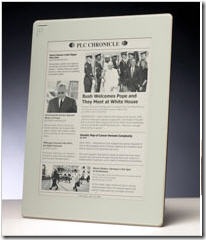
Yesterday eink newspaperPlastic Logic Corporation unveiled it's latest (and as yet unnamed) device:  a big light-weight plastic screen version of an eNewspaper.  Its light, portable and constantly updated.  The device should be on the market early next year.

The screen is close to 81/2 x 11 inches and is continually updated by a wireless link (where wireless is available).  Hundreds of pages can be stored to read at leisure for those who do not want to keep up to the minute.

The device is easy to read since it uses eInk technology.  The is the same technology that is used for Bookeen's Cybook, the Sony PRC reader, Irex Illad and other eBook readers. 

It will be fascinating to see which news organizations will be the first to implement.  Hearst already distributes versions of it's paper on the Kindle.  I have been wondering about that -- as a daily reader of the New York Times and Washington Post online, it would take a lot to convince me to buy an expensive device to view what I can now see for free.  But evidently Kindle and Hearst believe there is a market out there and are pushing ahead.

The more I think about it the more I am able to relegate it to an Interesting idea and fun technology.  But the real question for me is much more urgent:  Do any of us need one more device? 

I am the proud owner of a Cybook, an Irex Illiad, an eBookwise reader, a Palm, a Nokia based cell phone, a Blackberry, an ultra-mobile pc and 2 laptops.  Do I really need one more thing to carry around?  It has gotten to the point that when I travel I practically need a separate suitcase just to carry my cords, cradles and cables. 

None of the above mentioned devices is close to ideal for eBook reading let alone eNewspaper.  The eInk devices are nice but don't accommodate color and are not backlit.  The Blackberry, cellphone and Palm work fine, but the screen is way small.  The UMPC is heavy and overkill as are the laptops. 

I find that the device I read from most often in my Palm.  It is backlit, has beautiful color with a great touch screen, connects to the Internet from almost anywhere and has multiple useful programs and functions besides. I can even hook up to skype and use it as a phone.  My only complaint is the size of the screen -- very small. 

Makes me think that it is easy to get gadget blind and lose track of the real objective -- information!


Monday, September 8, 2008

Thrumpton Hall eBook edition

Thrumpton Hall by Miranda Seymour was one of those books that took me forever to finish.  I'm not even sure why.  Henri suggested that it was because it is the quintessential British book.  Nothing happens for something like 300 pages.  But that really isn't the reason. 

This is a very odd and oddly affecting book. I found it beautifully written and deeply unsettling.  I am always attracted and repulsed by stories of great obsession.  From Romeo and Juliet to George Seymour and Thrumpton Hall, the power of obsession is both fascinating and repulsive. 

This is the story of a house, a fading way of life and an entire family.  The story is always dominated by George Seymour. He is a priggish snob and a self aggrandizing jerk.  A study in eccentricity and total self obsession.  He wants to be an aristocrat but the closest he can get is to being a bastard descendant of Charles II.  He wants a title but wasn't born to it and didn't have enough money to buy one.  In the beginning I tried to be be at least marginally non-judgmental.  By the end, I just flat out hated him.

The story is saved by Miranda Seymour's writing skill.  She does not spare her father or herself.  And the story is infinitely humanized by the interwoven narrative of her Mother and her mother's memories. 

Miranda Seymour is a fine writer and I am a fan which is why I picked up the book in the first place.  I find it fascinating that today she is living at Thrumpton Hall.  She rents it out for weddings, movie shoots and even as a vacation spot just to keep it.  In many ways she is as tied to the house as he.   In Thrumpton Hall she has proven that not only is she a fine writer but that (as her Mother points out) she is much like her father. 

The official stuff:

Dear Thrumpton, how I miss you tonight, wrote twenty-one-year-old George Seymour in 1944. But the object of his affection was not a young woman but a house—ownership of which was then a distant dream. But he did eventually acquire Thrumpton, a beautiful country house in Nottinghamshire, and it was in this idyllic home that Miranda Seymour was raised.

Her upbringing was far from idyllic, however, as life revolved around her father's capriciousness. The house took priority and everything else was secondary, even his wife. Until, that is, the day when George Seymour, already in his golden years, took to wearing black leather and riding powerful motorbikes around the countryside in the company of a young male friend. Had he taken leave of his senses? Or had he finally found them? And how did this sea change affect his wife and daughter?

Both biography and family memoir, this sometimes hilarious, sometimes heart-wrenching story—told in a voice as unforgettable as it is moving—is a riveting and ultimately shocking portrait of desire and the devastating consequences of misplaced love.

Monday, September 1, 2008

As I Live and Breathe the Cell Phone is Taking over the Center

Henri has been doing some thinking about kids, cell phones, open systems and the PC.  Here are his reflections. . .

cellphone Nothing has given me greater pleasure in life than the birth of my children. My youngest daughter turned thirty two this month. The next events in line have all had to do with the birth of revolutionary ideas in the world that I have lived in for sixty five years so far.

Let’s see, there was the birth of computing as a business support system. Then there was the ongoing revolution in electronics. The development of the human genome from the first days of the shape and form of DNA to the publication of the first actual readout of the genome itself was as fundamental a breakthrough in human knowledge.

Along the way there have been many gratifying moments and more than a few terrifying discoveries. The Ozone hole, global Warming and other threats to the ecosystems that sustain us all are among the scariest. Of course even the greatest gains in knowledge can be perverted by misuse or abuse. The idea that scientists are responsible for their creations is still gaining traction. Codes of ethics and other means of controlling misuse of great ideas are still in their infancy.

Meanwhile the Personal Computing revolution has given birth to the Internet and the Cell phone revolution has been playing around with the power that network offers. Now we are about to watch the birth of a new stage in that set of gains in human communication.

The PC King is dying and a new Queen is about to take over. Open systems are coming to cell phones. Taken together with the still growing power of handheld devices this will end the reign of King PC. Cell phones are the new center of Personal Computing. The iPhone is the earliest prophet of this revolution but the next wave will blow away all doubt.

You can start with the Android Operating System contributed by Google and end with the ever evolving nature of handheld devices themselves. It has been years since anything like the vitality that exists in the competition for market share in Cell Phones existed anywhere else in the electronic world.

There are reasons to believe that this next revolution in Personal Computing will bring on revolutions in education, publishing, government and too many other human institutions to mention here.

cellphone girlI am hoping to watch and continue to work to help those revolutionary times achieve the best possible results for the most people possible. There are millions of people who like me see these changes as positive. I hope you are among them.

Friday, August 22, 2008

The Way We'll Be: The Zogby Report on the Transformation of the American Dream eBook edition

Perhaps it is the result of growing up as an expat, but I have always had a fascination with American society and social systems.  When I heard about this book at Book Expo, I knew it was a "must read."  And now, I have just finished it.

Some of the info is fascinating, some of it verifies my opinions and makes me feel smart, some of it made me feel like I was slogging through, just to finish. 

This is a book well worth investing in.  I am not sure it is one to read the way I did -- linearly from cover to cover.  It is probably better read in fits and starts as the spirit moves you. 

I am by nature an optimist, although my views have been tempered by reality over the years.  Zogby seems to be all optimist. And for the most part paints a much rosier picture of the future than I the one I see.

I like the idea that the generation coming up will change America and American politics.  Because of their beliefs Americans will become more tolerant, authentic and informed.  I like the idea that we will become more cohesive, agreeable, rational and global in our thinking.

Maybe it is all true, I hope so; but I wonder if human nature is really going to undergo that profound change within a generation.  I guess only time will tell!

Interesting and well worth the time and money to investigate! 

Here is what the publisher says:

According to super pollster John Zogby, whom The Washington Post calls “the maverick predictor,” the conventional wisdom about the United States–that we’re isolated from the world, politically fragmented, and inclined toward material pleasure–isn’t just flawed; it may be 180 degrees from the truth.

In this far-reaching and illuminating look at contemporary American life, Zogby reveals nothing less than The Way We’ll Be. Drawing on thousands of in-depth surveys conducted especially for the book, Zogby points out where we’re headed–politically, culturally, and spiritually.

The American dream is in transition; it is rapidly being redefined by four meta-movements: living with limits as consumers and citizens; embracing diversity of views and ways of life; looking inward to find spiritual comfort; and demanding authenticity from the media, our leaders, and leading institutions.

Spearheaded by today’s eighteen-to-twenty-nine-year-olds–the “First Global” generation–Americans are becoming more internationalist, consensus-oriented, and environmentally conscious and less willing to identify themselves by the things they do to earn or spend their money. But this is more than a youth tide. Americans of all ages are moving beyond old divides–red state/blue state, pro-life/pro-choice, beer drinker/wine connoisseur–to form a new national consensus that will shape the nation for decades to come. Zogby’s cogent analysis of the data yields an astonishing perspective on Americans’ thoughts, feelings, and beliefs, now and in coming years.

Understanding this emerging reality will be key for

  • leaders in all fields who want to reach audiences that are more media-savvy, better informed, and more technologically enabled than ever before
  • individuals in search of rewarding and fulfilling careers in tomorrow’s growth fields 
  • politicians and CEOs looking to marry policies and practices to the rising demand for social responsibility 
  • anyone who wants to market to the emerging new American consensus

Beyond telling a fascinating story, the conclusions in this book are a must-read for everyone from Main Street to Madison Avenue to Capitol Hill. Filled with expert analysis and insight from one of today’s most successful predictors and trend spotters, The Way We’ll Be will redefine how we view America’s future.

Google
 

Subscribe Now: Feed Icon