Showing posts with label E Ink. Show all posts

Tuesday, July 14, 2009

The eBook Reading Device Mystery solved

kindle mystery Interesting article in the Wall Street Journal yesterday about eBooks and how they are priced.

But the statement that really caught my attention wasn't about pricing at all. It was a prediction by Sarah Rotman Epps:

Ms. Epps, the Forrester analyst, estimates that by year end there will be more than three million dedicated e-reader devices in the U.S., with two million sold in 2009.

All of the press about the Kindle makes it sound like they are flying off the shelves and in fact almost everyone has one. Of course, I have yet to see one in real life. . . Until now I have just chalked it up to a vague idea that maybe I am just too sheltered; don't get out enough.

But this article has made me actually sit down and do the math.

The estimated US population in 307 million. An estimate three million devices means that approximately .01% of the population will own one by the end of the year. No wonder I haven't seen one yet!

Wednesday, January 7, 2009

eBooks and Screen Technologies

So a lot of power is wasted in displaying the images on our current cell phone screen. That makes building batteries that are compact enough and light enough but still powerful enough difficult. Now the technical whizzes who brought those tiny phones down to a size where you can lose them in a purse are fixing that problem. The eInk display and other power sipping device types are appearing in full color glory in prototypes today.

The article in the NY Times technology section today is only one source of this news. We are reading more and more about the power saving capabilities of various new technologies. This may actually be the year when some of these ideas turn into real phones. Reflecting light from outside sources selectively is the basis of some of these technical marvels. That makes the display brighter in sunlight than it is in a shady spot nearby.

The display design by Qualcomm based on MEMS technology is particularly interesting because it uses tiny mirrors that selectively reflect red, green or blue light. The amount of power used by this screen can be as low as one mw (milliwatt) versus over 200 mw in your current scriStock_000002038586XSmalleen. This type of screen is not backlit and thus will need a frontal light source if you are addicted to using it in the dark.

A higher energy use backlit screen but one that is still substantially lower than current technology uses LED lighting and tiny shutters to display images. This version of the future uses around 50 mw to supply a bright color display but is not as useable in daylight as the lower power choices. All of this technology is aimed at solving the recharge problem that plagues any serious cell phone user.

I’m still anxiously awaiting the new technology that allows me to read on a five by seven inch display for up to fifty hours without recharging my phone once. Of course it will still have to fit in my pocket so it should fold up or roll up when I am not using it. Ideally we ought to be able to build these displays so that they can generate power for recharging the whole device from ambient light like a calculator so we never have to plug the damn thing in at all.

Posing nearly impossible problems for engineers to solve is more fun than adapting to their latest and greatest idea in the form that it finally reaches the market. eInk is still slow and not available in full color. MEMS technology is still in the future. Flexible displays are still largely fantasy but reaching the realm of the possible quickly. I expect my ideal display will appear by the end of this decade if not sooner.

Electromechanical marvels like 300,000 tiny shutters on a small display do amaze me a bit. But then I think about all of those huge old monitors that are on the scrap heap today. We are living in a totally flat panel world now, and that happened in less than ten years. The pace is constantly accelerating and new technologies are competing for our interest daily. EBook dedicated readers will not survive long in this world.

That they appeared at all is a statement about how inefficient markets can be when they move this fast. Of course the truth is the gadget happy among us are driving this rate of change faster and faster. At what point can this all slow down enough to make it possible for me to learn how to use all of the features in my new phone before it is obsolete? Maybe that is just not important after all but it would be nice wouldn’t it?

Monday, October 6, 2008

The Sony PRS 700 and the eBook Reader Market

sony_prs-700_readerLast week Sony proudly announced the 3rd generation PRS series eBook Reader.  It has some nice features; particularly the reading light and the fact that it has a touch screen.

And yet I can't help thinking that something is broken in the marketplace! This new Sony readers and the rumored Kindle device prove to me that the Reader design world is stuck in neutral.

There is little happening in the narrowly focused electronic reading world that makes sense to me. It is now nearly twenty years after we tried putting books on a CD ROM disc to stimulate reading opportunities. Over time the Internet and cheap hard drive space have removed the CD disc from the equation.

Today, the digital publishing is still very much alive and growing rapidly (if not broadly). The best reader that money can buy is still very expensive ($800) and excruciatingly dumb.

The consumer is quite happy with a multifunction device that has about three inches of screen space.  After all you can read books, handle email, surf the net and listen to music all with one device.  And that doesn't even take into consideration the convenience of being able to make and receive phone calls!

Reading devices are still being designed by people who know some technology.  What they don't seem to know much about is the consumer generally or publishing specifically.  And therein lies the rub.

So where is publishing headed? Debates about that vary from the sublime to the ridiculous as do most debates. The one thing everyone seems to agree on is that the Internet or its children will provide the delivery vehicle.

Cell phones with substantial screens or projection capabilities are going to hit the market soon. With their programmability based on open operating systems they almost certainly will become the device of choice for both computing and reading. They will also probably take over the world of TV show presentation to major audiences everywhere.

So what is possibly wrong in that world? The idiots that keep designing readers persist in building devices that will not compete. They are holding back the market that they need to develop before it is too late for them. Goodbye Sony reader: Goodbye Kindle: Hello open systems and the new old revolution.

All that cell phones really still need to own this market should appear in the next generation phones. I am hoping that happens because the brain dead place holders made by Amazon, Sony and Phillips make no sense. Or maybe they make as much sense in this market as one hundred thousand dollar CD recorders would make in today’s data transfer marketplace. Yes folks,  twenty years ago a CD Recorder cost a hundred g’s.

Cell phones are following that cost and value curve and dedicated reading devices are not.  Wether they recognize it or not -- this game is already over.  The spindle, ah the bindle, no the, don’t help me, I’ll get it. . . oh yeah, THE KINDLE,  that’s it, is dead. It was slaughtered by a real market before it mattered to anyone anywhere except a few engineers and those of us early adopters who bought their bad designs.

Tuesday, September 9, 2008

The New York Times Reports A New E-Newspaper Reader Echoes Look of the Paper

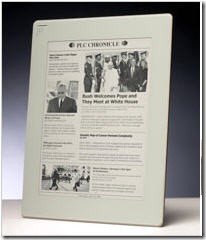
Yesterday eink newspaperPlastic Logic Corporation unveiled it's latest (and as yet unnamed) device:  a big light-weight plastic screen version of an eNewspaper.  Its light, portable and constantly updated.  The device should be on the market early next year.

The screen is close to 81/2 x 11 inches and is continually updated by a wireless link (where wireless is available).  Hundreds of pages can be stored to read at leisure for those who do not want to keep up to the minute.

The device is easy to read since it uses eInk technology.  The is the same technology that is used for Bookeen's Cybook, the Sony PRC reader, Irex Illad and other eBook readers. 

It will be fascinating to see which news organizations will be the first to implement.  Hearst already distributes versions of it's paper on the Kindle.  I have been wondering about that -- as a daily reader of the New York Times and Washington Post online, it would take a lot to convince me to buy an expensive device to view what I can now see for free.  But evidently Kindle and Hearst believe there is a market out there and are pushing ahead.

The more I think about it the more I am able to relegate it to an Interesting idea and fun technology.  But the real question for me is much more urgent:  Do any of us need one more device? 

I am the proud owner of a Cybook, an Irex Illiad, an eBookwise reader, a Palm, a Nokia based cell phone, a Blackberry, an ultra-mobile pc and 2 laptops.  Do I really need one more thing to carry around?  It has gotten to the point that when I travel I practically need a separate suitcase just to carry my cords, cradles and cables. 

None of the above mentioned devices is close to ideal for eBook reading let alone eNewspaper.  The eInk devices are nice but don't accommodate color and are not backlit.  The Blackberry, cellphone and Palm work fine, but the screen is way small.  The UMPC is heavy and overkill as are the laptops. 

I find that the device I read from most often in my Palm.  It is backlit, has beautiful color with a great touch screen, connects to the Internet from almost anywhere and has multiple useful programs and functions besides. I can even hook up to skype and use it as a phone.  My only complaint is the size of the screen -- very small. 

Makes me think that it is easy to get gadget blind and lose track of the real objective -- information!


Monday, April 21, 2008

eBooks on the Small Screen

Last Wednesday morning, while eating breakfast and scanning the Wall Street Journal, I stumbled across an article by Lee Gomes.  He wrote a long piece about reading Ian McEwan’s novel “Amsterdam” on his Blackberry:

“Contrary to all of my previous expectations, not only was I reading the novel on my cellphone, I was enjoying it, too.

Until a few weeks ago, my assumption had been that a useable electronic book would need to resemble a Gutenberg book as much as possible, with, for example, pages of screen text about the same size as pages of print. I had heard reports that Japanese commuters were using cellphones to read books. But I figured that was sort of the thing only Japanese commuters would ever see fit to do."

I burst out laughing and handed the article to my husband.  Henri has long maintained that reading an eBook on a small device is a terrible idea.  He's not even interested in trying to read a book on a handheld device.  I have an ongoing (and so far unsuccessful) campaign to convince him to be more open minded.

He scanned the article and then grudgingly conceded that Lee might have a point.  He was quick to add, however, that he remained unconvinced.  And then he couldn't help himself.  He pointed out that I was possibly a hypocrite --  since I got my Cybook last November I haven't really used anything else for leisure reading.   

big palmThat evening as I was in the middle of reading Marisa de los Santos'  Belong to Me, my Cybook froze.  That is a story for another day (and it ended up to be no big deal).  The point of this story is that for the first time in six months I had use another device to finish the book.  

I had almost forgotten the reasons to read on a handheld device, but as I started to use the Palm they came back to me:

  • Backlit - I can read in the dark
  • Portable - I can have all my important info with me and still read anywhere
  • Touch Screen - easy to scroll and move around
  • Vivid Color - I really like color
  • Wireless - instant connectivity to the rest of the world

The bonus discovery:  the thumb button in the middle of the device is much easier to use and more intuitive than the button on the right side of the Cybook.  I also found that the ergonomics of holding and balancing the device were really comfortable.

There are really only two advantages to reading on the Cybook -- a bigger reading surface and the ability to read in bright and direct sunlight. 

I am not sure that those advantages really outweigh the advantages of reading on the PDA. specifically the touch screen and the wireless access. 

Just to check myself, I pulled out a very old Windows PC based PDA and charged it up.  All of the advantages of the Palm PLUS I was not so confined by the DRM.  Suddenly I could read protected PDF, Palm and MS Lit files. 

For the price of a Cybook or Sony Reader you can buy a Pocket PC that runs windows, has a touch screen, adds a keyboard and includes a cellphone. 

Friday morning I got the Cybook functioning again, but I'm still reading on the Palm. 

Of course, I am now actively considering upgrading my Verizon phone to an XV6800.

Turns out, that small screen isn't so bad after all!

Tuesday, January 8, 2008

eBooks and the Perfect Reader

irexsonykindle There has been a lot of talk about eBook hardware in the last year:  the Irex Illiad, the Sony reader, the Cybook and finally the Kindle. Lots of press.  Lots of talk.

With each new device the questions arises:  Is this the new iPod for books?  Is this the piece of hardware that will take eBooks mainstream?  The "Killer Device" for eBooks?

The talk is seductive. I admit to having gotten a little sucked into that mind set.  I like the idea that somehow, someday there will be a "killer device" that will catapult eBooks into the next dimension.

This morning, while in the shower (I do my best thinking in the shower), it struck me -- the whole concept is totally fallacious.  It is, in fact, highly unlikely that there will ever be such a thing.

Think about it.  All over the world people are reading digital books.  Most of them read these eBooks on PCs, PDAs and mobile phones.

They aren't waiting for the perfect reader.  In fact they aren't even necessarily interested in a new gadget that will transform the whole electronic reading experience.  They are quite happy just as they are.  Thank you very much. 

Sure, there are some annoying inconveniences but basically, the technology is "good enough" for them just as it is.

cellphone girlMost of the "good enough" readers are young, hip and wired.  They are generally under 35 and grew up with computers, games boys and cell phones.  They are dexterous and have decent eyesight.  They think of books as something their parents read to them before they could play video games.  Alternatively, they think of books as some kind of bizarre punishment inflicted on them in the name of education. 

old man reading Most of the people waiting for the "killer device" think of books as iconic.  They seem to feel that the physical form of a book is somehow sacred.  After all, they grew up reading books, libraries were well funded and book stores were everywhere.  They expect the electronic reading experience to replicate the familiar print experience. 

In the end it is all about expectations and familiarity.  And then there is this:  the "good enough" generation is growing even as those waiting for the "killer device" are slowly and inexorably dying off.

Tuesday, December 11, 2007

Technology is not the Point!

Henri Reynard weighs in on eBook Technology.  Henri presents his views on E Ink, the Kindle and what he really wants.

eink

A spate of eBook readers has hit the market recently with one or two yet to follow. The display candidate of the moment is the technology based on E Ink which rhymes with pink but has the visual value of oink to my eyes.

The background is gray and slightly hazy.  I do not think that the visual effects of a book are very well presented. AND they all cost over three hundred dollars.  A sum of money for which these days you can get a fully featured portable PC. Or for that matter more than half of an Iphone if you really like technology that much.

I am not a fan of any of the current crop of eBook readers but they are getting better at getting the size and weight close to right for the avid reader. E Ink readers have one major drawback: they are fragile and not as capable of living through a good drop to the floor from the bed – a criteria for books in my house.

My wife is a technocrat of the first order so I get to hold a lot of technology in these hands. New technology is not likely to impress me unless I think it will actually move the market. Take for example the Kindle, well named if you believe in burning books.

I seldom have used a book to start a fire, notice I did not say never. But the Kindle suffers from some interesting drawbacks. It is totally proprietary and makes no apologies about that fact. It also loses in the cost derby since it has no price advantage to go along with its other restrictions. Note that it cannot read protected PDF which is one of the most prevalent formats for eBooks sold today.

No! I think I will wait on a better technology than the current oink -- ER, E Ink -- crop before I buy another reader. Maybe the tablet PC will be back in a solid and simple light weight form before this is all over. An open standard and a really large memory with a lot of computing capability. Now that would be an eBook that didn't depend on a lot of new untried technology.

Wouldn't that be nice?

Google
 

Subscribe Now: Feed Icon